Cold Wallet vs Hot Wallet: Which Should You Use?

The comparison beginners actually need
Most articles explaining cold and hot wallets stop at definitions — one’s online, one isn’t. The more useful question is which one actually fits your situation, and the honest answer for most people isn’t «pick one» — it’s understanding the specific trade-offs well enough to combine them intelligently. This comparison focuses less on what each term means and more on the practical decision itself.
What each one is actually optimized for
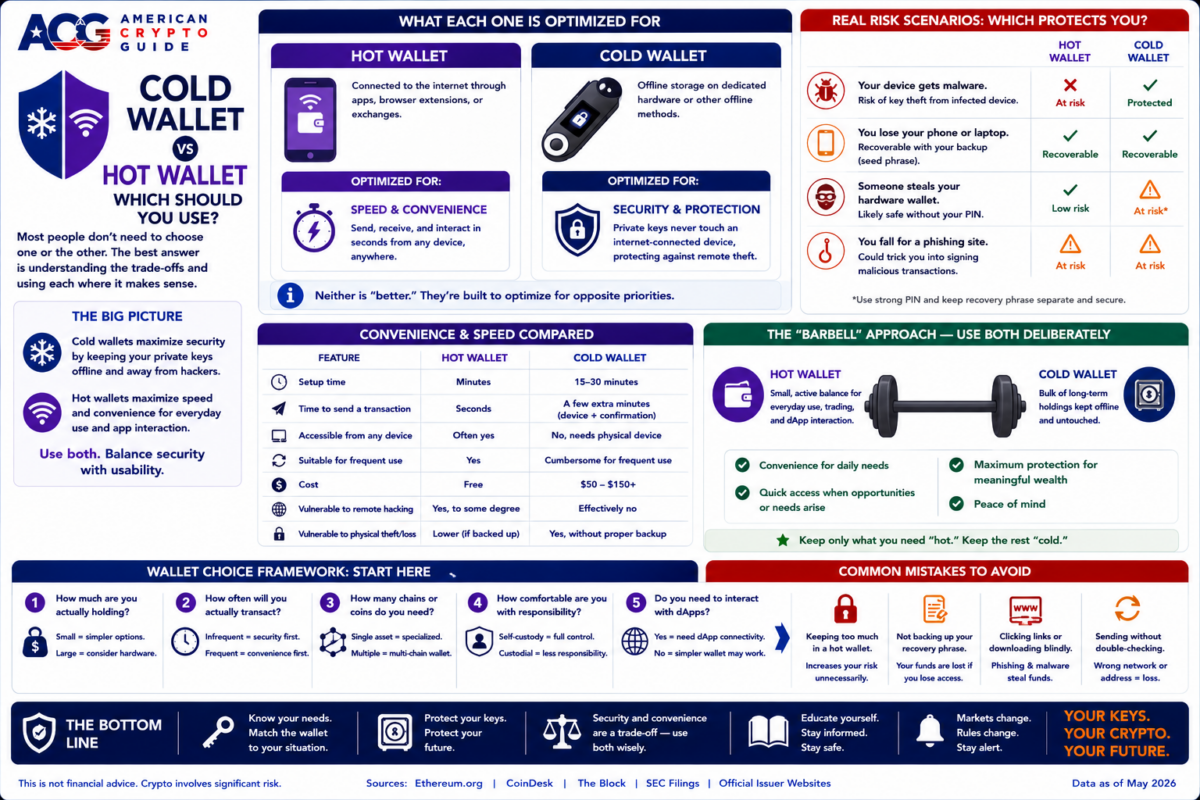
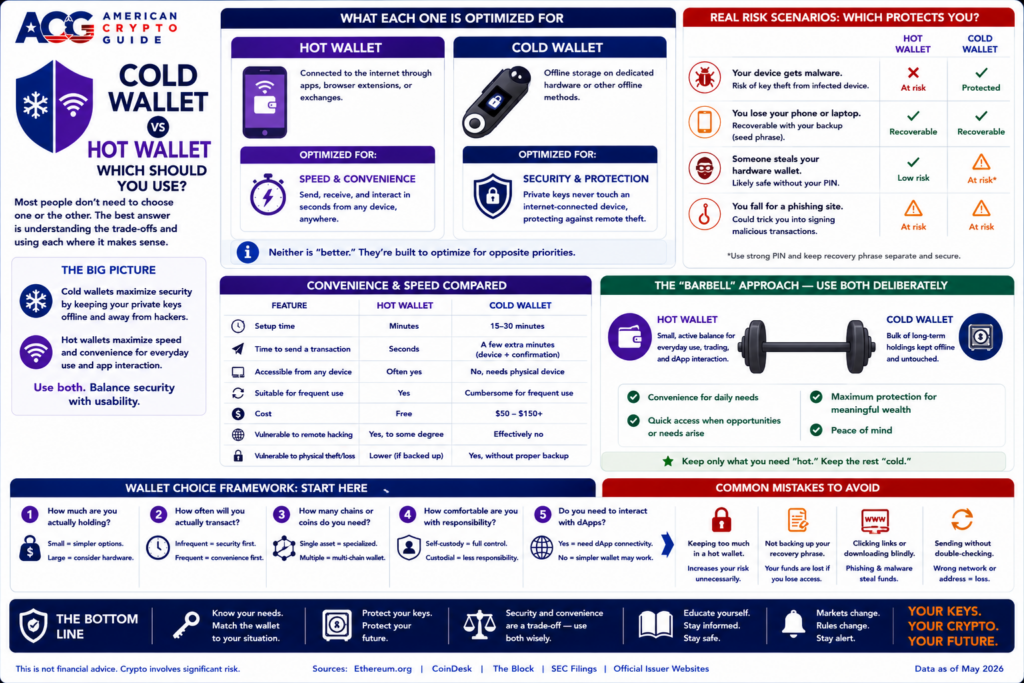
A hot wallet — connected to the internet through a mobile app, browser extension, or exchange account — is optimized for speed and convenience. You can send, receive, and interact with applications in seconds, from any device, without additional hardware. A cold wallet — a hardware device or other offline storage method — is optimized for security against remote theft, since private keys never touch an internet-connected device where they could be extracted by malware or a remote attacker. Neither is a strictly «better» technology; they’re built to optimize for opposite priorities, and that’s the entire basis for the comparison.
Security profile compared
Hot wallets face a genuine, ongoing attack surface: malware capable of extracting keys from an infected device, phishing attacks tricking you into approving malicious transactions, and the general risk that comes with any private key existing on a device connected to the broader internet. Cold wallets eliminate the remote component of this risk entirely — an attacker without physical access to the device, and without your PIN, has no practical way to extract the private key remotely. Cold wallets aren’t invulnerable, though: physical theft, a compromised recovery phrase backup, or coercion remain real risks that offline storage doesn’t address on its own.
Worth being precise about: «cold wallets are more secure» is true specifically for remote, internet-based attacks — the most common category of crypto theft by far. It’s not true in every possible risk category; physical security still matters, and a cold wallet with a carelessly stored recovery phrase can be less secure in practice than a well-managed hot wallet holding a small amount.
Convenience and speed compared
| Hot wallet | Cold wallet | |
|---|---|---|
| Setup time | Minutes | 15-30 minutes |
| Time to send a transaction | Seconds | A few extra minutes (device connection, physical confirmation) |
| Accessible from any device | Often yes | No, requires the physical device |
| Suitable for frequent daily use | Yes | Cumbersome for frequent use |
| Cost | Free | $50-$150+ |
| Vulnerable to remote hacking | Yes, to some degree | Effectively no |
| Vulnerable to physical theft/loss | Lower (device-independent recovery in some cases) | Yes, without a proper backup |
Real risk scenarios and which wallet type actually protects against each
- Scenario: your phone gets malware from a malicious app. A hot wallet on that device is at genuine risk; a cold wallet’s private key, never exposed to the phone, is unaffected even if the phone is compromised.
- Scenario: you lose your phone or laptop. A hot wallet’s funds are recoverable if you backed up the seed phrase correctly, regardless of device loss — the same is true for a cold wallet, as long as its separate recovery phrase backup is intact.
- Scenario: someone physically steals your hardware wallet. Without your PIN, the funds remain protected on most modern devices, which lock or wipe after repeated incorrect PIN attempts — though this scenario is exactly why cold wallets aren’t automatically «safer» if physical security around the device itself is weak.
- Scenario: you fall for a phishing site. Both wallet types are vulnerable here if you’re tricked into approving a malicious transaction — cold wallets reduce key exposure, but they don’t prevent you from being socially engineered into approving something harmful, which is why reviewing what you’re actually signing matters regardless of wallet type.
The «barbell» approach — using both deliberately
Rather than choosing one exclusively, many experienced holders deliberately split funds: a small, active balance in a hot wallet for everyday spending, trading, or dApp interaction, and the bulk of long-term holdings in a cold wallet, rarely touched. This mirrors a common financial planning principle — keeping a small amount of readily accessible cash while the majority of savings sits somewhere less immediately liquid but more secure. Neither wallet type has to «win» the comparison when the actual answer is using each for what it does best.
Why this split exists industry-wide, not just as personal advice
Even large, security-conscious institutions — exchanges, custodians, and crypto-native companies — follow the same fundamental split at scale: the substantial majority of customer funds held in cold storage, with a smaller operational balance kept in hot wallets to process withdrawals and daily transaction volume. This isn’t a coincidence or a beginner-specific recommendation; it’s the same risk-management logic applied at every scale, from an individual holder to a company managing billions in customer assets. Coinbase’s own published security practices, available at https://www.coinbase.com/security, describe exactly this kind of majority-cold, minority-hot custody split as standard practice.
📬Did you like this article?
Subscribe and receive our posts directly in your inbox. Free!
Sin spam. Puedes darte de baja cuando quieras.
Deciding your own split
- Estimate how much you genuinely need readily accessible for regular spending, trading, or dApp use, and keep roughly that amount in a hot wallet.
- Move the remainder — anything you’re not actively using in the near term — to cold storage, treating it as a savings account rather than a spending account.
- Reassess periodically, particularly after a significant change in holdings or usage pattern, rather than treating the initial split as permanent.
- Don’t let «eventually I’ll set up cold storage» become indefinite procrastination if your hot wallet balance has grown well beyond what you’d be comfortable losing — the setup effort is worth it once the stakes justify it.
Common mistakes in this decision
- Treating the choice as permanent and binary rather than a split that can and should shift as your holdings and habits change.
- Keeping meaningful long-term savings in a hot wallet purely out of setup inertia, despite the amount clearly justifying cold storage.
- Assuming a cold wallet eliminates all risk, leading to carelessness with the recovery phrase backup — the device is only half of the security model.
- Over-engineering a cold storage setup for a genuinely small amount, adding unnecessary friction without a proportional security benefit.
- Forgetting that «hot» includes exchange balances, not just wallets you set up yourself. Funds left on an exchange are effectively hot-wallet risk, custodied by a third party rather than a wallet you directly manage.
How professional and institutional custody informs the individual decision
Watching how professional custodians handle this same trade-off offers a useful benchmark for individuals trying to decide their own split. Institutional custody providers typically hold the vast majority of assets — often cited in the 90-98% range across major platforms — in cold storage, with only a small operational float kept hot to service withdrawals without delay. While an individual’s exact needs differ from an exchange processing thousands of transactions daily, the underlying ratio is instructive: if organizations managing billions of dollars and employing dedicated security teams still keep the overwhelming majority of assets offline, that’s a meaningful data point for anyone tempted to keep a larger-than-necessary hot balance purely for convenience.
How your asset mix affects the right split
The right cold-to-hot ratio isn’t purely a function of total dollar amount — what you actually hold matters too. Someone holding primarily long-term Bitcoin, rarely trading or interacting with applications, naturally skews toward a heavier cold allocation, since there’s little practical benefit to keeping much of it hot. Someone actively participating in DeFi, holding a diverse mix of tokens across multiple chains, and regularly interacting with new protocols has a legitimate reason to keep a larger hot balance, since the friction of constantly moving funds to and from cold storage for routine activity would meaningfully hurt their actual use case. Neither approach is wrong — the point is that the split should reflect genuine behavior, not an arbitrary percentage borrowed from somewhere else without considering how it actually applies to your own holdings and habits.
 You might also likeWhat Is Bitcoin? A Complete Beginner’s Guide
Signs it’s time to shift more toward cold storage
A few practical signals suggest your current hot wallet balance has outgrown what convenience alone justifies: you’re checking the balance with growing anxiety rather than routine habit, the amount now represents a meaningful share of your overall net worth, or you realize you haven’t actually needed that much readily accessible for months. None of these signs demand an immediate, dramatic reallocation, but they’re worth treating as a prompt to revisit the split deliberately, rather than letting a hot wallet balance grow simply because moving it felt like an inconvenient extra step at the time.
Cold and hot wallets aren’t competing products — they’re two tools built for different jobs, and the question «which should you use» is best answered with «both, in a ratio that matches how you actually use crypto.» Understanding the specific risk each one protects against, rather than treating one as universally superior, is what turns this from an abstract security debate into a practical, personal decision you can actually apply.