How to Choose the Right Crypto Wallet for You

Why «best wallet» is the wrong first question
Every wallet ranking, including any you’ll find elsewhere, ultimately answers a different question than the one that actually matters for you personally: not «which wallet is best,» but «which wallet fits how I specifically plan to use crypto.» A wallet that’s perfect for someone actively trading across a dozen DeFi protocols daily is the wrong choice for someone holding a small long-term position they check twice a year. This guide walks through the actual questions worth answering before looking at any specific product, since the right answers to these questions narrow the field far more effectively than any generic «best of» list.
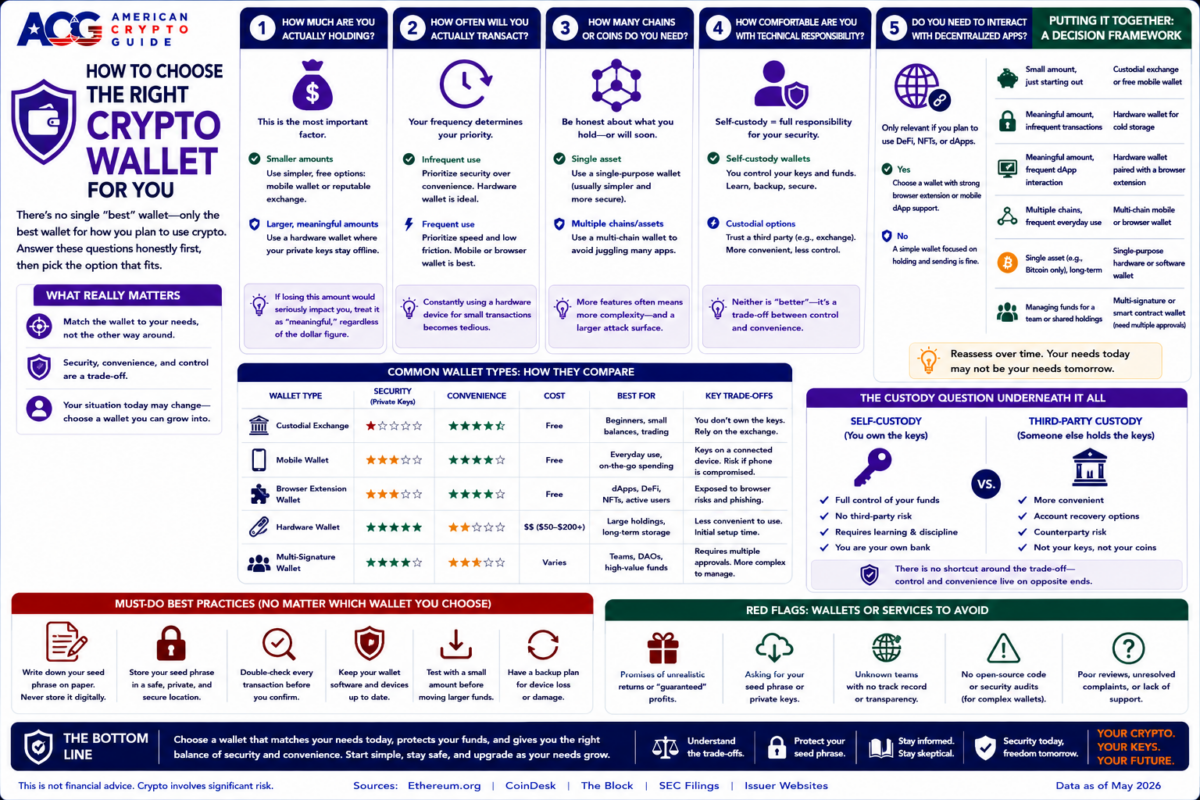
Question 1: How much are you actually holding?
This is the single most important variable, and it should drive nearly everything else. Smaller amounts — money you’re comfortable treating as a learning investment — reasonably justify simpler, free options: a mobile wallet or even a reputable exchange’s custodial balance while you build comfort with the basics. Larger, meaningful amounts — savings you’d be genuinely upset to lose — justify the extra cost and setup effort of a hardware wallet, where your private keys never touch an internet-connected device.
A useful gut-check: if losing this amount would meaningfully affect your finances or peace of mind, treat it as «meaningful» regardless of the actual dollar figure. The threshold is personal, not a fixed number.
Question 2: How often will you actually transact?
Someone making an occasional purchase or holding long-term has very different needs than someone actively trading, swapping tokens, or interacting with decentralized apps weekly. Infrequent use favors wallets optimized for security over convenience — a hardware wallet used only a few times a year imposes little friction. Frequent use favors wallets optimized for quick, low-friction transactions — a mobile or browser extension wallet you can access in seconds, since constantly connecting and disconnecting a hardware device for routine activity becomes genuinely tedious.
Question 3: How many different chains or coins do you actually need?
If you’re holding only Bitcoin, a Bitcoin-specific wallet (software or hardware) is simpler and often more security-focused than a general-purpose multi-chain option. If you’re holding assets across Ethereum, various Layer 2 networks, and other blockchains, a multi-chain wallet becomes considerably more practical than juggling a separate app for every network. Be honest about what you actually hold or plan to hold soon, rather than choosing maximum flexibility «just in case» — broader support often means a larger, more complex piece of software with a correspondingly larger attack surface.
 You might also likeWhat Is Bitcoin? A Complete Beginner’s Guide
Question 4: How comfortable are you with technical responsibility?
Self-custody wallets place full responsibility for security on you: generating and backing up a seed phrase correctly, verifying device authenticity, and never exposing your recovery phrase to anything digital. Custodial options — leaving funds on a reputable exchange — remove that responsibility, at the cost of trusting a third party with your funds and giving up the «not your keys, not your coins» principle self-custody offers. Neither choice is objectively correct; it’s a genuine trade-off between control and convenience that depends on your own comfort level and how much time you’re willing to invest in learning proper security practices.
Question 5: Do you need to interact with decentralized apps?
If your crypto use is purely holding and occasional transfers, this question doesn’t apply much. If you plan to use DeFi platforms, mint NFTs, or otherwise interact with dApps, you’ll want a wallet with strong browser extension or mobile dApp connectivity — a hardware wallet alone can’t do this without pairing to a compatible interface, and not every wallet type handles dApp connections equally smoothly.
Putting it together: a decision framework
| Your situation | Recommended wallet type |
|---|---|
| Small amount, just starting out | Custodial exchange balance or a free mobile wallet |
| Meaningful amount, infrequent transactions | Hardware wallet, used primarily for cold storage |
| Meaningful amount, frequent dApp interaction | Hardware wallet paired with a browser extension |
| Multiple chains, frequent everyday use | Multi-chain mobile or browser extension wallet |
| Single asset (e.g., Bitcoin only), long-term hold | Single-purpose hardware or software wallet for that asset |
| Managing funds for a team or high-value shared holdings | Multi-signature or smart contract wallet requiring multiple approvals |
The custody question underneath all of this
Every wallet decision ultimately traces back to one underlying question: who controls the private keys? A custodial option (an exchange balance) means a company does; a self-custody wallet (hardware, mobile, or browser extension, set up correctly) means you do. This distinction matters more than any specific feature comparison, because it determines what happens in every failure scenario — a company’s insolvency or a security breach on their end affects custodial funds; your own backup practices and device security affect self-custodied funds. Understanding which risk category you’re more comfortable managing is worth more than comparing any two products’ feature lists directly.
📬Did you like this article?
Subscribe and receive our posts directly in your inbox. Free!
Sin spam. Puedes darte de baja cuando quieras.
Common decision mistakes worth avoiding
- Choosing the most feature-rich wallet without needing most of the features. Extra functionality often means extra complexity and a larger attack surface, without a corresponding benefit if you’re not actually using those features.
- Assuming a hardware wallet is always the «correct» answer regardless of amount. For genuinely small holdings, the setup effort and cost may not be proportional to what’s actually being protected.
- Picking a wallet based purely on popularity or brand recognition without checking whether it actually fits your specific chain and use-case needs.
- Underestimating how often you’ll actually want to transact, leading to frustration with a security-focused wallet that’s inconvenient for regular use, or security compromises from choosing convenience when the amount involved warranted more caution.
- Never revisiting the decision as circumstances change. A wallet chosen for a small starting balance may no longer fit once holdings grow significantly — periodically reassessing is reasonable, not excessive.
It’s completely fine to use more than one wallet
Many experienced crypto users don’t settle on a single wallet — they use different tools for different purposes: a hardware wallet for long-term cold storage, a mobile or browser extension wallet for active, smaller-scale use, and sometimes a specific single-purpose wallet for a particular chain they use heavily. There’s no rule requiring consolidation into one wallet, and splitting funds across purposes this way is a common, reasonable way to balance security and convenience rather than compromising on either.
A worked example to make the framework concrete
It helps to see the five questions applied to an actual scenario rather than left abstract. Imagine someone who’s bought a moderate amount of ETH and a couple of popular tokens, checks their holdings a few times a month, occasionally wants to try a DeFi platform they’ve read about, and has never managed a hardware device before. Walking through the questions: the amount is meaningful enough to warrant more than a pure custodial approach, but the frequency and dApp interest suggest a browser extension or mobile wallet would fit daily use better than a hardware-only setup. The reasonable answer here is a self-custody browser extension or mobile wallet for everyday use, with a plan to add a hardware wallet later specifically for the portion of holdings they don’t plan to touch regularly — not an all-or-nothing choice between «hardware wallet» and «everything else,» but a combination matched to how the holdings actually get used.
A second example: someone holding a single, larger Bitcoin purchase they intend to hold for years, who has no interest in DeFi, NFTs, or frequent trading. Here the answers point clearly toward a single-purpose hardware wallet, since the amount justifies the cost and setup effort, the low transaction frequency means the extra friction of a hardware device is barely noticeable, and there’s no dApp requirement pulling toward a more feature-rich alternative. Working through concrete scenarios like these, matched against your own actual situation rather than a hypothetical «ideal» user, is generally more useful than trying to apply the framework in the abstract.
The wallet setup that made sense when you first bought a small amount of crypto often stops making sense once your holdings grow, your usage patterns shift, or new wallet options with genuinely better trade-offs become available. Rather than treating a wallet decision as permanent, it’s worth briefly revisiting the same five questions covered above every so often — perhaps whenever your total holdings change meaningfully, or when you notice yourself increasingly wishing your current setup did something it doesn’t. This isn’t about constantly switching wallets, which introduces its own risk and hassle, but about recognizing that the right answer genuinely can change over time, and treating an old decision as fixed simply because it was right once isn’t a good enough reason to keep it if your circumstances have moved on.
For an independent overview of digital security fundamentals applicable across nearly any wallet type or brand, the Electronic Frontier Foundation publishes general security guidance at https://www.eff.org/issues/security, useful background alongside crypto-specific research when making this decision.
Final thoughts
Choosing the right crypto wallet isn’t about finding the objectively «best» product — it’s about honestly answering a handful of questions about how much you’re holding, how often you’ll transact, how many assets you need to manage, and how much technical responsibility you’re willing to take on. Once those answers are clear, the field of reasonable options narrows dramatically, and the remaining choice becomes far easier than trying to evaluate every wallet on the market against a generic checklist.