What Is Bitcoin? A Complete Beginner’s Guide

The three-word answer (and why it isn’t enough)
Ask ten people «what is Bitcoin?» and you’ll get ten different three-word answers: digital gold, internet money, a scam, the future. None of them are wrong exactly, but none of them explain anything either. They’re labels, not explanations — and labels are how most beginners end up more confused after reading an article than before.
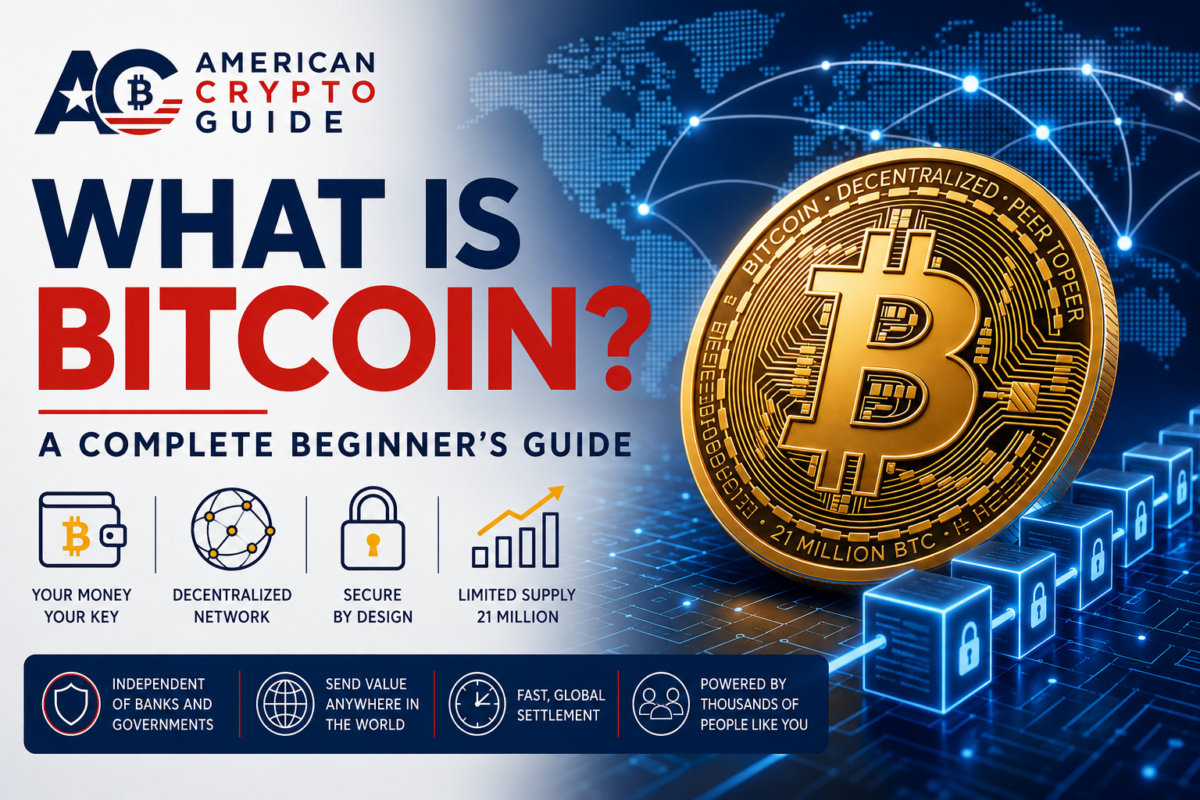
So let’s skip the label. Bitcoin is a system that lets two people move value to each other without a bank, a payment processor, or any company sitting in the middle — verified instead by thousands of computers around the world that all agree on the same public record. That’s the whole idea. Everything else — the price charts, the mining rigs, the «number go up» memes — is a consequence of that one design choice.
Money before Bitcoin: a 30-second history lesson
To see why that design choice matters, it helps to remember how money has always worked before 2009:
- You had a coin or a note, and whoever physically held it, owned it.
- Then banks started keeping ledgers — lists of who owed what to whom — and money became mostly entries in a database that only the bank could edit.
- Every digital payment you’ve ever made (a card swipe, a bank transfer, a PayPal payment) still works this way today: a company’s private database gets updated, and you trust that company got it right and won’t freeze, reverse, or lose your entry.
Bitcoin’s creator, an anonymous person or group using the name Satoshi Nakamoto, published a nine-page paper in 2008 proposing something nobody had made work before: a ledger with no company in charge of it at all, verified instead by the network itself. The original paper is still online and worth skimming even if you never touch the technical parts — you can find it hosted at <bitcoin.org>.
What actually happens when you send Bitcoin
The ledger everyone can see
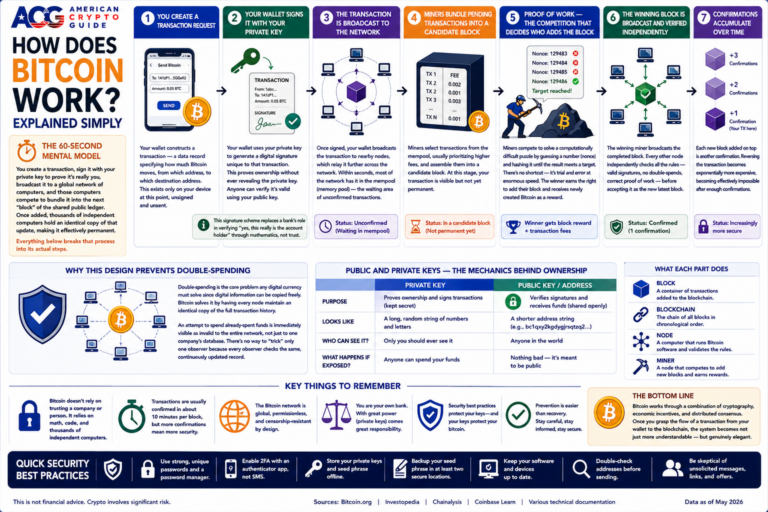
Every Bitcoin transaction ever made lives on something called the blockchain — a public record, copied across tens of thousands of computers (called nodes) worldwide. When you send Bitcoin, you’re not moving a file the way you’d email a photo. You’re broadcasting a message to this network that says «move this amount from this address to that address,» signed in a way that only you could have signed it.
Think of the blockchain less like a vault and more like a shared spreadsheet that millions of strangers all keep an identical copy of, and all cross-check against each other constantly. No single copy can be secretly edited, because it would no longer match everyone else’s.
Mining, in plain English
New transactions need to be bundled into a «block» and added to that shared spreadsheet — and that job is done by miners, computers competing to solve a difficult math puzzle. Whoever solves it first gets to add the next block and earns newly created Bitcoin as a reward. This process, called proof of work, is what makes the ledger expensive to attack: rewriting history would mean out-computing the rest of the planet’s miners combined.
Wallets and keys — the part people get wrong
A Bitcoin wallet doesn’t actually «hold» your coins the way a physical wallet holds cash. Your coins always live on the blockchain. What your wallet stores is a private key — a secret piece of data that proves ownership and lets you authorize transactions. Lose that key with no backup, and there is no customer service line to call; the coins tied to it are permanently unreachable. This single fact trips up more beginners than anything else about Bitcoin.
Bitcoin vs the money in your bank account
Here’s where the differences become concrete rather than philosophical:
📬Did you like this article?
Subscribe and receive our posts directly in your inbox. Free!
Sin spam. Puedes darte de baja cuando quieras.
| Bitcoin | Bank account balance | |
|---|---|---|
| Who controls it | You, via your private key (if self-custodied) | The bank |
| Can it be frozen | Not by a third party | Yes, by the bank or a court order |
| Supply | Fixed at 21 million coins, ever | Central banks can create more |
| Settlement speed | Minutes to about an hour, worldwide | Instant locally; days for international transfers |
| Reversibility | Transactions are final | Chargebacks and reversals are possible |
| Access requirements | Internet connection | A bank account and, often, ID/address verification |
| Transparency | Every transaction is publicly viewable | Private, visible only to you and the bank |
Neither column is objectively «better» — they’re built for different trade-offs. A reversible payment system is genuinely useful when you get scammed by a merchant; a payment system that can’t be frozen is genuinely useful if you don’t trust the institution holding your money in the first place.
Where the value actually comes from
This is the question that stops most beginners cold, and the honest answer is: the same place any currency’s value comes from — shared belief that other people will accept it later. The US dollar isn’t backed by gold anymore either; it’s backed by trust in the US government and economy. Bitcoin is backed by trust in its code, its fixed supply, and the size of the network securing it.
What makes Bitcoin’s case unusual is the fixed supply. There will only ever be 21 million bitcoins, a hard limit written into the software itself. Roughly every four years, in an event called the halving, the rate of new coin creation cuts in half. You can track the current supply and halving countdown live at trackers like https://www.blockchain.com/explorer.
Five things beginners assume that aren’t quite right
- «Bitcoin is anonymous.» It isn’t — it’s pseudonymous. Every transaction is public forever; addresses just aren’t automatically tied to your legal name, though they often can be traced back to you.
- «You buy a whole Bitcoin.» You don’t have to. Bitcoin is divisible down to 0.00000001 BTC, a unit called a satoshi. You can buy $20 worth.
- «Bitcoin transactions are free.» They’re not — you pay a network fee to miners, which rises and falls with how busy the network is.
- «It’s the same as ‘crypto’ in general.» Bitcoin is one cryptocurrency among thousands, and the oldest one, but Ethereum, stablecoins, and other tokens work differently under the hood.
- «Losing your password means losing everything, always.» True for self-custodied wallets, but if you buy through a regulated exchange, that exchange manages the keys for you — with its own trade-offs.
Is Bitcoin legal where you live?
In most of the world, yes — including the United States, the United Kingdom, the European Union, Canada, Australia, and Japan, where it’s legal to buy, hold, and sell it, subject to tax reporting rules. A handful of countries restrict or ban it outright, including China and Egypt, while El Salvador and the Central African Republic have gone the opposite direction and adopted it as legal tender. Rules also change over time, so if you’re outside the US, checking your own country’s current financial regulator guidance is worth the five minutes.
How people actually acquire their first Bitcoin
Most beginners get their first Bitcoin through a regulated exchange — a company that lets you deposit regular currency and buy Bitcoin at the current market price, similar to a brokerage app. The process typically involves identity verification, a bank transfer or card payment, and then a choice: leave the coins on the exchange, or withdraw them to your own wallet for full self-custody. Both paths are common; which one makes sense depends on how much you’re holding and how comfortable you are managing your own private keys.
The risks nobody sneaks into the marketing
Bitcoin’s price has moved more than 20% in a single week on multiple occasions — this is not a stable place to park money you need next month. Beyond volatility, self-custody comes with real technical responsibility, scams targeting beginners are common, and regulation is still evolving in many countries. None of this makes Bitcoin uniquely dangerous compared to other assets, but it does mean the «get rich» narratives you’ll see online routinely skip the downside.
Should you buy Bitcoin? A framework, not advice
Nobody — including this guide — can tell you whether Bitcoin belongs in your life. What’s fair to say is this: understanding how it works should come before deciding whether to own it. If you’ve made it this far, you already understand the mechanics better than most people who own some. From here, the next reasonable steps are learning how wallets actually work, how exchanges compare on fees and security, and how the tax rules apply in your own country — each its own decision, made with real information instead of hype.