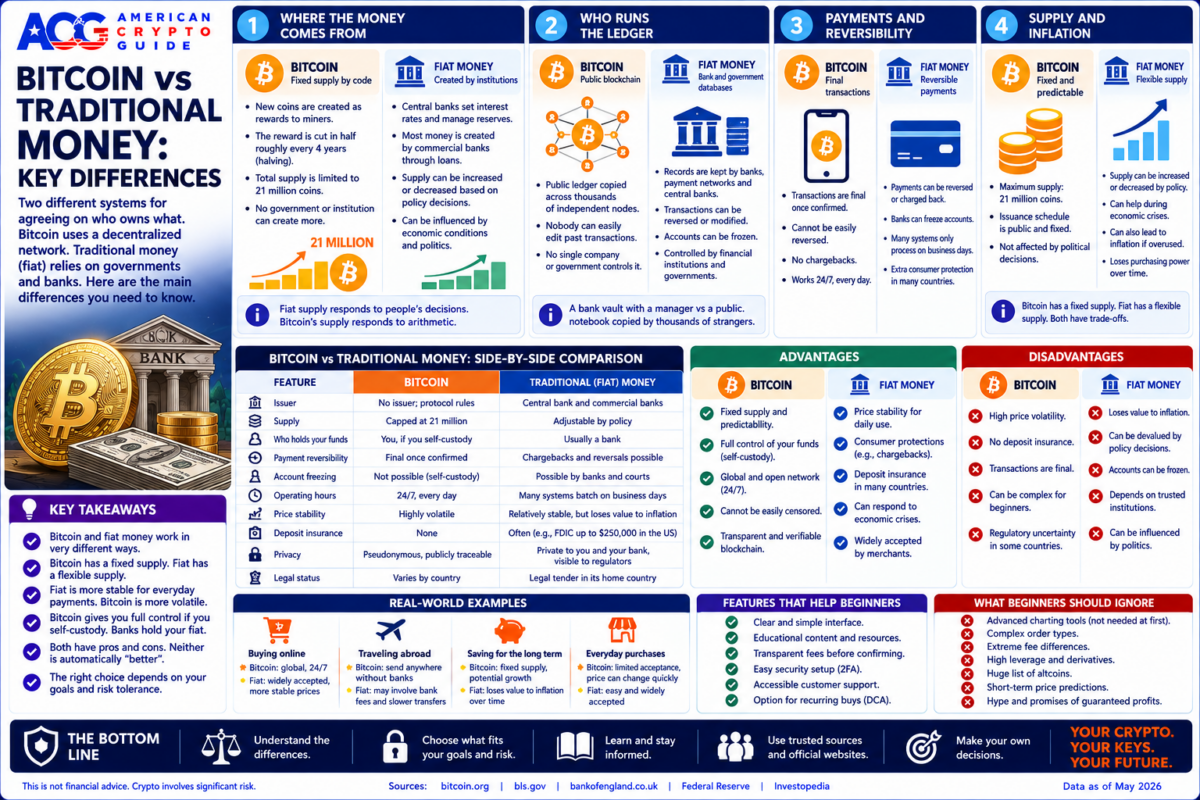
Bitcoin vs Traditional Money: Key Differences

Two ways of agreeing on who owns what
Every monetary system, no matter how fancy, answers one boring question: who owns what, and who gets to say so? Your paycheck, your savings account and the cash in your pocket all answer that question by pointing at an institution. Bitcoin answers it by pointing at a network of computers running the same rules.
 You might also likeWhat Is Bitcoin? A Complete Beginner’s Guide
That single difference is the root of almost everything people argue about when they compare bitcoin vs fiat currency. Fiat is simply government-issued money, like the US dollar, the euro or the pound, that isn’t redeemable for gold or any other commodity. It works because a government declares it legal tender and people trust the system behind it.
This article walks through where the two systems truly differ, where they surprisingly overlap, and which trade-offs matter in daily life. It isn’t a pitch for either side.
Where the money comes from
Fiat: created by institutions, in two layers
Most people picture a central bank printing banknotes. In reality, physical cash is a small slice of the supply. The bulk of modern money is bank deposits, created when commercial banks make loans. The central bank sets interest rates and manages reserves, and the commercial banks do the rest. The Bank of England has published a plain-language explanation of this process in its Quarterly Bulletin on money creation.
The upside is flexibility. A central bank can respond to a recession or a banking panic by adding liquidity. The downside is that supply is a policy decision, and policy can be wrong, late or politically influenced.
Bitcoin: created by a schedule nobody can edit
Bitcoin’s issuance is written into its software. New coins appear only as rewards to miners who add blocks to the chain, and the reward is cut in half roughly every four years in an event called the halving. The total can never exceed 21 million coins. The design is described in the original Bitcoin whitepaper.
Fiat supply responds to people’s decisions. Bitcoin’s supply responds to arithmetic.
Neither approach is automatically «better». A fixed supply gives predictability, but it also means the system cannot expand to cushion a crisis. A flexible supply can cushion a crisis, but it can also be stretched too far.
Who runs the ledger
Traditional money lives in private or public databases. Your bank keeps one ledger, the card network keeps another, and a central bank keeps the one that banks use among themselves. These institutions can reverse a payment, freeze an account, or correct a mistake.
Bitcoin runs on a public ledger called the blockchain, copied across thousands of independent nodes. Nobody can edit an old entry without redoing an enormous amount of computational work, which is the whole point of mining.
Think of it as the difference between:
- A bank vault with a manager: safe if the manager is honest and competent, and fixable when something goes wrong.
- A public notebook copied by thousands of strangers: nobody can quietly alter a line, but nobody can quietly fix one either.
Side-by-side: the practical differences
| Feature | Bitcoin | Traditional (fiat) money |
|---|---|---|
| Issuer | No issuer; protocol rules | Central bank and commercial banks |
| Supply | Capped at 21 million | Adjustable by policy |
| Who holds your funds | You, if you self-custody | Usually a bank |
| Payment reversibility | Final once confirmed | Chargebacks and reversals possible |
| Account freezing | Not possible for self-custodied coins | Possible by banks and courts |
| Operating hours | 24/7, every day | Many systems batch on business days |
| Price stability | Highly volatile | Relatively stable, but loses value to inflation |
| Deposit insurance | None | Often (e.g., FDIC up to $250,000 in the US) |
| Privacy | Pseudonymous, publicly traceable | Private to you and your bank, visible to regulators |
| Legal status | Varies by country | Legal tender in its home country |
Notice that no row is a clean win for either column. The table is really a list of trade-offs.
Volatility: the difference everyone notices first
If you’ve ever watched a Bitcoin price chart, you know it can swing double digits in a week. That makes it a poor unit for pricing a cup of coffee or a monthly rent. Merchants and employees want a unit that holds its value between Monday and Friday.
Fiat currencies are far steadier day to day, which is why they dominate everyday commerce. But «steady» isn’t «constant». Fiat quietly loses purchasing power through inflation. The US Bureau of Labor Statistics tracks this through its Consumer Price Index, and even a modest 3% annual rate roughly halves purchasing power over about 24 years.
So the comparison looks like this:
- Fiat: small, steady erosion, with occasional painful episodes.
- Bitcoin: large swings in both directions, with a long-term story that depends on adoption continuing.
Which risk you prefer depends on your time horizon. Someone paying bills next month cares about stability. Someone thinking in decades may care more about scarcity.
Safety nets: what happens when something goes wrong
The fiat safety net
In the United States, the FDIC covers deposits up to $250,000 per depositor, per insured bank, per ownership category. You can read the exact rules on the FDIC deposit insurance page. If a card is stolen, regulations and card network policies typically limit what you lose, and you can dispute fraudulent charges.
That protection is a real feature, and it exists because the system has intermediaries who can be held accountable.
The Bitcoin safety net (or the lack of one)
With Bitcoin, you are the bank, at least if you hold your own keys. Lose the private key and the coins are unreachable. Send funds to the wrong address and there’s no helpline to reverse it. Fall for a scam and the transaction is final.
The same property that makes Bitcoin censorship-resistant also makes mistakes permanent.
📬Did you like this article?
Subscribe and receive our posts directly in your inbox. Free!
Sin spam. Puedes darte de baja cuando quieras.
Holding Bitcoin on an exchange brings back some convenience, but it also brings back counterparty risk. Exchanges are not covered by deposit insurance the way banks are, and some have failed in the past.
Speed, cost and borders
Domestic bank transfers can feel instant, but international ones often take days and pass through several correspondent banks, each taking a fee. Bitcoin doesn’t care about borders: a transaction is confirmed in minutes to about an hour, whether it’s across the street or across the ocean.
There are caveats worth being honest about:
- Fees fluctuate. When the network is busy, on-chain fees can rise sharply.
- Both sides need to be set up. The receiver needs a wallet, and converting to local currency introduces exchange fees and spreads.
- Everyday payments are clunky. Bitcoin’s base layer is slow compared to a card tap, though second-layer systems like the Lightning Network aim to improve that.
For remittances and cross-border transfers, Bitcoin can be genuinely competitive. For buying lunch, a debit card still wins for most people.
Control, censorship and trust
Who can stop your payment?
With fiat, a payment passes through institutions that follow laws and internal policies. That’s useful when the goal is stopping fraud or sanctioned activity. It can also mean accounts get frozen incorrectly, or payments are blocked for reasons the customer finds opaque.
With self-custodied Bitcoin, no third party can block a valid transaction from being broadcast. This is what attracts people living under capital controls or unstable institutions, and it’s also what regulators worry about.
What are you trusting?
This is the cleanest way to see the difference:
| You trust… | Fiat | Bitcoin |
|---|---|---|
| A government to manage the currency | Yes | No |
| A bank to hold your balance | Yes | Only if you use a custodian |
| Open-source software and math | Partly | Yes |
| Your own ability to protect secrets | Barely | Entirely, if self-custodied |
Nobody escapes trust entirely. Bitcoin shifts it from institutions toward code and personal responsibility, and that’s a heavier load for some people than others.
Taxes and legal treatment
Fiat is the unit in which your taxes are calculated and paid. Bitcoin, in many countries, is treated as an asset instead of a currency. In the United States, the IRS classifies it as property, so selling it, spending it or swapping it can trigger a taxable event. The agency’s virtual currency FAQ explains how this works.
This has a practical consequence: buying a $5 coffee with Bitcoin means recording a tiny capital gain or loss, which is a bookkeeping headache that paying with dollars never creates. Rules differ widely across countries, so check your own tax authority’s guidance before assuming anything.
The myths on both sides
Debates about this topic tend to collapse into slogans. A few worth correcting:
- «Bitcoin is just a scam.» Bitcoin has run continuously since 2009 and is held by individuals, funds and some companies. You can question its price without calling the technology fake.
- «Fiat is worthless paper.» Fiat is backed by taxation, legal tender laws and the productive capacity of an economy. It isn’t backed by gold, but that doesn’t make it meaningless.
- «Bitcoin is anonymous.» It’s pseudonymous. Transactions are publicly recorded and often traceable.
- «Bitcoin will replace banks.» So far, the two have mostly coexisted, and many people interact with Bitcoin through regulated financial companies.
- «Fiat is stable.» Stable compared to Bitcoin in the short run, yes. Over decades, inflation and currency crises tell a more complicated story.
So which is better?
It depends on what you need the money to do.
Fiat tends to fit better when you want to:
- Pay bills, rent and groceries without thinking about price swings
- Have insurance and legal recourse if something goes wrong
- Keep tax reporting simple
Bitcoin tends to fit better when you want to:
- Hold a scarce asset outside the banking system
- Move value across borders without intermediaries
- Keep full control of your funds, and accept the responsibility that comes with it
For many people, the realistic answer is both, in different proportions and for different jobs. Plenty of people keep fiat for daily life and treat Bitcoin as a small, long-term holding they can afford to see fall sharply.
A short checklist before you decide anything
- Define the job. Spending, saving, investing and sending money abroad are different jobs.
- Size your exposure. Only hold what you could watch drop by half without losing sleep.
- Decide who holds the keys. Custody on an exchange and self-custody carry different risks.
- Learn the tax rules in your country before you buy.
- Ignore the loudest voices. Anyone claiming one system will certainly destroy the other is selling a story.
Final thoughts
Comparing Bitcoin with traditional money isn’t a contest with a single winner. Fiat offers stability, legal protection and universal acceptance, at the cost of a supply that policymakers control and a purchasing power that slowly shrinks. Bitcoin offers scarcity, borderless transfers and self-custody, at the cost of volatility, irreversibility and personal responsibility.
Understanding those trade-offs puts you in a better position than most of the people arguing about them online. Use whichever tool fits the job, and be honest about the risks of each.
This article is for educational purposes only and isn’t financial advice.