Best Crypto Exchanges for Beginners

What «beginner-friendly» actually means in practice
A beginner-friendly exchange isn’t necessarily the cheapest or the most feature-rich one — it’s the one that gets a genuine first-timer through account setup, a first purchase, and basic security setup without confusion or costly mistakes. That means prioritizing interface clarity, quality educational content, and accessible customer support over the deepest charting tools or the absolute lowest possible fee. This list focuses specifically on that beginner lens, which produces a different ranking than a general «best exchange» comparison would.
Coinbase — the default beginner starting point
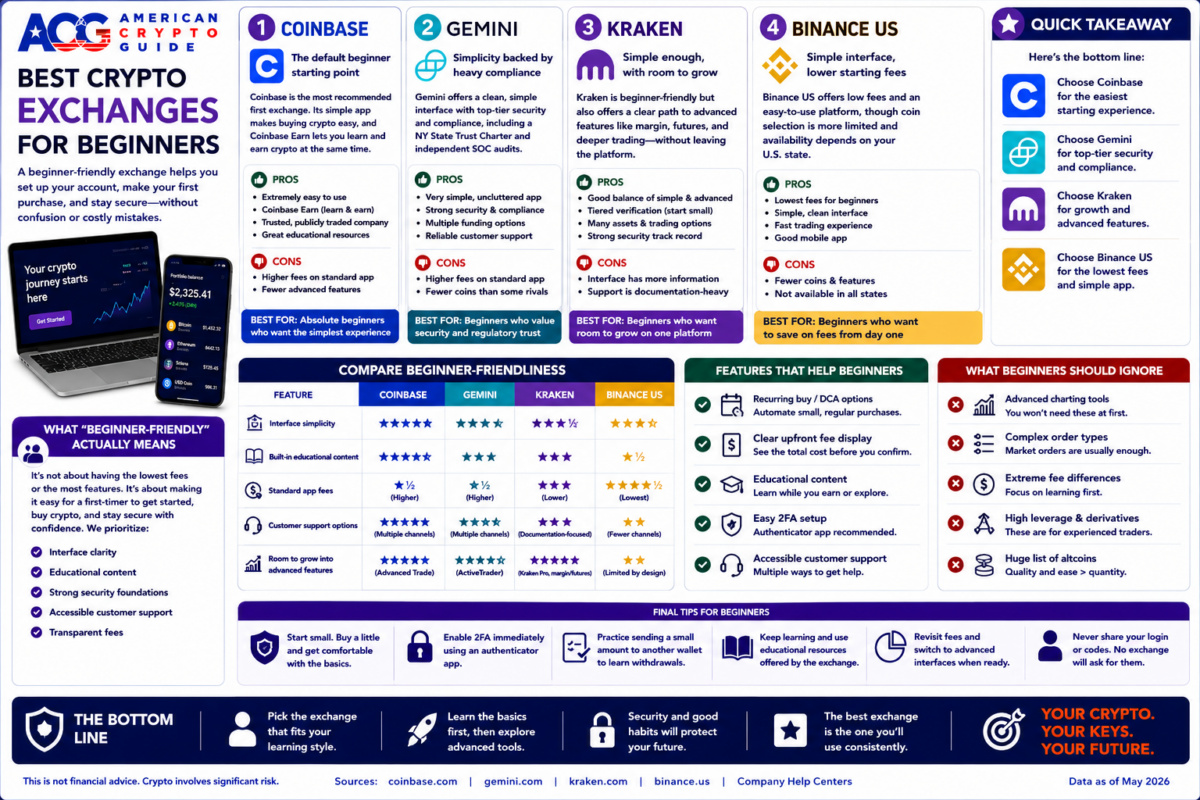
Coinbase remains the most commonly recommended first exchange for a reason: its standard app interface is deliberately simple, walking new users through buying their first crypto with minimal decision-making required. Coinbase Earn, a built-in feature letting users learn about specific crypto projects and earn a small amount of that asset for completing short educational modules, doubles as genuinely useful onboarding content rather than just marketing. The trade-off, well-documented elsewhere, is that the standard app’s fees run higher than several competitors — a reasonable cost for a beginner prioritizing simplicity, worth revisiting once you’re comfortable enough to consider Coinbase Advanced Trade instead.
Gemini — simplicity backed by heavy compliance
Gemini’s standard interface shares Coinbase’s philosophy of calm, uncluttered design, and its heavy regulatory compliance — including a New York State Trust Charter and independent SOC audits — offers a specific kind of reassurance some beginners find valuable: verifiable, third-party-confirmed security claims rather than marketing language alone. Like Coinbase, Gemini’s beginner-facing app carries higher fees than its advanced ActiveTrader interface, a pattern worth understanding early even if you don’t switch immediately.
Kraken — simple enough, with room to grow
Kraken’s standard interface is slightly more information-dense than Coinbase’s or Gemini’s, but it remains manageable for a first-time user while offering a clearer path to more advanced features (margin, futures, deeper charting) without needing to switch platforms entirely as your comfort level grows. Its tiered verification system also means a beginner testing the waters doesn’t need to complete the most demanding documentation requirements immediately — a genuinely practical feature for someone unsure how much they’ll actually use the platform.
Binance US — simple interface, lower starting fees
Binance US offers a comparatively low-fee entry point with an interface simple enough for first-time use, though its narrower asset selection and state-by-state availability (a consideration unique to this platform) are worth checking before committing. For a beginner specifically prioritizing lower costs from day one, rather than accepting a higher beginner-app fee with plans to switch interfaces later, Binance US is worth serious consideration.
Comparing beginner-friendliness directly
| Coinbase | Gemini | Kraken | Binance US | |
|---|---|---|---|---|
| Interface simplicity | Highest | High | Moderate | Moderate-high |
| Built-in educational content | Strong (Coinbase Earn) | Moderate | Moderate | Limited |
| Standard app fees | Higher | Higher | Lower | Lowest |
| Customer support options | Multiple channels | Multiple channels | Documentation-focused | Fewer channels |
| Room to grow into advanced features | Yes (Advanced Trade) | Yes (ActiveTrader) | Yes (Kraken Pro, margin/futures) | Limited by design |
Features that actually help beginners — not just marketing claims
- Recurring buy / dollar-cost averaging options, letting a beginner automate small, regular purchases rather than needing to decide when to buy each time.
- Clear, upfront fee display before confirming a purchase, rather than a fee buried in a spread that’s harder to notice.
- Built-in educational content tied to real platform features (like Coinbase Earn), rather than generic articles disconnected from the actual buying experience.
- Straightforward two-factor authentication setup during onboarding, ideally defaulting to or clearly recommending an authenticator app over SMS.
- Accessible customer support with multiple contact methods, since a first-time user is more likely to need help with an account issue than an experienced trader.
What beginners should specifically ignore when comparing exchanges
- Advanced charting tools and technical indicators. These matter enormously to active traders and essentially not at all to someone making an occasional purchase.
- Margin and futures trading availability. These carry real risk that beginners specifically should not engage with early, regardless of whether a platform offers them.
- The absolute lowest possible fee on the most advanced interface. A fractional fee difference between two advanced trading interfaces is irrelevant if you’re not yet comfortable using either one.
- Marketing claims about being «the best exchange» in isolation. Look instead for specific, verifiable claims — security audits, regulatory standing, actual fee schedules — rather than superlative marketing language.
A simple decision path for first-timers
- You want the most hand-held, widely recommended starting point: Coinbase, accepting the standard app’s higher fees as the cost of simplicity while you learn.
- You want that same simplicity with an emphasis on independently verified security: Gemini.
- You want simplicity now with room to grow into more advanced trading later on the same platform: Kraken.
- You’re comfortable with a straightforward interface and want the lowest fees from the start: Binance US, after confirming your state has full access.
A useful mental model for any first exchange choice: you’re not committing permanently. Most beginners eventually use more than one platform as their needs evolve, and starting with any of the reputable options above, rather than agonizing over finding the single «correct» first choice, gets you to actual hands-on learning faster.
📬Did you like this article?
Subscribe and receive our posts directly in your inbox. Free!
Sin spam. Puedes darte de baja cuando quieras.
Why starting simple matters more than starting optimal
There’s a real cost to over-researching the «perfect» first exchange: time spent comparing marginal fee differences between platforms is time not spent actually learning how buying, storing, and securing crypto works in practice — knowledge that matters far more to a beginner’s long-term outcomes than which specific exchange they started on. Any of the platforms covered here, used correctly with two-factor authentication enabled and a modest starting amount, is a perfectly reasonable place to begin.
Questions worth asking yourself before picking your first exchange
Beyond comparing the platforms themselves, a few honest questions about your own habits and goals narrow the decision faster than any feature comparison: Do you want to check prices daily, or set something up and mostly ignore it? Are you more comfortable trusting a company with a longer public track record, or one with the lowest possible fees? Do you already use a related financial app (a brokerage, a payment service) that might make one platform’s interface feel more familiar than another? None of these questions have a universally correct answer, but working through them honestly, rather than defaulting to whichever platform a friend or online post mentioned first, tends to produce a choice you’ll actually feel comfortable sticking with long enough to learn from.
The Federal Trade Commission publishes general consumer guidance on evaluating financial platforms and investment products, including newer categories like crypto exchanges, at https://consumer.ftc.gov, a useful general resource alongside platform-specific research.
Common first-exchange mistakes worth avoiding
- Choosing an exchange based purely on a friend’s recommendation without checking whether it’s actually available and well-supported in your own country or state.
- Skipping two-factor authentication setup during onboarding, planning to «add it later» — a habit that leaves an account vulnerable during exactly the period when a beginner is least equipped to notice something going wrong.
- Depositing a large amount immediately before getting comfortable with the platform’s interface, fee structure, and withdrawal process using a smaller test amount first.
- Assuming the standard app and any advanced trading interface on the same platform are entirely separate products requiring separate accounts, when in most cases they draw from the same underlying balance and login.
- Getting overwhelmed by advanced features visible in the interface and assuming they’re mandatory to understand before making a first purchase — most beginner-relevant actions (buying, holding, basic security) don’t require touching margin, futures, or advanced order types at all.
How to know when you’ve outgrown a beginner-focused setup
At some point, many users find the constraints that made a platform beginner-friendly start to feel limiting rather than helpful — wanting lower fees than the standard app offers, wanting access to a broader range of assets, or wanting deeper control over order execution. Recognizing this shift is a good sign, not a problem: it typically means switching to the same platform’s advanced interface (Coinbase Advanced Trade, Gemini ActiveTrader, Kraken Pro) rather than needing an entirely new exchange, since all of the platforms covered here support this kind of graduation without requiring you to start over from scratch.
The best crypto exchange for a beginner isn’t the one that wins every category in a general comparison — it’s the one that gets you through your first purchase and basic security setup without confusion, at a fee you’re comfortable paying while you’re still learning. Coinbase, Gemini, Kraken, and Binance US each offer a genuinely reasonable beginner experience with slightly different trade-offs; picking any one of them and actually starting is more valuable than continuing to compare marginal differences between all four.