Best Crypto Wallets in 2026: Complete Comparison

What «best» means when a wallet needs to hold more than one coin
A wallet built for a single cryptocurrency has one job. A multi-chain crypto wallet has to do that job for Bitcoin, Ethereum, and dozens of other networks at once, each with its own address format, fee structure, and security quirks. That’s a fundamentally harder problem, which is why the «best» general-purpose crypto wallet rankings look different from a single-coin comparison — the winners here are judged as much on how many networks they handle cleanly as on raw security.
 You might also likeWhat Is Bitcoin? A Complete Beginner’s Guide
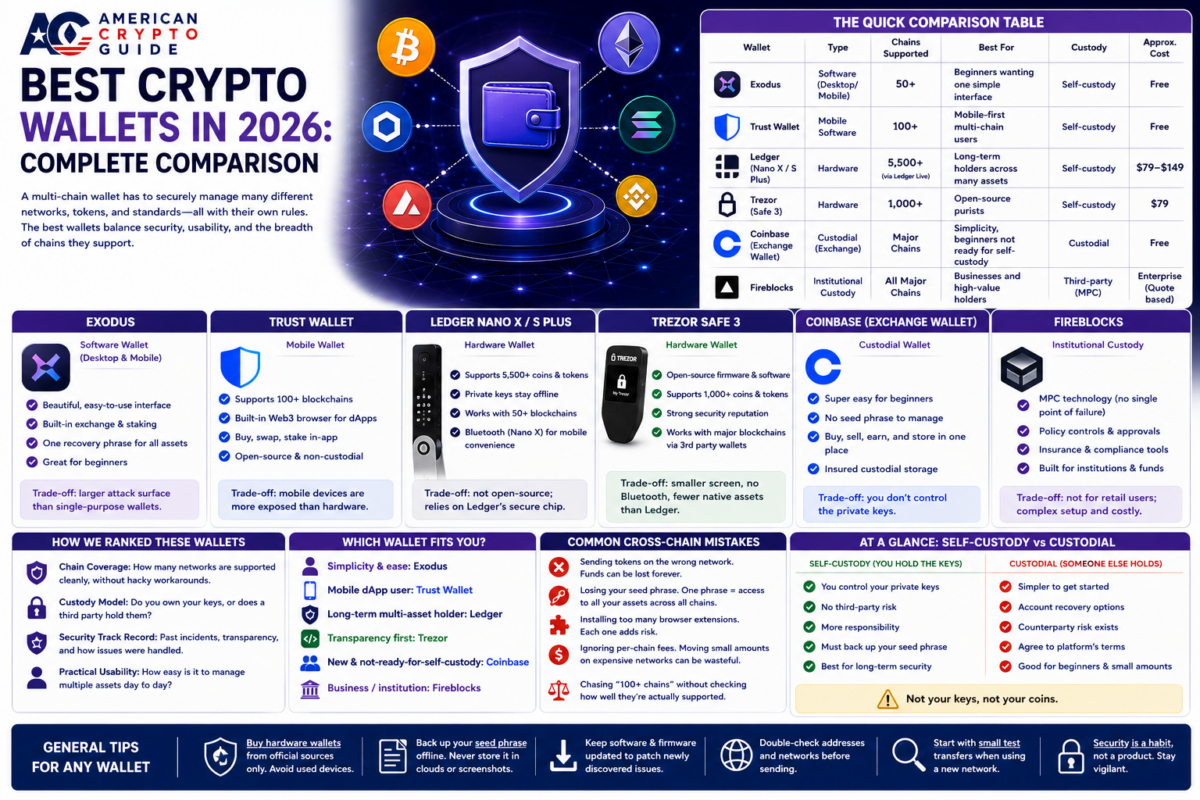
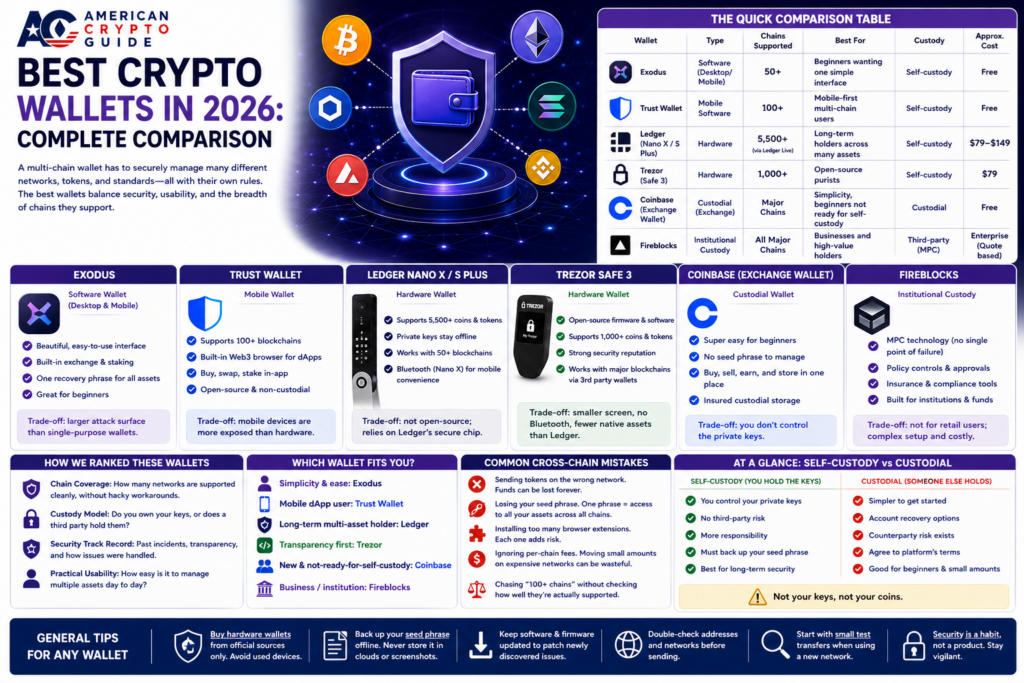
The quick comparison table
| Wallet | Type | Chains supported | Best for |
|---|---|---|---|
| Exodus | Software (desktop/mobile) | 50+ | Beginners wanting one simple interface |
| Trust Wallet | Mobile software | 100+ | Mobile-first multi-chain users |
| Ledger (Nano X/S Plus) | Hardware | 5,500+ (via Ledger Live) | Long-term holders across many assets |
| Trezor (Safe 3) | Hardware | 1,000+ | Open-source purists |
| Coinbase (exchange wallet) | Custodial | Major chains | Simplicity, beginners not ready for self-custody |
| Fireblocks | Institutional custody | All major chains | Businesses and high-value holders |
Multi-chain software wallets
Exodus
Exodus built its reputation on making a genuinely confusing category — holding dozens of unrelated cryptocurrencies — feel approachable. One interface, one recovery phrase, and a built-in exchange feature for swapping between supported assets without leaving the app. The trade-off of that convenience is a larger attack surface than a single-purpose wallet, since one app now touches many different blockchain integrations.
Trust Wallet
Trust Wallet, owned by Binance, supports an unusually broad range of blockchains and has become a default choice for mobile-first users who regularly interact with decentralized apps across multiple ecosystems. It’s non-custodial, meaning you control your own keys, and includes a built-in Web3 browser for connecting directly to dApps from the same app you hold your coins in.
Worth sitting with: the more chains and features a wallet packs into one app, the more code is running on your device that could theoretically contain a bug. Breadth of support is a genuine convenience, but it isn’t free from a security standpoint.
Multi-chain hardware wallets
Ledger (Nano X and Nano S Plus)
Ledger’s companion app, Ledger Live, supports thousands of assets across dozens of blockchains, making it one of the broadest hardware wallet ecosystems available. Your private keys stay on the physical device regardless of which chain you’re interacting with, which is the core security benefit hardware wallets offer over software-only options. Official specifications are published at https://www.ledger.com.
📬Did you like this article?
Subscribe and receive our posts directly in your inbox. Free!
Sin spam. Puedes darte de baja cuando quieras.
Trezor (Safe 3)
Trezor covers a smaller but still substantial range of chains compared to Ledger, with the trade-off being full open-source firmware that independent researchers can audit line by line. For holders who prioritize verifiable transparency over maximum chain coverage, that trade-off is often worth it. Documentation lives at https://trezor.io.
Custodial exchange wallets
Coinbase and similar exchange-held balances
The simplest option for a beginner holding multiple cryptocurrencies is often to leave them on a reputable exchange rather than managing self-custody across several different wallets. You give up direct control of your private keys, but you also give up the responsibility of managing multiple recovery phrases correctly — a real trade-off, not a strictly worse option, especially for smaller holdings.
Institutional-grade options
Fireblocks and similar custody platforms
For businesses, funds, and individuals holding significant value across many assets, institutional custody platforms like Fireblocks offer multi-party computation (MPC) security models, insurance coverage, and compliance tooling that individual hardware wallets simply aren’t built for. This category exists specifically because «hold your own keys» advice doesn’t scale cleanly to organizations managing complex approval workflows.
How we ranked these
- Chain coverage — how many networks does it support cleanly, without janky third-party integrations?
- Custody model — does it give you your own keys, or does a third party hold them?
- Security track record — has the wallet or its ecosystem faced major incidents?
- Practical usability — can someone actually manage multiple assets without constant confusion?
Which wallet fits which type of person
- You hold a handful of well-known coins and want simplicity: Exodus.
- You’re mobile-first and interact with dApps across chains regularly: Trust Wallet.
- You hold meaningful value across many assets long-term: Ledger, for the broadest hardware-secured chain coverage.
- You want maximum auditability over maximum chain support: Trezor.
- You’re new to crypto entirely and not ready for self-custody: a reputable exchange’s custodial balance, while you learn.
- You manage funds for a business or fund: an institutional custody platform, not a consumer wallet at all.
Common cross-chain wallet mistakes worth avoiding
- Sending a token to the wrong network’s address format. An address that looks valid on one chain can be invalid, or worse, valid but unrecoverable, on another.
- Assuming one recovery phrase protects everything equally. Multi-chain wallets typically use a single seed phrase across all supported assets — losing it means losing access to all of them at once, not just one.
- Installing browser extensions for every new chain you try. Each additional extension is another potential attack surface; consolidate where you reasonably can.
- Ignoring per-chain fee differences. Moving a small amount on a high-fee network can cost more in transaction fees than the amount being moved.
- Treating «supports 100+ chains» as automatically better than «supports 10 chains well.» Depth of support matters as much as breadth.
Final thoughts
The best crypto wallet for holding a diverse portfolio isn’t the one that claims to support the most networks — it’s the one that handles the networks you actually use cleanly, securely, and without adding unnecessary complexity to your daily routine. For most people, that means picking one or two wallets deliberately rather than accumulating a different app for every coin they’ve ever bought.