Biggest Ethereum News This Month

Updated for August 2026. This roundup covers the stories actually shaping Ethereum right now — not just the price headline.
The month in one paragraph
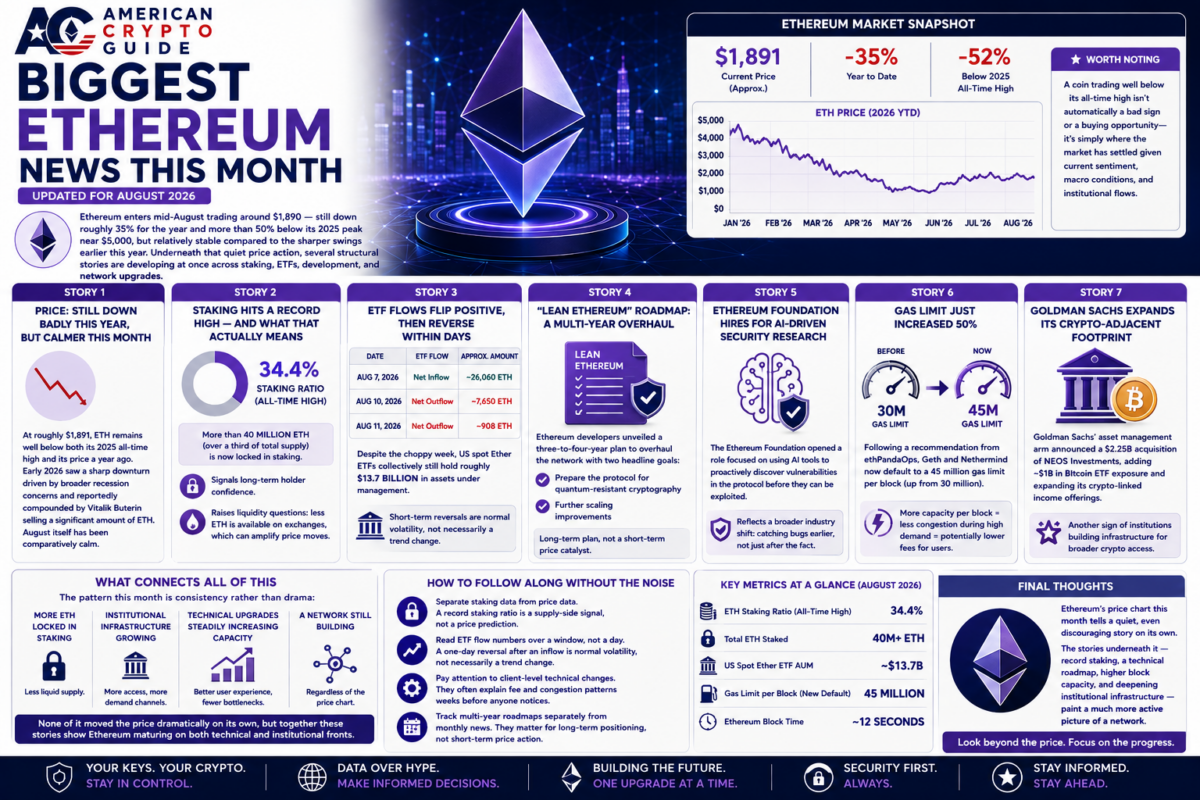
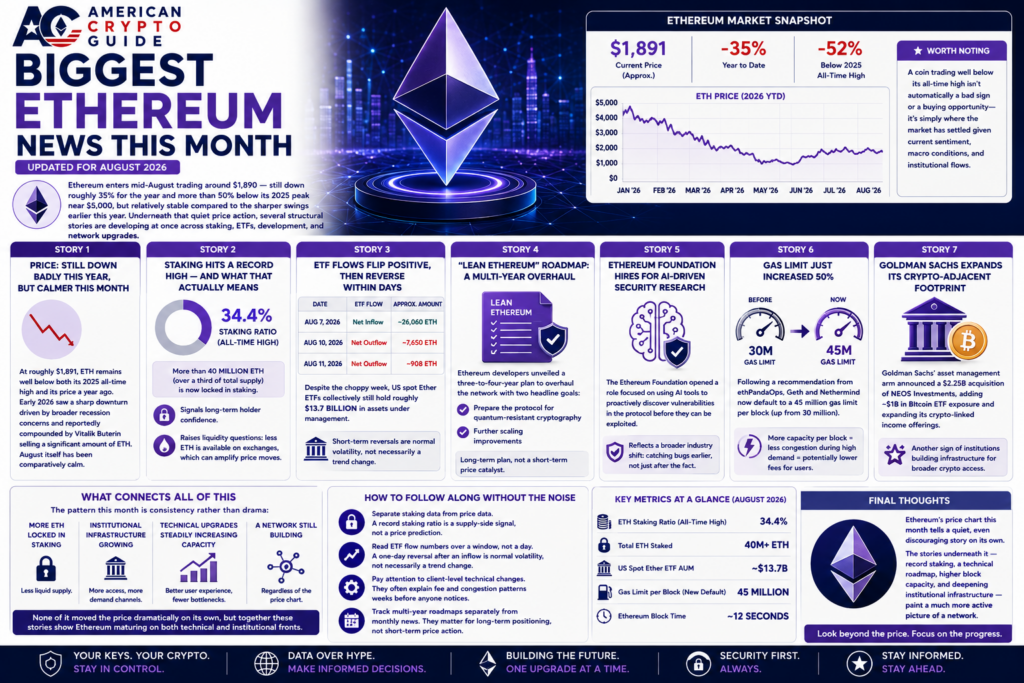
Ethereum enters mid-August trading around $1,890 — still down roughly 35% for the year and more than 50% below its 2025 peak near $5,000, but relatively stable compared to the sharper swings earlier this year. Underneath that quiet price action, several structural stories are developing at once: staking just hit an all-time high, ETF flows briefly turned sharply positive before reversing, the Ethereum Foundation unveiled a multi-year overhaul plan, and a technical change that barely made headlines just increased the network’s transaction capacity by 50%. None of these single-handedly explain the price chart, but together they show where Ethereum’s actual momentum sits right now.
Story 1 — Price: still down badly this year, but calmer this month
At roughly $1,891, ETH remains well below both its 2025 all-time high and its price a year ago, according to ongoing coverage from Fortune and TheStreet. Early 2026 saw a sharp downturn driven by broader recession concerns and reportedly compounded by Ethereum co-founder Vitalik Buterin selling a significant amount of ETH. August itself has been comparatively calm, with price hovering in a narrow band rather than making the dramatic moves seen earlier in the year.
Worth noting: a coin trading well below its all-time high isn’t automatically a bad sign or a buying opportunity — it’s simply where the market has settled given current sentiment, macro conditions, and institutional flows. Treat price level alone as context, not a signal.
Story 2 — Staking hits a record high — and what that actually means
Ethereum’s staking ratio reached an all-time high of 34.4% in mid-August, meaning more than 40 million ETH — over a third of total supply — is currently locked in the network’s proof-of-stake system. A rising staking ratio generally signals long-term holder confidence, since staked ETH isn’t instantly liquid. At the same time, it raises a fair question about liquidity: with more ETH locked away, less remains freely circulating on exchanges, which can amplify price moves in either direction when demand shifts.
Story 3 — ETF flows flip positive, then reverse within days
US spot Ether ETFs recorded a notable net inflow of roughly 26,060 ETH on August 7, only to see outflows of about 7,650 ETH on August 10 and a smaller 908 ETH outflow on August 11, according to data reported by TheStreet citing CoinGlass. Despite the choppy week, these funds collectively still hold roughly $13.7 billion in assets under management.
| Date | ETF flow | Approx. amount |
|---|---|---|
| Aug 7, 2026 | Net inflow | ~26,060 ETH |
| Aug 10, 2026 | Net outflow | ~7,650 ETH |
| Aug 11, 2026 | Net outflow | ~908 ETH |
Short-term flow reversals like this are common and don’t necessarily signal a change in longer-term institutional sentiment — but they’re a useful reminder that ETF activity, much like retail trading, isn’t a one-directional trend even during periods of overall accumulation.
📬Did you like this article?
Subscribe and receive our posts directly in your inbox. Free!
Sin spam. Puedes darte de baja cuando quieras.
Story 4 — The «Lean Ethereum» roadmap: a multi-year overhaul
Ethereum developers unveiled a roadmap describing a three-to-four-year plan to significantly overhaul the network’s technical core, with two headline goals: preparing the protocol for quantum-resistant cryptography and further scaling improvements. Multi-year roadmaps like this rarely produce immediate price impact, but they matter for anyone evaluating Ethereum’s long-term technical direction rather than its next-quarter price action.
Story 5 — The Ethereum Foundation hires for AI-driven security research
The Ethereum Foundation opened a new role specifically focused on using AI tools to proactively discover vulnerabilities in the protocol before they can be exploited. It’s a small hiring announcement on its face, but it reflects a broader shift across the crypto security industry: using automated tooling to catch smart contract and protocol-level bugs earlier, rather than relying solely on after-the-fact audits and bug bounties.
Story 6 — A quiet but consequential change: the gas limit just grew 50%
Following a recommendation from the Ethereum client research group ethPandaOps, the latest releases of two major execution clients — Geth and Nethermind — now default to a 45 million gas limit per block, up from 30 million. In plain terms, this increases how much transaction activity each block can process, which can help ease network congestion during high-demand periods. Technical changes like this rarely trend on social media, but they directly affect the gas fee experience for everyday users, since block capacity is one of the core levers behind fee spikes.
Story 7 — Goldman Sachs expands its crypto-adjacent footprint
Goldman Sachs’ asset management arm announced a $2.25 billion acquisition of NEOS Investments, a deal that adds roughly $1 billion in Bitcoin ETF exposure to Goldman’s product lineup and expands its broader crypto-linked income offerings. While the deal itself centers on Bitcoin exposure rather than Ethereum directly, it’s part of the same institutional infrastructure build-out shaping both major cryptocurrencies’ accessibility to traditional investors.
 You might also likeWhat Is Bitcoin? A Complete Beginner’s Guide
What connects all of this
Looking past the individual headlines, the pattern this month is consistency rather than drama: more ETH locked in staking, more institutional infrastructure being built around crypto broadly, and quiet technical upgrades steadily increasing what the network can actually handle. None of it moved the price dramatically on its own, but together these stories describe a network maturing on both the technical and institutional fronts, even during a stretch where the price chart alone tells a much less flattering story.
How to follow along without the noise
- Separate staking data from price data. A record staking ratio is a supply-side signal, not a price prediction.
- Read ETF flow numbers over a window, not a single day. A one-day reversal after a strong inflow day is normal volatility, not necessarily a trend change.
- Pay attention to client-level technical changes, even when they don’t trend — they often explain fee and congestion patterns weeks before anyone notices the effect.
- Track multi-year roadmaps separately from monthly news — they matter for long-term positioning, not short-term price action.
Final thoughts
Ethereum’s price chart this month tells a fairly quiet, even discouraging story on its own. The stories underneath it — record staking, a technical roadmap addressing quantum resistance, expanding block capacity, and deepening institutional infrastructure — paint a considerably more active picture of a network still building, even while the market takes its time catching up.