Ledger Nano X Review: Is It Still Worth Buying?

The short verdict
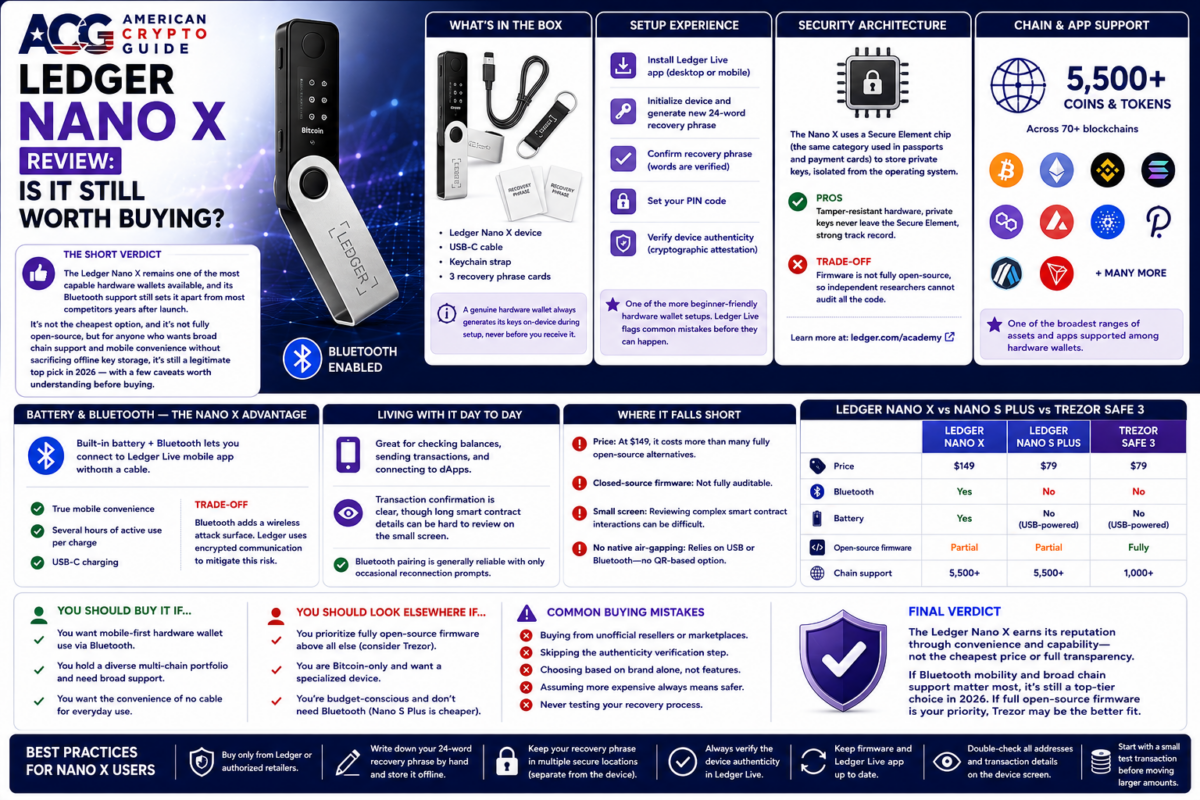
The Ledger Nano X remains one of the most capable hardware wallets available, and its Bluetooth support still sets it apart from most competitors years after launch. It’s not the cheapest option, and it’s not fully open-source, but for anyone who wants broad chain support and mobile convenience without sacrificing offline key storage, it’s still a legitimate top pick in 2026 — with a few caveats worth understanding before buying.
What’s actually in the box
The Nano X ships with the device itself, a USB-C cable, a keychain strap, and three recovery phrase cards for writing down your seed phrase by hand. There’s no pre-printed seed phrase card with anything on it, and there shouldn’t be — a genuine hardware wallet always generates its keys on-device during setup, never before you receive it.
Setup experience
Setup happens entirely through the Ledger Live companion app, available on desktop and mobile. The process walks through generating a new 24-word recovery phrase, confirming it by re-entering select words, and setting a device PIN. It’s a genuinely well-designed onboarding flow — one of the more beginner-friendly setups among hardware wallets, with the app flagging common mistakes (like proceeding without properly confirming the recovery phrase) before they can happen.
Worth pausing on: during setup, Ledger explicitly prompts you to verify the device hasn’t been tampered with, using a cryptographic attestation check. Skipping this step defeats a real security safeguard — it takes under a minute and shouldn’t be treated as optional.
Security architecture
The Nano X uses a Secure Element chip — the same category of tamper-resistant hardware used in passports and payment cards — to store private keys, isolated from the device’s general-purpose operating system. This is a meaningfully different (and generally considered more robust) approach than software-only key storage. The trade-off, and the most common criticism of Ledger’s entire product line, is that the firmware running alongside the Secure Element is not fully open-source, meaning independent researchers can’t audit every line of code the way they can with a fully open-source competitor like Trezor.
Ledger has published its security model and past incident responses at https://www.ledger.com/academy, which is worth reading directly rather than taking any single review’s summary at face value.
📬Did you like this article?
Subscribe and receive our posts directly in your inbox. Free!
Sin spam. Puedes darte de baja cuando quieras.
Chain and app support
This is where the Nano X genuinely distinguishes itself. Through the Ledger Live app, it supports well over 5,500 coins and tokens across dozens of blockchains — a considerably broader range than most competing hardware wallets. For anyone holding a diverse portfolio spanning multiple ecosystems, this breadth of support alone can be the deciding factor over a narrower, more specialized device.
Battery and Bluetooth — the Nano X’s defining feature
Unlike Ledger’s cheaper Nano S Plus, the Nano X includes a built-in battery and Bluetooth connectivity, letting it pair directly with the Ledger Live mobile app without a cable. In practice, this makes it genuinely usable as a daily-carry device rather than something that stays in a drawer connected to a desktop. Battery life comfortably covers several hours of active use between charges, and the device charges over USB-C.
The trade-off is philosophical as much as technical: Bluetooth introduces a wireless attack surface that a fully wired device simply doesn’t have. Ledger’s Bluetooth implementation includes its own encryption layer specifically to mitigate this, but security-maximalist users who want zero wireless surface area still gravitate toward wired-only alternatives.
Living with it day to day
For regular use — checking balances, sending transactions, connecting to a handful of dApps — the Nano X feels closer to a genuinely convenient piece of hardware than the clunkier early hardware wallets from years past. Transaction confirmation on the device’s small screen is clear, if occasionally tedious for very long smart contract calls where you have to review technical data in a tiny window. The mobile Bluetooth pairing is generally reliable, with occasional reconnection prompts that are a minor annoyance rather than a real problem.
Where it falls short
- Price. At $149, it costs meaningfully more than fully open-source alternatives with comparable core security.
- Closed-source firmware. For users who specifically prioritize independent auditability, this remains a real, not merely theoretical, drawback.
- Small screen for complex transactions. Reviewing a long or unusual smart contract interaction on the Nano X’s limited display can be genuinely difficult to verify carefully.
- No native air-gapping option. Unlike QR-based devices, the Nano X always relies on either USB or Bluetooth to communicate, which some security-conscious users specifically want to avoid entirely.
Ledger Nano X vs Nano S Plus vs Trezor Safe 3
| Ledger Nano X | Ledger Nano S Plus | Trezor Safe 3 | |
|---|---|---|---|
| Price | $149 | $79 | $79 |
| Bluetooth | Yes | No | No |
| Battery | Yes | No (USB-powered) | No (USB-powered) |
| Open-source firmware | Partial | Partial | Fully |
| Chain support | 5,500+ | 5,500+ | 1,000+ |
Who should buy it
- Anyone who wants mobile-first hardware wallet use via Bluetooth, without giving up broad chain support.
- Holders managing a genuinely diverse multi-chain portfolio who value Ledger Live’s wide compatibility.
- Users upgrading from a cheaper hardware wallet who specifically want the convenience of not needing a cable for everyday use.
Who should look elsewhere
- Anyone who prioritizes fully auditable, open-source firmware above other considerations — Trezor is the more consistent choice there.
- Bitcoin-only holders who don’t need multi-chain support and would rather have a narrower, more specialized device.
- Budget-conscious buyers who don’t specifically need Bluetooth — the Nano S Plus offers nearly identical core security for roughly half the price.
 You might also likeWhat Is Bitcoin? A Complete Beginner’s Guide
Final verdict
The Ledger Nano X earns its reputation less through being the cheapest or the most transparent hardware wallet, and more through being the most convenient one that still keeps private keys genuinely offline. If Bluetooth mobility and broad chain support matter to you more than fully open-source firmware, it remains a well-justified purchase in 2026. If those priorities are reversed, it’s worth seriously comparing against Trezor’s lineup before deciding.