Trezor Model One Review: Pros and Cons

The short verdict
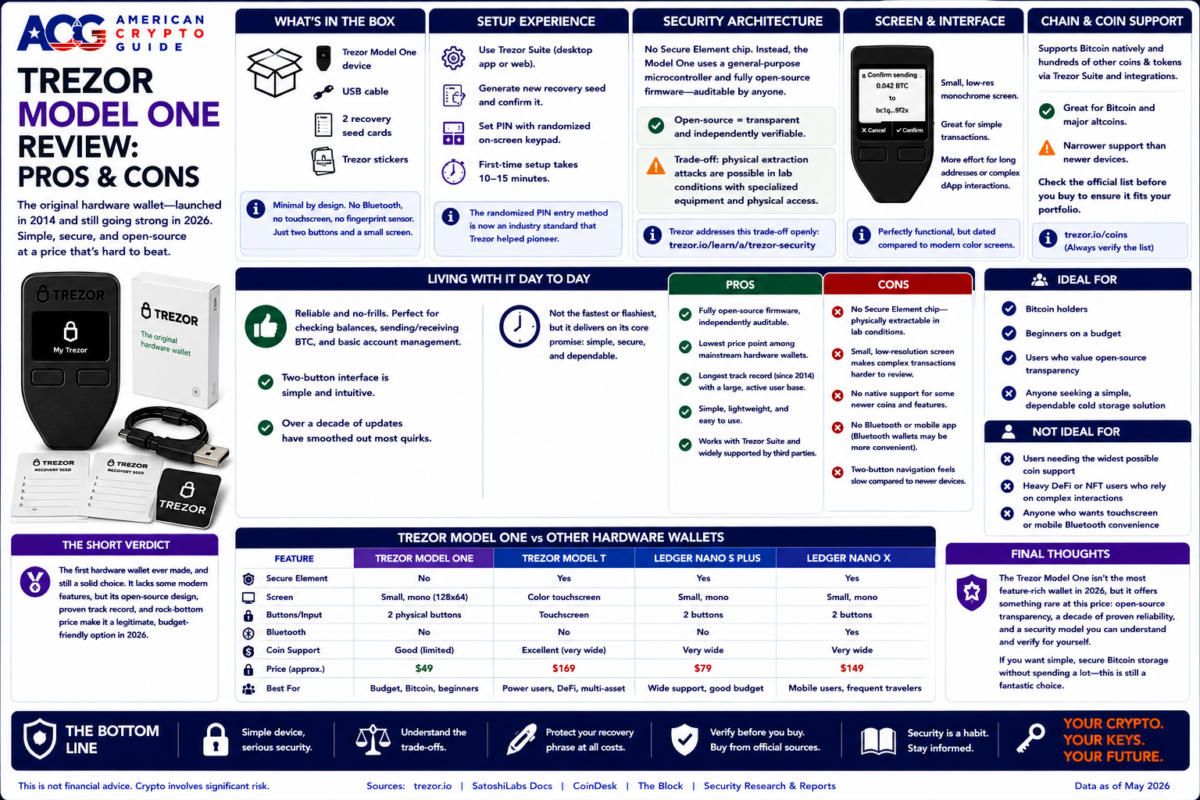
The Trezor Model One holds a genuinely unique place in crypto hardware history: it was the first hardware wallet ever brought to market, launched in 2014, and it’s still sold and supported today at one of the lowest price points in the category. It lacks some of the polish and broader chain support of newer devices, but its fully open-source design and long, transparent track record make it a legitimate, budget-friendly choice in 2026 for anyone prioritizing verifiable security over the latest features.
What’s in the box
The Model One ships with the device itself, a USB cable, two recovery seed cards, and a set of Trezor stickers — a notably minimal package compared to some newer competitors, reflecting both its age and its straightforward design philosophy. There’s no Bluetooth module, no touchscreen, and no fingerprint sensor; the device is built around two physical buttons and a small monochrome display.
Setup experience
Setup happens through Trezor Suite, the manufacturer’s companion application, available as a desktop app or browser-based interface. The process walks through generating a new recovery seed, confirming it, and setting a PIN using a randomized on-screen keypad layout — a detail specifically designed to prevent someone recording your hand movements from being able to infer your PIN by watching. First-time setup takes about 10-15 minutes and is generally straightforward, though the small screen makes reading longer confirmation text somewhat more effortful than on devices with larger displays.
Worth noting for context: the randomized PIN entry method the Model One uses has been adopted, in some form, across much of the hardware wallet industry since — a reminder that some of this device’s original design decisions have aged into genuine industry standards rather than outdated quirks.
Security architecture — the trade-off that defines this device
The Model One’s defining security characteristic, for better and worse, is what it doesn’t have: a dedicated Secure Element chip, the specialized tamper-resistant hardware used in most competing devices (including Trezor’s own newer models) to physically isolate private key storage. Instead, the Model One relies on a general-purpose microcontroller combined with its fully open-source firmware design, allowing independent researchers to audit every line of code running on the device — something not possible with devices using proprietary Secure Element firmware.
This is a genuine trade-off, not a simple downgrade. Security researchers have demonstrated physical extraction attacks against the Model One’s chip under lab conditions, requiring direct physical possession of the device and specialized equipment — a threat model most individual users don’t realistically face, but one worth understanding rather than dismissing. Trezor’s own security documentation, available at https://trezor.io/learn/a/trezor-security, addresses this trade-off directly rather than obscuring it, which is itself a point in favor of the company’s general transparency.
Screen and interface limitations
The Model One’s small, low-resolution monochrome screen is its most dated feature by 2026 standards. Reviewing longer or more complex transaction details — a multi-step smart contract interaction, for instance — is noticeably more cumbersome than on devices with larger, higher-resolution color screens. For simple send-and-receive transactions, the interface remains perfectly functional; for anyone planning heavy DeFi or complex multi-chain use, this limitation is worth weighing seriously.
📬Did you like this article?
Subscribe and receive our posts directly in your inbox. Free!
Sin spam. Puedes darte de baja cuando quieras.
Chain and coin support
The Model One supports Bitcoin natively and, through Trezor Suite and third-party integrations, a range of additional cryptocurrencies — though its supported coin list is narrower than more recently released devices, including Trezor’s own newer models. For users holding primarily Bitcoin, this limitation is largely irrelevant; for anyone managing a broad, diverse multi-chain portfolio, it’s a genuine constraint worth checking against your specific needs before buying.
 You might also likeWhat Is Bitcoin? A Complete Beginner’s Guide
Living with it day to day
For straightforward use — checking balances, sending and receiving Bitcoin, basic account management — the Model One remains a reliable, no-frills tool over a decade after launch. The two-button interface, while simple, is reasonably intuitive once you’re used to it, and the device’s long track record means most software quirks have long since been identified and resolved through firmware updates. It’s not the fastest or flashiest device to actually hold and use, but «no-frills and reliable» has been this product’s core identity since 2014, and it delivers consistently on that promise.
Pros
- Fully open-source firmware, independently auditable by anyone, with no proprietary black-box components.
- Lowest price point among mainstream hardware wallets from an established, reputable manufacturer.
- Longest track record of any hardware wallet on the market, with over a decade of public use and no history of a remote exploit compromising customer funds.
- Randomized PIN entry, protecting against shoulder-surfing and certain observation-based attacks.
- No Bluetooth, eliminating an entire category of wireless attack surface some competitors carry.
Cons
- No Secure Element chip, leaving it theoretically more vulnerable to sophisticated physical extraction attacks than newer competitors, though this requires direct physical possession and specialized equipment.
- Small, low-resolution screen, making complex transaction review more cumbersome than on newer devices.
- Narrower coin and chain support compared to more recently released hardware wallets.
- No touchscreen or Bluetooth, which some users will experience as limiting rather than as a deliberate security feature.
- Dated overall design, functional but visibly a decade-old product next to newer competitors.
Trezor Model One vs newer alternatives
| Trezor Model One | Trezor Safe 3 | Ledger Nano S Plus | |
|---|---|---|---|
| Price | ~$69 | ~$79 | ~$79 |
| Secure Element chip | No | Yes | Yes |
| Open-source firmware | Fully | Fully | Partial |
| Screen | Small monochrome | Larger color touchscreen | Small color screen |
| Chain support | Narrower | Broader | Broader |
| Track record | Longest (since 2014) | Newer | Newer |
Who should buy it
- Bitcoin-focused holders who don’t need broad multi-chain support and want the lowest-cost entry point from a genuinely reputable, long-established manufacturer.
- Security-conscious users who prioritize fully open-source, independently auditable firmware above having a Secure Element chip.
- Budget-conscious buyers who still want a device with a meaningfully longer public track record than any newer alternative can offer.
Who should look elsewhere
- Users managing a broad, multi-chain portfolio will find the Model One’s narrower coin support a genuine limitation compared to Trezor’s own newer models or competitors.
- Anyone who wants Bluetooth or a larger touchscreen interface for convenience will find the Model One’s minimal, dated design a real drawback rather than a deliberate feature.
- Users specifically prioritizing Secure Element-based protection against sophisticated physical attacks may prefer a newer device, even at a similar price point.
How the Model One has aged compared to its original competitors
It’s worth putting the Model One’s longevity in context: nearly every hardware wallet that launched around the same time it did has either been discontinued or replaced by substantially redesigned successors. The Model One’s continued availability, largely unchanged in its core design philosophy since 2014, is unusual in an industry where product cycles tend to move quickly. This isn’t purely nostalgia on Trezor’s part — the device still functions as a legitimate entry-level option specifically because its open-source foundation has aged well, receiving ongoing firmware support and security patches over a period during which many competing early-generation devices simply stopped receiving updates altogether.
What actual owners tend to say after years of use
Independent user reviews and community discussion around the Model One, accumulated over more than a decade, tend to converge on a consistent pattern: praise for reliability and a genuine sense of trust built over years of use, paired with acknowledgment that the interface feels dated next to newer devices. It’s a rare product category where a device can accumulate over ten years of real-world usage data, and that history matters — firmware bugs get found and fixed, edge cases get identified, and a device that’s still functioning reliably after a decade of public scrutiny has, in a meaningful sense, been tested more thoroughly than any newer competitor possibly could be. This doesn’t make it immune to future issues, but it does mean the device isn’t an unknown quantity the way a newly released product inevitably is.
Firmware update history and ongoing support
A legitimate question for any decade-old product is whether it’s still actively maintained or effectively abandoned with only nominal support. The Model One has continued receiving firmware updates addressing security improvements and compatibility changes well into its second decade on the market, a genuinely reassuring sign for anyone worried about buying a device the manufacturer might quietly stop supporting. Checking a hardware wallet’s update history directly through the manufacturer’s own changelog, rather than assuming based on a device’s age alone, is a reasonable step for any buyer — and in the Model One’s case, that history holds up well against the concern.
The Trezor Model One earns its continued place on the market less through cutting-edge features and more through what it’s always represented: a fully transparent, independently auditable, no-frills approach to hardware wallet security at one of the category’s lowest price points. It’s not the device to choose if you need broad multi-chain support or a modern touchscreen experience, but for Bitcoin-focused holders who value verifiable open-source security and a genuinely long track record over the latest hardware, it remains a defensible choice more than a decade after its original launch.