Coinbase Review 2026: Fees, Features, and Safety

The short verdict
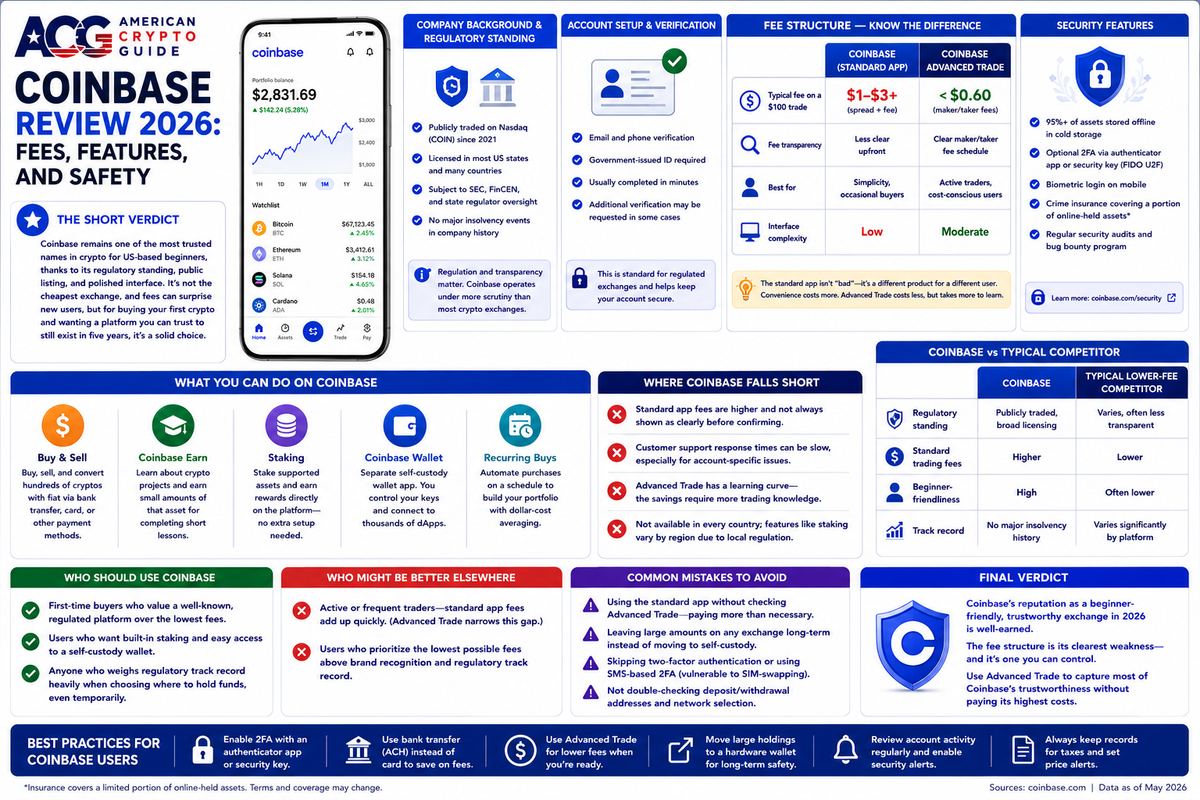
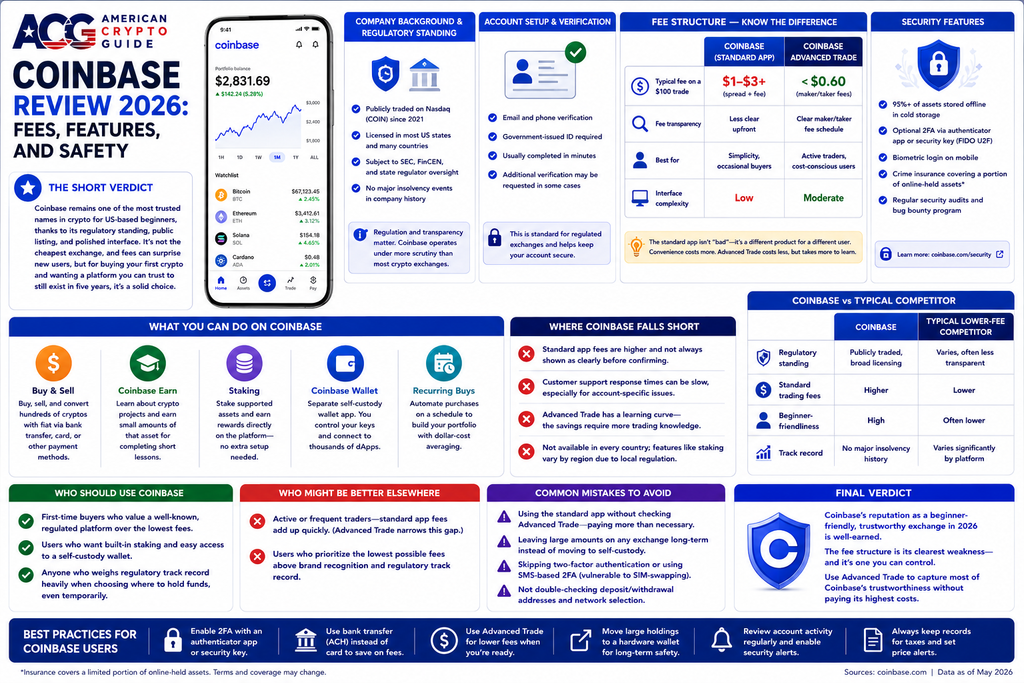
Coinbase remains one of the most trusted names in crypto for US-based beginners, largely because of its regulatory standing, public listing, and genuinely polished interface. It’s not the cheapest exchange, and its standard trading fees can catch new users off guard, but for someone buying their first crypto and wanting a platform they can reasonably trust to still exist in five years, it remains a defensible default choice in 2026.
Company background and regulatory standing
Coinbase is a publicly traded company (listed on Nasdaq since 2021), which brings a level of financial disclosure and regulatory scrutiny that most crypto exchanges don’t operate under. It’s licensed to operate in most US states and a number of other countries, and unlike several competitors, it has never faced the kind of insolvency event that’s hit other major platforms. That track record matters more than marketing copy — exchange history is one of the more reliable signals of trustworthiness in an industry with a genuinely troubled history of collapses.
Account setup and verification
Opening a Coinbase account requires the standard identity verification process common to regulated exchanges: email, phone number, and a government-issued ID. The process is generally fast, often completing within minutes for straightforward cases, though it can take longer if additional verification is triggered. This friction exists because Coinbase operates as a regulated financial business, not because of anything specific about the platform being unusually cautious.
Fee structure — the part that actually needs explaining
This is where Coinbase draws the most criticism, and the criticism is largely fair: the standard Coinbase app has a notably different, and higher, fee structure than Coinbase Advanced Trade, a separate interface aimed at more active traders.
| Coinbase (standard app) | Coinbase Advanced Trade | |
|---|---|---|
| Typical fee on a $100 trade | Often $1–$3+ (spread + fee) | Often under $0.60 |
| Fee transparency | Less clear upfront | Clear maker/taker fee schedule |
| Best for | Simplicity, occasional buyers | Active traders, cost-conscious users |
| Interface complexity | Low | Moderate |
Worth understanding, not just noting: the standard app isn’t secretly worse — it’s a different product aimed at a different user. The convenience fee buys a simpler experience; Advanced Trade buys a lower cost at the price of a steeper learning curve. Neither is a trap, but only one of them fits most beginners’ actual comfort level.
📬Did you like this article?
Subscribe and receive our posts directly in your inbox. Free!
Sin spam. Puedes darte de baja cuando quieras.
Security features
Coinbase stores the large majority of customer funds in offline cold storage, a standard best practice among reputable exchanges, and offers optional features like biometric login and hardware security key support for two-factor authentication — a stronger option than SMS-based 2FA, which remains vulnerable to SIM-swapping attacks. Coinbase also carries crime insurance covering a portion of assets held in its online hot wallets, though this insurance has historically covered a small fraction of total platform holdings, consistent with industry norms rather than a unique weakness.
Coinbase publishes its security practices directly at https://www.coinbase.com/security, worth reading for anyone deciding how much of their holdings to keep on the platform long-term versus moving to self-custody.
What you can actually do on Coinbase
- Buy and sell a wide range of cryptocurrencies via bank transfer, debit card, or linked payment methods.
- Coinbase Earn, letting users learn about specific crypto projects and earn small amounts of that asset for completing educational content.
- Staking, for supported proof-of-stake assets, directly through the platform without needing separate infrastructure.
- Coinbase Wallet, a separate self-custody app for users who want to move beyond the custodial exchange balance.
- Recurring buys, letting users automate dollar-cost averaging into an asset on a set schedule.
Where Coinbase falls short
- Standard app fees are genuinely higher than several competitors’ default interfaces, and the fee isn’t always displayed as clearly as it could be before confirming a purchase.
- Customer support response times have been a recurring complaint in user reviews, particularly for account-specific issues requiring manual review.
- Advanced Trade’s learning curve is real — the cost savings require a level of comfort with order types that many casual users won’t want to develop.
- Not available in every country, and feature availability (like staking for certain assets) can vary by region due to local regulation.
Coinbase vs a typical direct competitor
| Coinbase | Typical lower-fee competitor | |
|---|---|---|
| Regulatory standing | Publicly traded, broad licensing | Varies, often less transparent |
| Standard trading fees | Higher | Lower |
| Beginner-friendliness | High | Often lower |
| Track record | No major insolvency history | Varies significantly by platform |
Who should use Coinbase
- First-time buyers who value a well-known, regulated platform over shaving fractions of a percent off every trade.
- Users who want built-in staking and easy access to a self-custody wallet without juggling multiple unrelated apps.
- Anyone who weighs regulatory track record heavily when choosing where to hold funds, even temporarily.
Who might be better served elsewhere
- Active or frequent traders, for whom Coinbase’s standard app fees would add up meaningfully faster than a lower-fee alternative — though Advanced Trade narrows this gap significantly.
- Users specifically prioritizing the lowest possible fees above brand recognition and regulatory track record.
Final verdict
Coinbase’s reputation as a beginner-friendly, trustworthy exchange in 2026 is largely earned — its regulatory standing and public listing offer a level of accountability that’s genuinely rare in the space. The fee structure is its clearest weakness, and it’s one entirely within a user’s control: anyone who takes the small extra step of using Advanced Trade instead of the standard app captures most of Coinbase’s trustworthiness without paying its steepest costs.