Ethereum ETF Approval: What It Means for Investors

What actually got approved
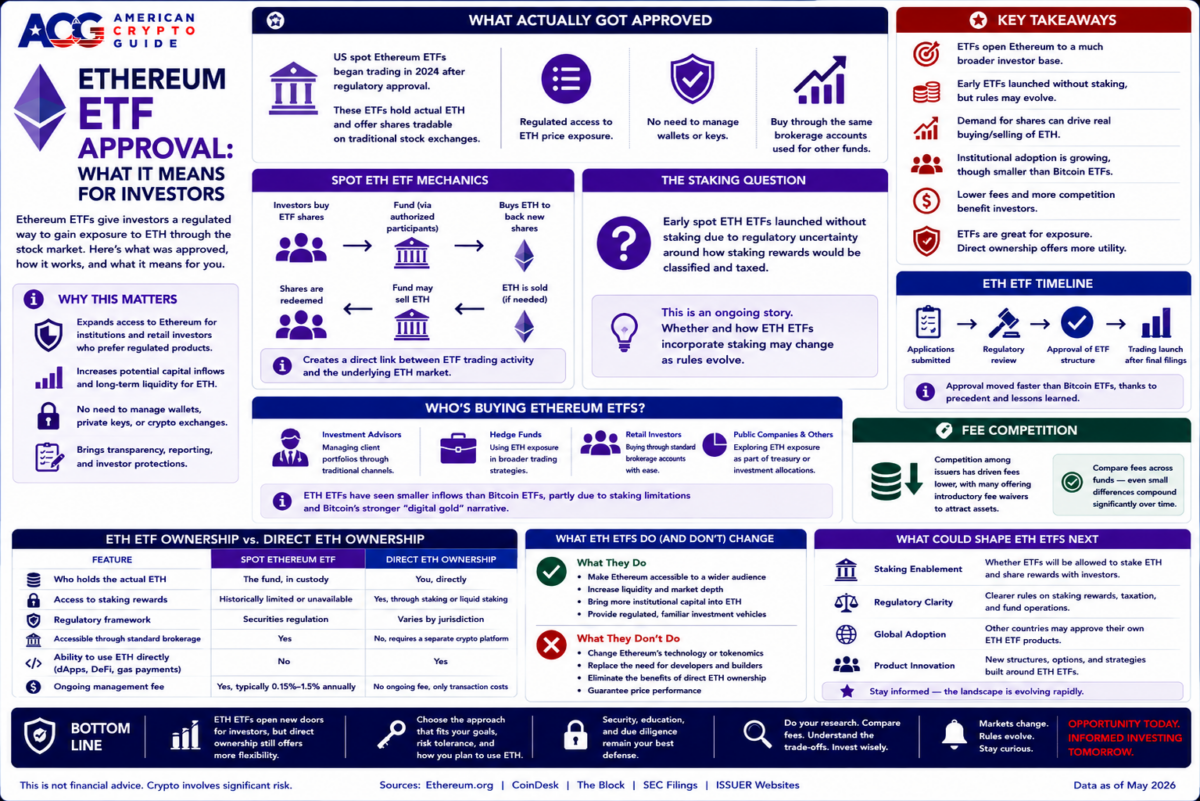
US spot Ethereum ETFs began trading in 2024, following regulatory approval that let fund issuers launch products holding actual ETH and offering shares tradable on traditional stock exchanges. As with Bitcoin’s earlier ETF approval, this gave investors a regulated way to gain price exposure to Ethereum without directly managing a wallet, private keys, or a crypto exchange account — buying shares through the same brokerage infrastructure used for any other traditional fund.
 You might also likeWhat Is Bitcoin? A Complete Beginner’s Guide
Spot ETH ETF mechanics
A spot Ethereum ETF holds actual ETH in custody and issues shares representing a proportional claim on those holdings, with the fund’s share price designed to track ETH’s market price closely. When investor demand for shares increases, the fund (through authorized participants) typically needs to acquire additional ETH to back new shares; when shares are redeemed, the reverse can occur. This creates a direct, if not always immediate, link between fund-level trading activity and actual buying and selling in the underlying ETH market — the same basic mechanism that governs spot Bitcoin ETFs.
The staking question that made ETH ETFs genuinely different
This is where Ethereum’s ETF story diverges meaningfully from Bitcoin’s. Because Ethereum uses proof of stake, ETH held anywhere — including within an ETF’s custody — could theoretically be staked to earn additional rewards, on top of any price appreciation. Early spot Ethereum ETFs launched without staking capability, largely due to regulatory uncertainty about how staking rewards would be classified and taxed within a fund structure. This meant early ETF holders received price exposure to ETH but missed out on the staking yield direct holders (or those using liquid staking) could access separately.
Worth understanding as an ongoing story, not a settled fact: whether and how ETH ETFs eventually incorporate staking has been an active area of regulatory discussion, with different outcomes possible as rules evolve. This is a meaningful, ETH-specific consideration that simply doesn’t apply to Bitcoin ETFs, since Bitcoin has no equivalent staking mechanism.
Timeline: how the approval happened
Ethereum ETF approval followed a similar regulatory arc to Bitcoin’s, though compressed into a shorter window given the precedent Bitcoin’s approval had already set. Initial approval covered the fund structures themselves, with actual trading launch following shortly after issuers completed remaining registration requirements. The relatively fast follow-through, compared to the multi-year process Bitcoin ETFs went through, reflected regulators applying lessons and precedent from the Bitcoin approval process rather than starting entirely from scratch.
Who’s actually buying Ethereum ETFs
Similar to Bitcoin ETF ownership patterns, Ethereum ETF holders span registered investment advisors managing client portfolios, hedge funds incorporating ETH exposure into broader strategies, and direct retail investors using standard brokerage accounts. Institutional filings disclosing fund ownership have shown a genuinely diverse buyer base, though Ethereum ETFs have generally seen smaller total inflows than their Bitcoin counterparts — a gap partly attributed to Bitcoin’s longer-established «digital gold» narrative among traditional investors, and partly to the staking limitation discussed above making direct ETH ownership comparatively more attractive to some institutional holders who specifically want staking yield.
Fee competition among issuers
As with Bitcoin ETFs, competition among Ethereum ETF issuers has pushed management fees down from initial levels, with several providers offering promotional fee waivers to attract early assets. Comparing fees across competing funds offering essentially the same core exposure remains worthwhile for any investor choosing between them, since even a modest difference in annual management fee compounds meaningfully for long-term holders.
Comparing ETH ETF ownership to direct ETH ownership
| Spot Ethereum ETF | Direct ETH ownership | |
|---|---|---|
| Who holds the actual ETH | The fund, in custody | You, directly |
| Access to staking rewards | Historically limited or unavailable | Yes, through staking or liquid staking |
| Regulatory framework | Securities regulation | Varies by jurisdiction |
| Accessible through standard brokerage | Yes | No, requires a separate crypto platform |
| Ability to use ETH directly (dApps, DeFi, gas payments) | No | Yes |
| Ongoing management fee | Yes, typically 0.15%-1.5% annually | No ongoing fee, only transaction costs |
What ETH ETFs don’t capture about Ethereum specifically
Beyond the staking yield gap, ETF ownership misses several dimensions specific to Ethereum’s broader ecosystem role. ETH is not just a speculative asset within Ethereum’s own network — it’s the currency required to pay gas fees, provide liquidity in DeFi protocols, and interact with the thousands of applications built on the network. An ETF share captures none of this functional utility; it’s purely a price-tracking instrument. For investors who see Ethereum’s value tied specifically to its role as the «fuel» for a growing application ecosystem, rather than purely as a price-appreciation asset, this distinction is worth weighing directly rather than assuming an ETF share and directly held ETH represent equivalent exposure to «Ethereum» as a whole.
📬Did you like this article?
Subscribe and receive our posts directly in your inbox. Free!
Sin spam. Puedes darte de baja cuando quieras.
How ETH ETF flows get interpreted by the market
Similar to Bitcoin, financial media tracks daily and weekly net flows into Ethereum ETFs as an institutional sentiment signal. The same caveat that applies to Bitcoin ETF flow data applies here too: not every dollar of gross inflow represents a simple directional bet on price, since some institutional activity involves hedged or market-neutral strategies using ETF shares as one component of a broader position. Treating flow data as a useful but imperfect signal, rather than a direct, one-to-one measure of bullish sentiment, produces a more accurate read of what the numbers actually represent.
The global ETF landscape for Ethereum
Beyond the US, other jurisdictions had already launched Ethereum-holding exchange-traded products before the US approval, including in Canada and parts of Europe, following the same general pattern seen with Bitcoin products. This broader global availability reinforces the same underlying trend across both major cryptocurrencies: regulated, exchange-traded access has expanded considerably beyond crypto-native platforms, giving traditional investors multiple regulated pathways to gain exposure depending on their home market.
What this means practically for different types of investors
- Investors who want simple, regulated price exposure without managing a wallet: an ETH ETF remains a straightforward option, accessible through existing brokerage infrastructure.
- Investors who specifically want staking yield alongside price exposure: direct ETH ownership, staked or through a liquid staking provider, has historically offered access to a reward stream ETF shares haven’t fully captured.
- Investors managing funds through retirement or advisor-managed accounts that can’t hold crypto directly: an ETF may be the only practical regulated pathway available, regardless of the staking trade-off.
- Investors who value Ethereum’s functional utility within its own ecosystem (using ETH for gas, DeFi, or dApp interaction) rather than purely as a portfolio holding: an ETF fundamentally can’t provide this, since shares aren’t usable ETH.
Why some analysts expected slower ETH ETF adoption than Bitcoin’s
Beyond the staking gap, several analysts pointed to Ethereum’s more complex investment narrative as a contributing factor in its comparatively slower institutional uptake following approval. Bitcoin’s «digital gold» framing has had over a decade to embed itself in mainstream financial commentary, giving traditional investors and advisors a simple mental model to reach for. Ethereum’s value proposition — a platform for smart contracts, DeFi, and a broad application ecosystem — requires more explanation to convey in the same brief pitch, which some analysts argue has made it a comparatively harder sell to advisors managing client portfolios who want a straightforward narrative before recommending an allocation. This isn’t a judgment on which narrative is more accurate, only an observation about which one has been easier to communicate quickly in a traditional finance context.
The US Securities and Exchange Commission maintains its own documentation on exchange-traded product regulation at https://www.sec.gov/investor, a useful primary source for understanding the regulatory framework governing both Bitcoin and Ethereum ETFs as that framework continues to evolve.
How custody differs behind the scenes for staked and unstaked ETH
For investors curious about the operational side, the distinction between staked and unstaked ETH custody within a fund structure isn’t just a regulatory formality — it reflects genuinely different technical and risk considerations. Unstaked ETH held by a custodian is relatively straightforward: it sits in cold storage, similar in principle to how a Bitcoin ETF custodian holds Bitcoin. Staked ETH, by contrast, requires actively running or delegating to validator infrastructure, introduces exposure to slashing risk if a validator misbehaves or goes offline, and involves a withdrawal queue that can affect how quickly a fund could liquidate staked positions to meet redemption requests. These operational complexities are part of why staking integration took longer to resolve for ETH ETFs than simply launching a spot fund holding unstaked ETH, and why any eventual staking-enabled fund structure needs to account for liquidity and risk management considerations that a pure spot Bitcoin fund never had to solve.
Ethereum ETF approval extended the same kind of regulated, brokerage-accessible pathway that Bitcoin ETFs opened a year earlier, but with a genuinely Ethereum-specific wrinkle: the staking yield question, which has no Bitcoin equivalent and has shaped how directly comparable ETH ETF ownership actually is to holding ETH yourself. Understanding that distinction — not just the headline fact that ETH ETFs exist — is what separates a surface-level read of this development from actually understanding what an investor gains, and gives up, by choosing an ETF over direct ownership.