How Does Bitcoin Mining Work? Full Explanation

The short version, before the technical one
Bitcoin mining is the process of adding new transactions to Bitcoin’s public ledger and, in return, earning newly created Bitcoin as a reward. It’s done by computers competing to solve a difficult math puzzle, and whoever solves it first gets to add the next «block» of transactions. That’s the entire idea in two sentences — everything below just explains why it works this way, and why it matters even if you never plan to mine anything yourself.
 You might also likeWhat Is Bitcoin? A Complete Beginner’s Guide
If some of the vocabulary here — blockchain, private key, wallet — feels unfamiliar, our guide on what Bitcoin actually is is worth reading first, since mining only makes sense once the ledger itself does.
Where mining fits in the bigger picture
Every Bitcoin transaction gets broadcast to a network of computers worldwide. Before it becomes permanent, it needs to be grouped with other pending transactions into a block, and that block needs to be added to the chain of every block before it — which is where the name blockchain comes from. Mining is simply the mechanism that decides who gets to add the next block, and makes cheating that process prohibitively expensive.
The three jobs miners actually do
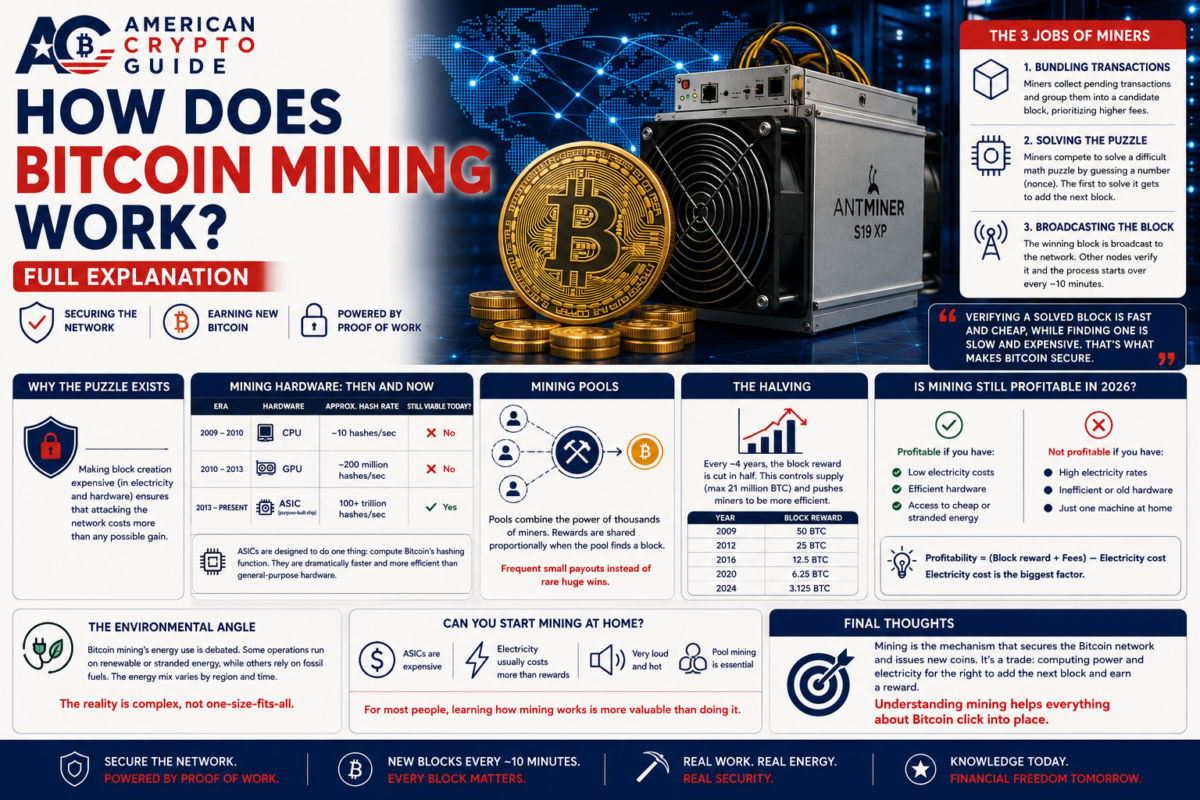
Bundling transactions
Miners collect pending transactions waiting to be confirmed and assemble them into a candidate block, prioritizing ones that pay a higher fee — this is why fees rise when the network is busy.
Solving the puzzle (proof of work)
This is the part people picture when they think of «mining.» Miners’ computers repeatedly guess a number (called a nonce) and run it through a cryptographic function, trying to produce an output below a specific target value. There’s no shortcut — it’s pure trial and error at enormous speed, measured in hashes per second. Whoever finds a valid answer first wins the right to add their block.
Broadcasting the winning block
Once a miner finds a valid answer, they broadcast the completed block to the rest of the network. Other nodes independently verify it follows every rule before accepting it, and the process starts over for the next block — roughly every 10 minutes.
This is the part worth sitting with: verifying a solved block is fast and cheap, while finding one is slow and expensive. That asymmetry is the entire security model — it’s what makes rewriting Bitcoin’s history require more computing power than exists on Earth outside the network itself.
Why the puzzle exists at all
It would be far simpler to let anyone add blocks whenever they want. The problem is that anyone could then rewrite history or approve fraudulent transactions. By making block creation expensive — in electricity and hardware — the system ensures that attacking it costs more than any reasonable reward for doing so. This approach is called proof of work, and it’s the same mechanism described in Bitcoin’s original 2008 design document, still hosted at <bitcoin.org>.
Mining hardware, then and now
Mining hardware has gone through three distinct eras, each making the previous one obsolete for serious mining:
📬Did you like this article?
Subscribe and receive our posts directly in your inbox. Free!
Sin spam. Puedes darte de baja cuando quieras.
| Era | Hardware | Approx. hash rate | Still viable for mining today? |
|---|---|---|---|
| 2009–2010 | CPU (regular computer) | ~10 hashes/sec | No |
| 2010–2013 | GPU (graphics card) | ~200 million hashes/sec | No |
| 2013–present | ASIC (purpose-built chip) | 100+ trillion hashes/sec | Yes |
ASICs (Application-Specific Integrated Circuits) are chips designed to do exactly one thing — compute Bitcoin’s specific hashing function — and nothing else, which makes them dramatically faster and more power-efficient than general-purpose hardware. This also means a regular laptop or gaming PC today contributes an immeasurably small, effectively zero, chance of mining a block.
Mining pools — why solo mining basically doesn’t happen anymore
Given how much computing power currently secures the network, an individual miner working alone might wait years, statistically, before ever finding a block. Mining pools solve this by combining thousands of miners’ hardware together, sharing out the reward proportionally whenever any member of the pool finds a block. It trades a rare huge payout for frequent small ones — the mining equivalent of a lottery syndicate.
The halving and its effect on miners
Roughly every four years, an event called the halving cuts the block reward in half — from 50 BTC per block at Bitcoin’s start, down through 25, 12.5, 6.25, and 3.125 today. This is a hard-coded part of Bitcoin’s design, capping total supply at 21 million coins. For miners, each halving directly cuts revenue from block rewards, forcing less efficient operations to shut down and pushing the remaining miners toward newer hardware and lower electricity costs to stay profitable.
Is mining still profitable in 2026?
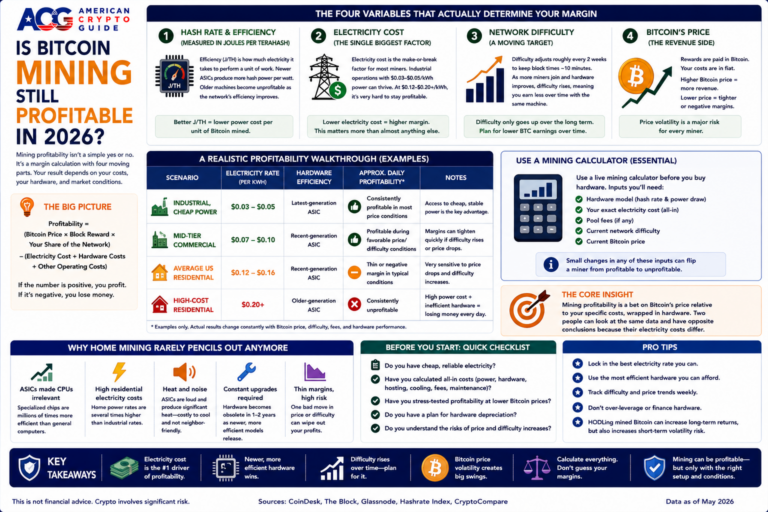
It depends almost entirely on two numbers most beginners underestimate: electricity cost and hardware efficiency. Large mining operations in regions with cheap electricity — often near hydroelectric, geothermal, or stranded natural gas sources — can remain profitable even as competition and difficulty rise. A hobbyist plugging a single modern ASIC into residential power in a country with average electricity rates, on the other hand, will typically find the electricity cost alone exceeds what they’d earn.
The environmental angle, briefly and fairly
Bitcoin mining’s electricity use is a genuinely debated topic, not a settled one. Critics point to its total energy consumption, comparable to that of some mid-sized countries. Supporters point to a growing share of mining running on renewable or otherwise stranded energy that would have gone unused. Both facts can be true at once, and the honest summary is that the energy mix varies significantly by region and operation — it isn’t a single fixed answer.
Can you start mining at home?
Technically yes, but realistically it’s rarely worthwhile for an individual today:
- Buying an ASIC costs anywhere from several hundred to several thousand dollars, and newer, more efficient models are released regularly.
- Electricity costs at typical residential rates usually outpace expected rewards for a single machine.
- Noise and heat from ASIC miners are significant — most are far too loud for a typical living space.
- Joining a pool is essentially required, since solo mining odds are negligible for one machine.
For most people curious about mining, understanding how it works — which this guide covers — is far more useful than actually attempting it at home.
Final thoughts
Bitcoin mining can sound like an abstract, almost mystical process from the outside, but it’s really a straightforward trade: computing power and electricity, exchanged for the right to add the next block and a share of newly created Bitcoin. Understanding that trade is what makes concepts like the halving, network security, and even Bitcoin’s price behavior click into place — mining isn’t a side detail of how Bitcoin works, it’s the mechanism the entire system depends on.