
What Determines the Price of Bitcoin?


There’s no «price setter» — here’s what that actually means
Unlike a stock, Bitcoin has no company setting a price target, no earnings report to react to, and no central authority deciding what it’s worth. Its price is simply whatever the last trade on an exchange settled at, continuously, 24 hours a day, across thousands of markets worldwide. That sounds almost too simple to be useful — but it’s actually the entire explanation for why Bitcoin behaves so differently from traditional assets: there’s no closing bell, no earnings season, and nothing pausing the market while new information gets absorbed.
 You might also likeWhat Is Bitcoin? A Complete Beginner’s Guide
Supply: the one variable that never changes on the fly
Bitcoin’s supply schedule is fixed in its code and can’t be adjusted by any company, government, or vote. New coins enter circulation only through mining rewards, which get cut in half roughly every four years in an event called the halving. This is the opposite of how most currencies work — a central bank can decide to print more dollars in response to economic conditions; Bitcoin’s issuance schedule was decided in 2009 and hasn’t changed since.
Worth sitting with: because supply is essentially fixed and predictable years in advance, almost all of Bitcoin’s price volatility comes from the demand side of the equation — not surprises in supply, the way an oil price shock or a crop failure might move a commodity.
Demand: the five forces that actually move it
Retail buying and selling
Individual buyers and sellers, often reacting to news, social media sentiment, or simple fear of missing out, create constant smaller-scale price movement — particularly visible during periods of heavy retail attention.
Institutional flows
Large purchases and sales by hedge funds, corporations, and asset managers move meaningfully more volume per transaction than retail activity. The introduction of spot Bitcoin ETFs in the United States, for example, gave traditional institutional investors a regulated way to gain exposure without holding Bitcoin directly — a structural shift that added a new, steady source of demand.
Macro conditions
Interest rate decisions, inflation data, and broader risk appetite across financial markets all influence how much capital flows toward higher-risk assets, Bitcoin included. When investors are feeling cautious, riskier assets — Bitcoin among them — often see outflows first.
Regulatory news
Announcements from regulators, whether restrictive or favorable, can move price quickly because they change the addressable market of who’s legally able to buy — from individual countries banning or approving crypto services, to major exchanges gaining or losing licenses.
📬Did you like this article?
Subscribe and receive our posts directly in your inbox. Free!
Sin spam. Puedes darte de baja cuando quieras.
Narrative and sentiment
Bitcoin has gone through distinct public narratives over its history — «digital gold,» «inflation hedge,» «speculative asset,» «institutional store of value» — and which narrative dominates at a given time shapes who’s buying and why, independent of any single hard fact.
The halving’s indirect effect on price
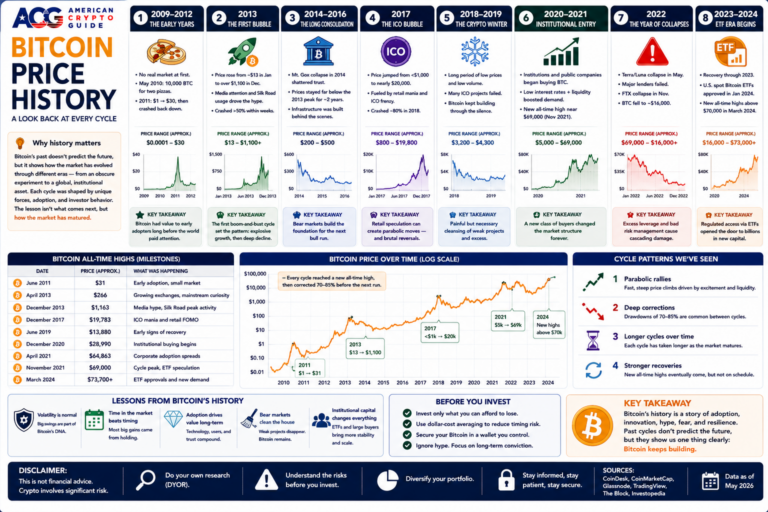
The halving doesn’t move price by itself — it’s a scheduled, publicly known event, so in an efficient market it shouldn’t be a surprise. What it does do is reduce the rate of new supply entering circulation, meaning that if demand stays constant or grows, the same buying pressure now competes for a smaller flow of new coins. Historically, halvings have preceded major price cycles, though correlation here is heavily debated among analysts — plenty of other macro and demand factors shift around the same multi-year windows.
Bitcoin vs other assets — what actually correlates
| Asset | Typical relationship to Bitcoin’s price | Why |
|---|---|---|
| US tech stocks (Nasdaq) | Moderate positive correlation, especially since 2020 | Both treated as «risk-on» assets by many institutional investors |
| Gold | Weak, inconsistent correlation | Both marketed as inflation hedges, but behave differently in practice |
| US dollar strength | Often inverse correlation | A stronger dollar typically reduces demand for alternative assets |
| Interest rates | Generally inverse correlation | Higher rates make low-risk yield more attractive relative to volatile assets |
None of these correlations are fixed laws — they shift over time as the investor base and macro environment change, which is part of why price prediction based purely on historical correlation is unreliable.
Why volatility is a feature of the system, not a flaw
Bitcoin’s relatively small total market size compared to traditional asset classes like global equities or bonds means the same dollar amount of buying or selling moves its price proportionally further. Add a market that trades continuously with no circuit breakers, and price swings of 5–10% in a single day aren’t unusual, even without major news. This isn’t a malfunction — it’s the direct, expected result of a smaller, always-open, sentiment-sensitive market.
Common price myths worth retiring
- «A big investor can single-handedly control the price.» Large holders (often called «whales») can influence price on short timeframes, but the market is far too large and globally distributed for any single actor to control it long-term.
- «The price only goes up in a bull market and only down in a bear market.» Both directions see sharp counter-trend moves; the labels describe the overall trend, not every individual week.
- «Price predictions from analysts are reliable.» Long-range Bitcoin price predictions have a poor historical track record across the board — useful for understanding an argument’s reasoning, not for planning around as fact.
- «More exchanges listing Bitcoin directly pushes the price up.» Listings increase accessibility, which can support demand over time, but don’t move price directly the way a large buy order does.
How to actually track it without falling for noise
- Watch the trend, not the tick. Daily price alerts create anxiety without adding useful information; weekly or monthly trend context tells you more.
- Separate price from adoption metrics. Wallet growth, transaction volume, and institutional flows often tell a clearer long-term story than the price chart alone.
- Be skeptical of single-cause explanations. Financial media often attributes a price move to one headline; in reality it’s almost always several forces overlapping at once.
- Use reputable, transparent data sources rather than social media sentiment alone — trackers like https://www.blockchain.com/explorer show on-chain activity directly, independent of any single narrative.
Final thoughts
Bitcoin’s price isn’t random, but it also isn’t governed by any single clean formula — it’s the constantly shifting balance between a fixed, predictable supply and a demand side influenced by retail sentiment, institutional flows, macro conditions, regulation, and prevailing narrative, all trading around the clock with no pause button. Understanding why it moves the way it does is far more useful than trying to predict exactly where it’s headed next.