Is Bitcoin Mining Still Profitable in 2026?

The profitability question in one framework
Whether Bitcoin mining is profitable isn’t a single yes-or-no answer — it’s a margin calculation with four moving parts, and the answer changes completely depending on where you sit on each one. A large operation with industrial electricity contracts and the newest hardware can mine profitably in conditions where a hobbyist with a single machine on residential power loses money every single day. This article breaks down exactly which variables matter and how they interact, rather than offering a single verdict that won’t actually apply to your specific situation.
 You might also likeWhat Is Bitcoin? A Complete Beginner’s Guide
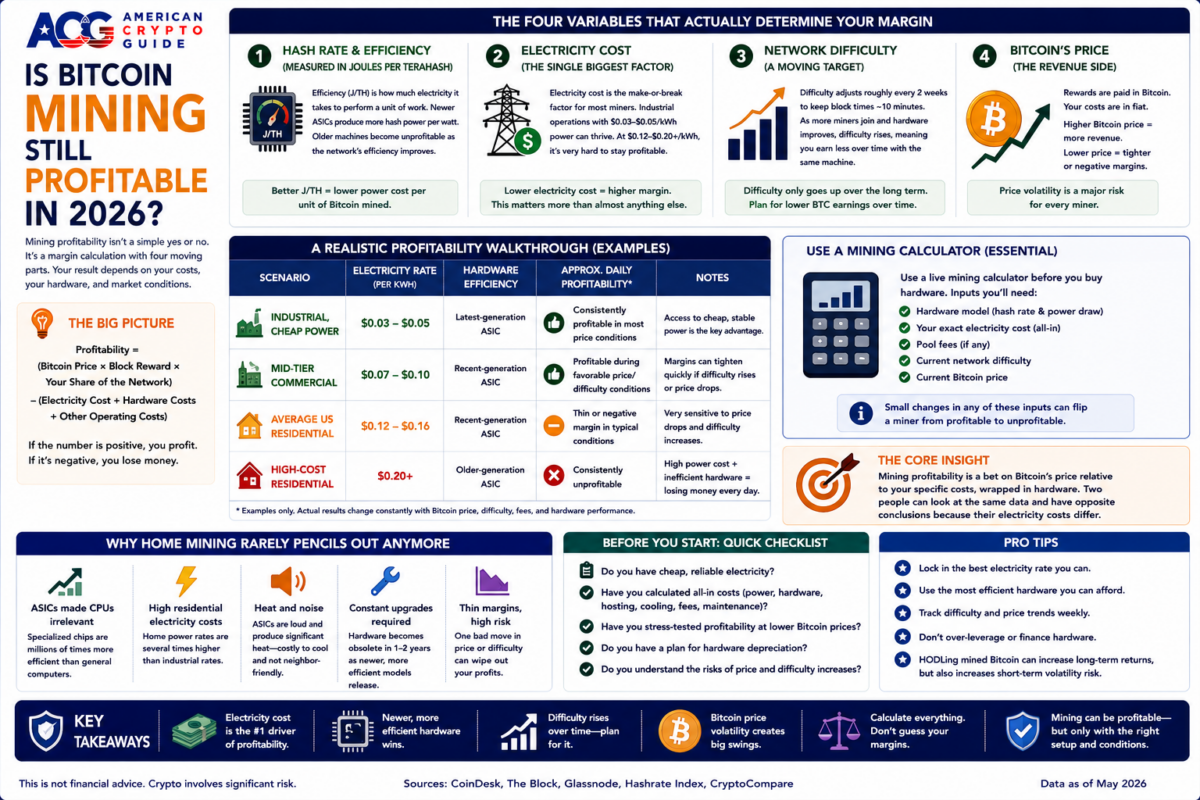
The four variables that actually determine your margin
Hash rate and efficiency (measured in joules per terahash)
Modern mining hardware is compared primarily on efficiency — how much electricity it consumes per unit of computing power, measured in joules per terahash (J/TH). Newer ASIC models consistently deliver more hashing power per watt than older generations, meaning two miners with identical electricity costs can have dramatically different margins simply based on hardware age. Older, less efficient machines that were profitable years ago often become unprofitable as newer hardware raises the network-wide efficiency bar, even without any change in electricity price.
Electricity cost — the single biggest factor for most miners
For the overwhelming majority of mining operations, electricity cost is the dominant variable in the profitability equation, often mattering more than every other factor combined. Industrial-scale operations in regions with cheap electricity — frequently near hydroelectric, geothermal, or otherwise stranded energy sources — can remain profitable at electricity rates a fraction of typical residential pricing. A miner paying average US residential electricity rates, by contrast, often finds the electricity cost alone exceeds expected mining revenue for anything short of the newest, most efficient hardware.
Network difficulty — a moving target that only gets harder
Bitcoin’s mining difficulty adjusts roughly every two weeks to keep block discovery at approximately 10 minutes regardless of how much total computing power (hash rate) is competing on the network. As more miners join and hardware improves industry-wide, difficulty rises, meaning the same hardware earns progressively less over time unless Bitcoin’s price rises enough to compensate. This is a structural headwind every miner faces, not a one-time consideration.
Bitcoin’s price — the revenue side of the equation
Mining costs (hardware and electricity) are largely fixed in real-world currency terms, while mining rewards are paid in Bitcoin. This means profitability is directly exposed to Bitcoin’s price: the exact same mining operation can be solidly profitable during a price rally and lose money during a downturn, without a single change to the hardware or electricity setup.
Worth internalizing as the core insight: mining profitability is really a bet on Bitcoin’s price relative to your specific costs, wrapped in hardware. Two people can look at identical difficulty and price data and reach opposite profitability conclusions, simply because their electricity costs differ by a factor of five or more.
A realistic profitability walkthrough with real numbers
| Scenario | Electricity rate | Hardware efficiency | Approximate daily profitability |
|---|---|---|---|
| Industrial, cheap power | $0.03–$0.05/kWh | Latest-generation ASIC | Consistently profitable in most price conditions |
| Mid-tier commercial | $0.07–$0.10/kWh | Recent-generation ASIC | Profitable during favorable price/difficulty conditions |
| Average US residential | $0.12–$0.16/kWh | Recent-generation ASIC | Thin or negative margin in typical conditions |
| High-cost residential | $0.20+/kWh | Older-generation ASIC | Consistently unprofitable |
These figures shift constantly as difficulty, price, and hardware efficiency change — the table illustrates the relationships between the variables rather than fixed numbers to rely on indefinitely. Live mining profitability calculators, which factor in current difficulty and price data, are the correct tool for an up-to-date estimate for any specific hardware and electricity rate combination.
Why home mining rarely pencils out anymore
Bitcoin mining’s earliest years genuinely could be profitable on a regular home computer. That window closed permanently once ASIC hardware — chips built to do nothing but Bitcoin’s specific hashing function — made general-purpose computers millions of times less competitive by comparison. Beyond the hardware gap, home mining faces additional practical headwinds: residential electricity rates are almost always higher than industrial rates, ASIC miners produce substantial heat and noise unsuited to most living spaces, and a single home-scale machine has a vanishingly small chance of finding a block on its own without joining a mining pool.
Where profitable mining actually happens today
Profitable mining in 2026 is concentrated in large-scale operations specifically located for cheap, reliable electricity — hydroelectric regions, areas with excess natural gas that would otherwise be flared or wasted, and locations with favorable industrial electricity agreements. These operations benefit from economies of scale in hardware purchasing, dedicated cooling infrastructure, and electricity contracts individual hobbyists simply can’t access. This concentration is part of why mining, despite Bitcoin’s decentralized design, has increasingly become an industrial-scale business rather than a hobbyist activity.
📬Did you like this article?
Subscribe and receive our posts directly in your inbox. Free!
Sin spam. Puedes darte de baja cuando quieras.
Mining pools and their effect on realistic returns
Given the odds involved, almost all miners — even mid-sized operations — participate in mining pools, combining computing power with many other participants and sharing rewards proportionally whenever any pool member finds a block. Pools typically charge a small fee, usually 1-3%, for this service, which factors directly into net profitability calculations. Solo mining outside a pool remains technically possible but is realistically only sensible for extremely large operations with enough hash rate to have a meaningful independent chance of finding blocks.
The halving’s compounding effect on margins
Roughly every four years, Bitcoin’s halving event cuts the block reward paid to miners in half, directly reducing revenue for identical hardware and electricity costs. Historically, halvings have forced less efficient miners — those with older hardware or higher electricity costs — out of profitability, concentrating mining further among the most efficient operations. Anyone evaluating mining profitability today should factor in where the next halving sits on the calendar and model how that reward reduction would affect their specific margin, not just current conditions.
Cloud mining — a profitability trap worth understanding
Cloud mining services let you pay for a share of remote mining capacity without owning hardware directly, marketed as a passive way to participate in mining profitability. In practice, this category has a long, well-documented history of scams and unprofitable contracts, where the service’s own fees consistently exceed any realistic mining returns passed on to customers. Legitimate cloud mining does exist, but the ratio of scams to genuine, profitable offerings in this specific category has historically been poor enough that extensive independent research — well beyond a provider’s own marketing claims — is essential before committing any funds.
Tax treatment can quietly erase apparent profitability
A frequently overlooked factor in mining profitability calculations is tax treatment, which varies by jurisdiction but commonly involves two separate taxable events: mined coins are often treated as ordinary income at their value the moment they’re received, and any later sale is treated as a separate capital gains event based on how the price moved since. A mining operation that looks profitable purely on an electricity-versus-revenue basis can look considerably less attractive once the tax obligation on newly mined coins is factored in, particularly in jurisdictions with high ordinary income tax rates. This is worth modeling explicitly rather than assuming mining profitability calculators — which typically focus on the hardware and electricity side alone — already account for it, since most don’t.
How rising institutional mining changes the competitive landscape
Publicly traded mining companies have grown substantially in recent years, bringing access to capital markets, larger-scale electricity contracts, and hardware purchasing power that individual and small-scale miners simply can’t match. This institutional growth has a direct effect on network difficulty: as these larger operations add hash rate, difficulty rises faster than it might in a market dominated by smaller, independent miners, compressing margins further for anyone without comparable scale advantages. It’s part of why the profitability gap between industrial-scale and hobbyist mining has widened considerably compared to Bitcoin’s earlier years, when the playing field was meaningfully more level.
A simple checklist before considering mining as an investment
- Know your actual electricity rate, not an assumed or average figure, since this single number often determines profitability more than any other factor.
- Calculate using current network difficulty and price, not historical figures, since both shift constantly and meaningfully affect the outcome.
- Factor in hardware depreciation and eventual obsolescence, not just the upfront purchase cost, since mining hardware has a limited competitive lifespan as newer models release.
- Account for pool fees in any profitability estimate, since solo mining is unrealistic for all but the largest operations.
- Model a range of Bitcoin price scenarios, not just current price, given how directly mining revenue depends on it.
- Compare mining’s realistic return against simply buying Bitcoin directly, since for most individuals, direct purchase avoids the hardware, electricity, and depreciation risk mining specifically introduces.
For live, continuously updated profitability calculations that account for current difficulty and price, tools like the one published by CoinWarz at https://www.coinwarz.com/mining/bitcoin/calculator factor in real-time network data rather than relying on static assumptions.
Final thoughts
Bitcoin mining profitability in 2026 isn’t a fixed fact — it’s a live calculation depending heavily on electricity cost, hardware efficiency, network difficulty, and Bitcoin’s price, all of which shift continuously. For most individuals outside of industrial-scale operations with genuinely cheap electricity, mining has become a considerably harder business case to justify than it once was — which is worth knowing clearly before treating it as a straightforward way to acquire Bitcoin rather than the specialized, capital-intensive business it’s actually become.