How to Reduce Ethereum Gas Fees

The two levers you actually control
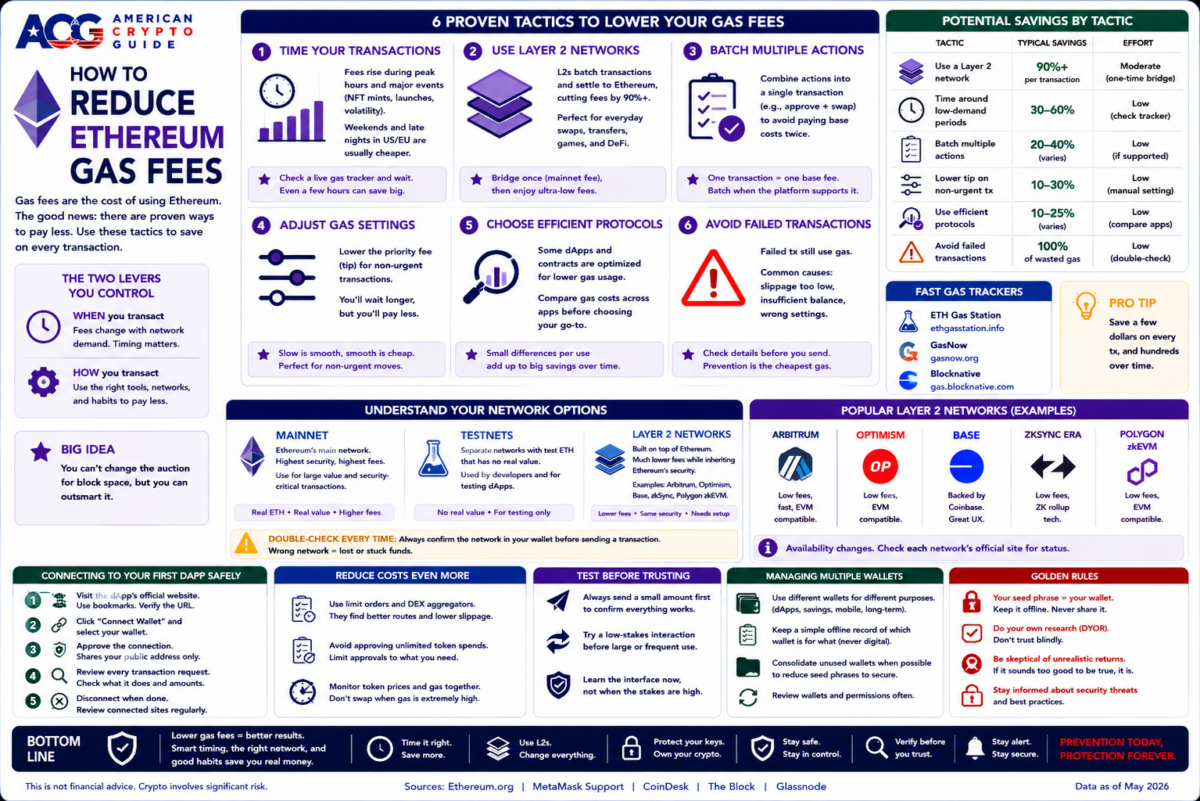
Gas fees on Ethereum come down to two things you can genuinely influence: when you transact, and how you transact. You can’t change the underlying auction for block space, but you can time your activity around it, choose infrastructure that sidesteps mainnet congestion entirely, and avoid unnecessary transactions that add up over time. This guide covers each practical lever in order of how much impact it typically has.
Tactic 1: Timing transactions around network demand
Ethereum’s gas fees rise and fall with real-time network activity, and that activity follows recognizable patterns. Weekday activity during peak hours in major time zones — particularly overlapping US and European business hours — tends to run higher than weekends or late-night hours in those regions. Major NFT mints, token launches, and periods of broad market volatility also reliably spike fees well above typical levels. For any transaction that isn’t time-sensitive, checking a live gas tracker before sending and simply waiting a few hours can meaningfully reduce the fee paid, sometimes by more than half.
Tactic 2: Using Layer 2 networks for everyday activity
This is the single highest-impact tactic available today. Layer 2 networks — separate chains built on top of Ethereum that batch many transactions together before settling back to the main chain — routinely offer fees a fraction of mainnet costs, often under $0.10 for a simple transaction compared to several dollars or more on mainnet during normal demand. Moving routine, frequent activity to a Layer 2 network while reserving mainnet for higher-value or security-critical transactions addresses the fee problem at its structural root, rather than just optimizing around mainnet’s inherent constraints.
Worth understanding before switching: using a Layer 2 network requires moving funds there first, typically through a bridge transaction, which itself costs mainnet gas. This one-time cost is usually worth it if you plan to make several subsequent transactions on the Layer 2 network, but it’s a real cost to factor into the decision, not a free switch.
Tactic 3: Batching multiple actions into one transaction
Where a platform supports it, combining several intended actions into a single transaction — rather than sending them separately — reduces the base overhead cost paid once per transaction, even though the total computational work is similar. Some DeFi platforms and wallet features specifically support this kind of batching for common multi-step actions, like approving a token and then using it in the same flow, cutting what would otherwise be two separate gas payments down to one.
Tactic 4: Adjusting gas settings manually for non-urgent transactions
Most wallets let you manually adjust the priority fee (tip) below the automatically suggested default, accepting a longer expected confirmation time in exchange for a lower cost. For a transaction with no real urgency — moving funds between your own wallets, for instance — deliberately setting a lower tip and accepting a wait of a few extra minutes (or longer, during quiet periods) can meaningfully reduce cost compared to accepting the wallet’s default «fast» estimate every time.
Tactic 5: Choosing gas-efficient protocols and interfaces
Not all smart contracts are written with equal efficiency, and some decentralized applications are specifically optimized to minimize the computational work — and therefore gas cost — required for common actions, while others are built with less attention to this detail. For frequent actions like token swaps, comparing the actual gas cost across a few different platforms offering the same core function before settling on one as your default can reveal meaningful, recurring savings over time.
📬Did you like this article?
Subscribe and receive our posts directly in your inbox. Free!
Sin spam. Puedes darte de baja cuando quieras.
Tactic 6: Avoiding failed transactions
A transaction that fails partway through — due to a price moving beyond your slippage tolerance, insufficient balance, or a smart contract condition not being met — still consumes the gas used up to the point of failure, without completing anything useful. Double-checking transaction parameters, particularly slippage tolerance settings on swaps and sufficient balance for both the transaction amount and its gas cost, avoids this specific, entirely avoidable source of wasted spending.
Comparing potential savings by tactic
| Tactic | Typical savings potential | Effort required |
|---|---|---|
| Using a Layer 2 network | 90%+ per transaction | Moderate (one-time bridge setup) |
| Timing around low-demand periods | 30-60% | Low (checking a tracker before sending) |
| Batching multiple actions | Varies, often 20-40% combined | Low, if platform supports it |
| Manually lowering tip on non-urgent transactions | 10-30% | Low |
| Choosing more gas-efficient protocols | Varies by platform, sometimes significant | Low, requires comparison |
| Avoiding failed transactions | 100% of what would have been wasted | Low, requires careful review before confirming |
Tools that help you time and estimate fees accurately
Live gas tracking tools display current base fee, recommended priority fee tiers, and typical confirmation times at each tier, letting you make an informed decision rather than guessing. Etherscan’s gas tracker, available at https://etherscan.io/gastracker, is a widely used, freely accessible option showing real-time network conditions alongside historical trend data, useful both for immediate decisions and for spotting recurring low-demand windows worth timing future transactions around.
When paying more is actually the right call
Not every situation calls for fee minimization as the top priority. Time-sensitive transactions — claiming a limited-availability opportunity, responding to a liquidation risk in a lending position, or any scenario where delay carries real cost — are worth paying a higher fee to confirm quickly, since the cost of being slow can easily exceed whatever was saved on gas. Similarly, high-value transactions where you specifically want fast, unambiguous confirmation before considering funds settled are reasonable cases for accepting a wallet’s default «fast» fee suggestion rather than manually reducing it.
Common mistakes when trying to save on gas
- Setting the priority fee too low for time-sensitive transactions, resulting in a transaction stuck pending for hours or longer during busy network periods.
- Bridging small amounts to a Layer 2 network where the one-time bridging cost exceeds the fees you’d realistically save through subsequent Layer 2 use — this tactic pays off with volume, not for a single small transaction.
- Ignoring slippage settings on swaps in an attempt to save time, leading to failed transactions that waste the gas already spent.
- Assuming every dApp handles gas equally efficiently, without ever comparing actual costs across similar platforms offering the same core function.
- Manually canceling and resending transactions repeatedly while trying to find the «perfect» low fee, which itself costs gas for each cancellation attempt.
A practical routine for keeping gas costs down over time
- Default to a Layer 2 network for frequent, smaller transactions, reserving Ethereum mainnet for higher-value or security-critical activity.
- Check a live gas tracker before any non-urgent mainnet transaction, and wait for a quieter window when the transaction isn’t time-sensitive.
- Review and adjust default wallet fee settings rather than always accepting the «fast» preset for transactions that don’t actually require speed.
- Double-check transaction parameters before confirming, specifically to avoid the wasted cost of an avoidable failed transaction.
A quick word on gas costs across different transaction types
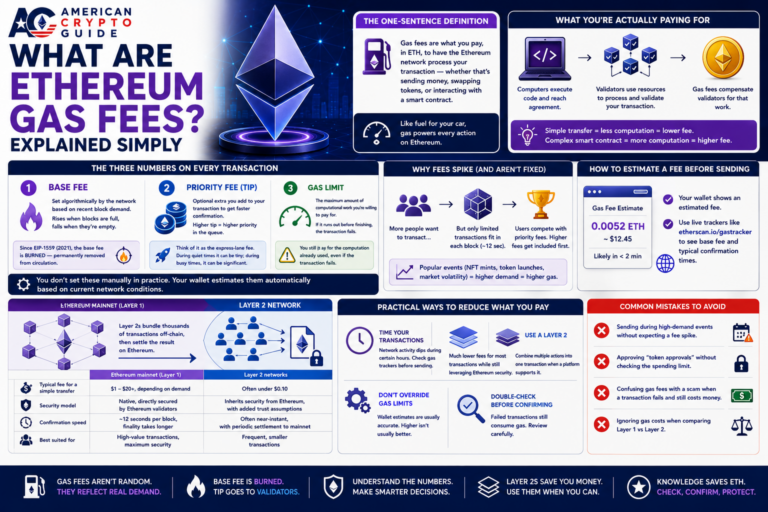
Not every action costs the same amount of gas, even under identical network conditions. A simple ETH transfer between two wallets is the cheapest possible transaction, since it involves minimal computation. Token transfers cost somewhat more, since they involve a smart contract updating a balance record rather than the network’s simplest native transfer mechanism. Complex DeFi interactions — swaps involving multiple pools, lending deposits, or multi-step transactions — cost considerably more, since the EVM has to execute correspondingly more logic. Understanding this hierarchy helps set realistic expectations: no amount of timing or tool use will make a complex multi-step DeFi transaction as cheap as a plain transfer, since the underlying computational cost genuinely differs.
Why gas costs differ so much between similar-looking actions
Two transactions that look identical from a user interface perspective can carry very different gas costs depending on what’s happening underneath. A token swap routed through a single liquidity pool typically costs less than one routed through multiple pools to find the best price, even though both accomplish the same basic goal of exchanging one token for another. Similarly, interacting with a contract for the first time sometimes costs more than subsequent interactions, since certain one-time setup operations (like initializing storage for your account within that specific contract) only need to happen once. Recognizing that the interface’s apparent simplicity doesn’t always reflect the underlying computational complexity helps explain why gas estimates can vary more than expected between seemingly similar actions, even on the same network at the same moment.
Reducing Ethereum gas fees isn’t about finding one clever trick — it’s about applying a small set of consistent habits: shifting routine activity to Layer 2 networks, timing non-urgent mainnet transactions around lower-demand windows, and avoiding avoidable waste from failed transactions. None of these individually eliminates gas fees entirely, since they’re a fundamental part of how Ethereum allocates limited block space — but together, they can meaningfully reduce what you actually pay over time without sacrificing the security and decentralization the fees exist to fund in the first place.