What Are Ethereum Gas Fees? Explained Simply

The one-sentence definition
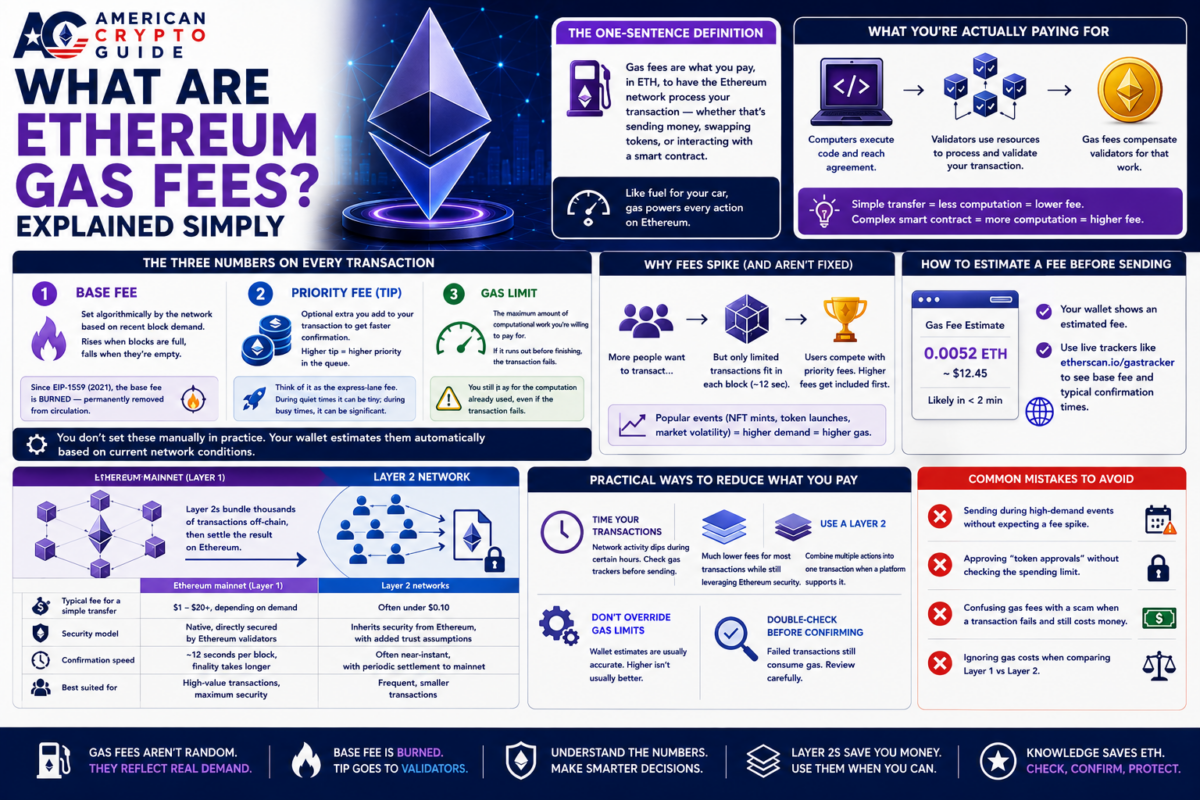
Gas fees are what you pay, in ETH, to have the Ethereum network process your transaction — whether that’s sending money, swapping tokens, or interacting with a smart contract. The name comes from a deliberate analogy: just like a car needs fuel to travel a distance, an Ethereum transaction needs «gas» to be processed, and more complex actions need more of it.
What you’re actually paying for
Every action on Ethereum requires computers around the world to execute code and reach agreement on the result. That computation isn’t free — validators are compensated for the resources spent processing your transaction, and gas fees are how that payment happens. A simple ETH transfer requires relatively little computation; a complex DeFi swap involving multiple smart contracts requires considerably more, which is why fees vary so much between different types of transactions.
The three numbers on every transaction
Base fee
The base fee is set algorithmically by the network itself based on how full recent blocks have been — it rises when demand is high and falls when it’s low. Since a 2021 upgrade called EIP-1559, this portion of every fee is permanently removed from circulation («burned») rather than paid to validators, which is part of what has kept ETH’s overall supply growth close to flat, or even negative, during busy periods.
Priority fee (tip)
The priority fee, or «tip,» is an optional extra amount you can add to have your transaction processed faster, ahead of others in the queue. Think of it as the express-lane fee — during quiet periods it can be negligible; during high-demand moments, a meaningful tip can be the difference between confirmation in the next block or a much longer wait.
Gas limit
The gas limit is the maximum amount of computational work you’re willing to pay for on a given transaction. A simple ETH transfer has a low, fairly standard gas limit; interacting with a complex smart contract requires a higher one, since more computation is involved. If a transaction runs out of allotted gas before completing, it fails — but you still pay for the computation already used, which is why setting a reasonable limit (usually handled automatically by your wallet) matters.
Worth remembering: you don’t manually calculate any of these numbers in practice. Modern wallets estimate them automatically based on current network conditions — but understanding what they represent explains why the fee shown to you changes from one moment to the next, sometimes dramatically.
📬Did you like this article?
Subscribe and receive our posts directly in your inbox. Free!
Sin spam. Puedes darte de baja cuando quieras.
Why fees spike (and why they aren’t a fixed price)
Ethereum processes a limited number of transactions per block, and blocks arrive roughly every 12 seconds. When more people want to transact than the network can process at that moment, they effectively bid against each other through the priority fee — those willing to pay more get included sooner. This is why gas fees spike sharply during popular NFT launches, major DeFi events, or periods of broad market volatility: demand for limited block space temporarily outstrips supply.
How to actually estimate a fee before sending
Most modern wallets show an estimated fee before you confirm any transaction, factoring in the current base fee and a recommended tip based on real-time network conditions. For a rough sense of where fees currently stand, independent trackers like https://etherscan.io/gastracker show live base fee data and typical confirmation times at different tip levels — useful for deciding whether to send a non-urgent transaction now or wait for a quieter moment.
Layer 2s: the modern fix for high fees
Layer 2 networks — separate systems built on top of Ethereum that batch many transactions together before settling the result back on the main network — have become the primary way the ecosystem addresses high gas costs. Instead of every individual transaction competing directly for Ethereum’s limited block space, thousands of Layer 2 transactions get bundled into a single, more efficient settlement on the main chain.
| Ethereum mainnet (Layer 1) | Layer 2 networks | |
|---|---|---|
| Typical fee for a simple transfer | $1–$20+, depending on demand | Often under $0.10 |
| Security model | Native, directly secured by Ethereum validators | Inherits security from Ethereum, with added trust assumptions |
| Confirmation speed | ~12 seconds per block, finality takes longer | Often near-instant, with periodic settlement to mainnet |
| Best suited for | High-value transactions, maximum security | Frequent, smaller transactions |
When gas fees matter more (and less) than people think
Gas fees matter most for frequent, small transactions — the cost can become a meaningful percentage of what you’re actually moving. They matter far less for infrequent, larger transactions, where a few dollars in fees is a rounding error relative to the amount involved. A common beginner mistake is applying the same fee-anxiety to a $10,000 transfer as to a $5 one, when the practical impact is entirely different.
Practical ways to reduce what you pay
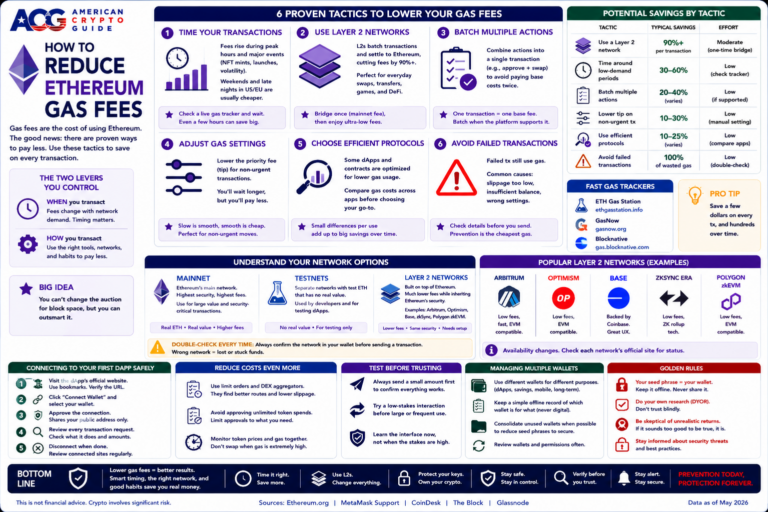
- Time non-urgent transactions for lower-demand periods — network activity tends to dip during certain hours, visible on live gas trackers.
- Use a Layer 2 network for frequent smaller transactions, reserving mainnet for higher-value or security-critical actions.
- Batch multiple actions into a single transaction where a platform supports it, rather than several separate ones.
- Avoid setting an unnecessarily high manual gas limit — most wallets estimate this accurately, and manual overrides rarely help.
- Double-check the transaction before confirming — a failed transaction due to an error still consumes gas without completing anything.
Common mistakes worth avoiding
- Sending a transaction during a known high-demand event (a popular NFT mint, a major token launch) without expecting a fee spike.
- Assuming a «free» transaction promised by a platform means zero gas cost — some platforms subsidize gas, but many simply mean no additional platform fee on top of the standard network gas.
- Confusing gas fees with a scam when a transaction fails and still costs money — this is normal network behavior, not fraud, though it’s worth understanding before it happens to you.
- Ignoring gas costs entirely when comparing Layer 1 versus Layer 2 options for a given task, when the difference can be substantial for frequent use.
Final thoughts
Gas fees can feel like an arbitrary tax on using Ethereum, but they’re really the direct cost of shared, decentralized computation — a market price for limited block space, adjusting in real time to demand. Once the base fee, tip, and gas limit make sense individually, the fee shown on any transaction stops looking random and starts looking like exactly what it is: a live snapshot of how busy the network happens to be right now.