
What Is a Seed Phrase? Complete Beginner’s Guide

The one-sentence definition
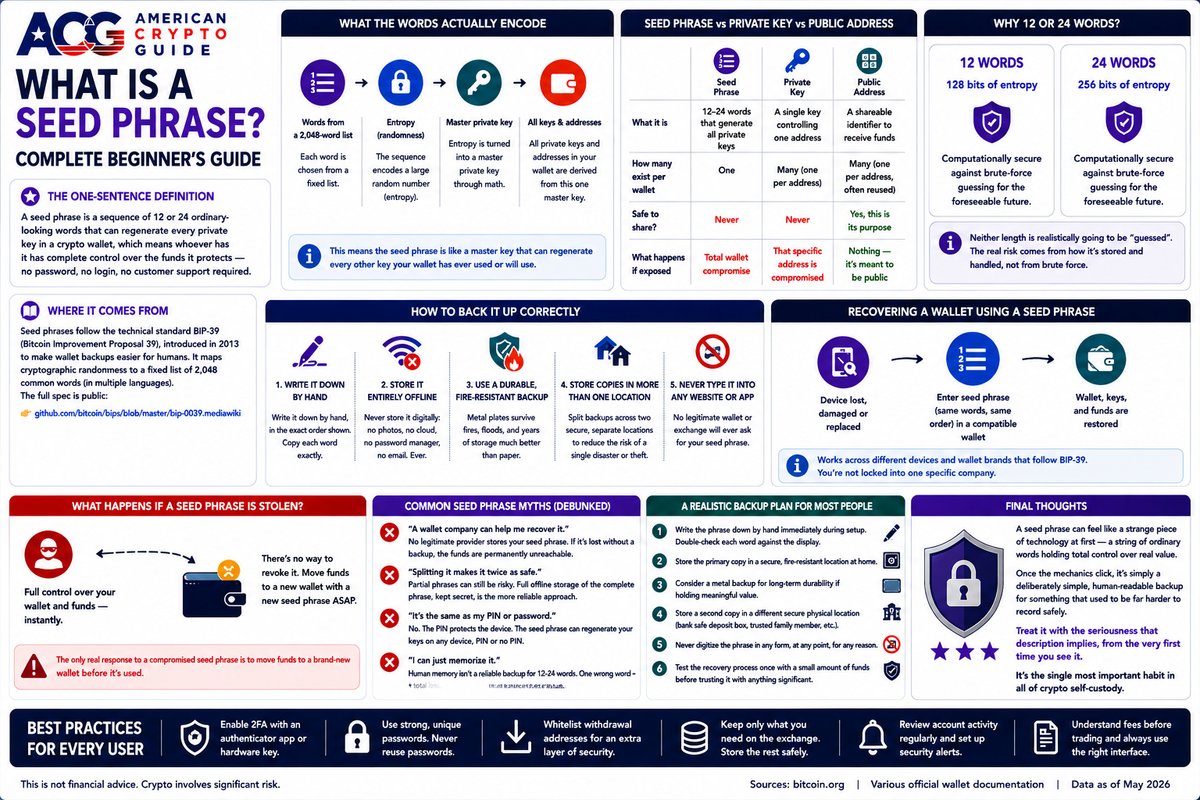
A seed phrase is a sequence of 12 or 24 ordinary-looking words that can regenerate every private key in a crypto wallet, which means whoever has it has complete control over the funds it protects — no password, no login, no customer support required. It’s simultaneously the most important piece of information in crypto self-custody and the single most common point of failure for beginners, which is exactly why it deserves a dedicated, careful explanation rather than a quick mention buried inside a wallet setup guide.
Where the seed phrase concept actually comes from
Seed phrases follow a technical standard called BIP-39 (Bitcoin Improvement Proposal 39), introduced in 2013 to solve a real usability problem. Before BIP-39, backing up a wallet meant backing up long strings of random-looking characters — technically accurate, but genuinely difficult for a human to write down correctly or verify without error. BIP-39 mapped that same cryptographic randomness onto a fixed list of 2,048 common English words (with equivalent lists in other languages), making the same underlying security dramatically easier for a person to record, read back, and verify by hand. The full technical specification is publicly documented at https://github.com/bitcoin/bips/blob/master/bip-0039.mediawiki, and the same standard has since been adopted well beyond Bitcoin, across most major cryptocurrencies and wallet software.
 You might also likeWhat Is Bitcoin? A Complete Beginner’s Guide
What the words actually encode
Each word in a seed phrase isn’t arbitrary — it’s drawn from that fixed 2,048-word list, and the specific sequence of words encodes a large random number called entropy. That number is then run through a mathematical process to generate a master private key, from which every individual address and private key in your wallet can be mathematically derived, in a predictable, repeatable sequence. This is why a single seed phrase can back up an entire wallet containing many different addresses and even multiple cryptocurrencies — they all trace back to that one root number.
Worth sitting with: this also means the seed phrase isn’t really «one password among many» — it’s closer to the master key that can regenerate every other key your wallet has ever used or will use. Losing it, or having it stolen, isn’t like losing access to one account; it’s losing (or exposing) the entire wallet at once.
Seed phrase vs private key vs public address
Beginners frequently conflate these three related but distinct concepts, so it’s worth separating them clearly:
| Seed phrase | Private key | Public address | |
|---|---|---|---|
| What it is | 12-24 words that generate all private keys | A single key controlling one address | A shareable identifier to receive funds |
| How many exist per wallet | One | Many (one per address) | Many (one per address, often reused) |
| Safe to share? | Never | Never | Yes, this is its purpose |
| What happens if exposed | Total wallet compromise | That specific address is compromised | Nothing — it’s meant to be public |
Why 12 or 24 words specifically
The word count isn’t arbitrary either — it directly reflects how much entropy (randomness) the phrase encodes, and therefore how difficult it would be to guess through brute force. A 12-word phrase encodes 128 bits of entropy; a 24-word phrase encodes 256 bits. Both are considered computationally secure against brute-force guessing for the foreseeable future — the difference matters more for specific security standards some organizations require than for practical, everyday risk. In plain terms: neither length is realistically going to be «guessed» by an attacker. The actual risk to a seed phrase almost always comes from how it’s stored and handled, not from someone mathematically reconstructing it from scratch.
How to back it up correctly
Write it down by hand, in the exact order shown
Most wallets display the phrase once, during setup, and expect you to write it down immediately rather than relying on the app to show it again later. Copy each word exactly, in the exact order presented — the sequence matters as much as the words themselves.
Store it entirely offline
The phrase should never exist in digital form anywhere it could be remotely accessed: no photo, no cloud note, no password manager, no email draft to yourself «just for now.» Every one of these defeats the core security benefit of offline key generation in the first place.
📬Did you like this article?
Subscribe and receive our posts directly in your inbox. Free!
Sin spam. Puedes darte de baja cuando quieras.
Consider a durable, fire-resistant backup
Paper degrades, burns, and fades. Metal seed phrase backup plates — stamped or engraved rather than written — are increasingly common among security-conscious holders specifically because they survive house fires, floods, and years of storage far better than paper does.
Store copies in more than one physical location
A single backup stored in the same location as the wallet device itself is vulnerable to the same fire, flood, or theft event affecting both simultaneously. Splitting backups across two secure, separate locations reduces that shared risk.
Never enter it into any website or app you didn’t initiate wallet recovery from yourself
This is the single most common way seed phrases get stolen today: a fake «wallet support» website, app, or browser pop-up asks you to «verify» or «restore» your wallet by entering your seed phrase. No legitimate wallet or exchange will ever ask for your seed phrase through a support chat, email, or unsolicited prompt. The only legitimate reason to type it in at all is restoring your own wallet, on the wallet’s own official software, by your own initiative.
Recovering a wallet using a seed phrase
If a device is lost, damaged, or replaced, the seed phrase is what allows full recovery: entering the same words, in the same order, into compatible wallet software regenerates the exact same private keys and addresses, restoring access to all associated funds. This works across different devices and even different wallet brands, as long as both follow the same BIP-39 standard — a deliberate design choice that avoids locking users into one specific manufacturer’s hardware or software forever.
What happens if a seed phrase is stolen
If someone else obtains your seed phrase, they gain the exact same total control over the wallet that you have — there’s no additional password layer standing between the phrase and full access to funds, and no way to «revoke» a compromised seed phrase after the fact. The only real response is moving funds to a brand-new wallet, with a newly generated seed phrase, as quickly as possible, before whoever has the compromised phrase can use it. This is precisely why the backup and storage practices above aren’t optional extra caution — they’re the entire security model for a self-custodied wallet.
Common seed phrase myths worth retiring
- «A wallet company can help me recover my seed phrase if I lose it.» No legitimate wallet provider stores or has access to your seed phrase — that’s the entire point of self-custody. If it’s lost without a backup, the funds are permanently unreachable.
- «Splitting my seed phrase into two locations makes it twice as safe.» True for physical loss risk, but a partial seed phrase alone doesn’t protect against theft the way it might seem — depending on how it’s split, a determined attacker with sophisticated tools might still be able to work with a partial phrase in some cases. Full offline storage of the complete phrase, kept secret, remains the standard, more reliable approach.
- «My seed phrase is different from my wallet’s PIN or password.» Yes, entirely — a device PIN protects local access to the hardware wallet itself, while the seed phrase is what can regenerate the wallet’s private keys on any device, PIN or no PIN.
- «I can just memorize it instead of writing it down.» Human memory isn’t a reliable long-term backup for a 12-24 word sequence where a single wrong word can mean total loss of access — write it down, don’t rely on memory alone.
A realistic backup plan for most people
- Write the phrase down by hand immediately during wallet setup, double-checking each word against the display.
- Store the primary copy in a secure, fire-resistant location at home, such as a safe.
- Consider a metal backup for long-term durability if holding meaningful value.
- Store a second copy in a different secure physical location — a bank safe deposit box, a trusted family member’s secure location, or similar.
- Never digitize the phrase in any form, at any point, for any reason.
- Test the recovery process once, with a small amount of funds, before trusting it with anything significant.
Final thoughts
A seed phrase can feel like a strange piece of technology the first time you encounter it — a string of ordinary words holding total control over real value. Once the mechanics click, though, it stops feeling mysterious and starts feeling like exactly what it is: a deliberately simple, human-readable backup for something that used to be far harder to record safely. Treating it with the seriousness that description implies, from the very first time you see it, is the single most important habit in all of crypto self-custody.