Best Crypto Exchanges in 2026: Full Comparison
What «best» should actually mean when picking an exchange
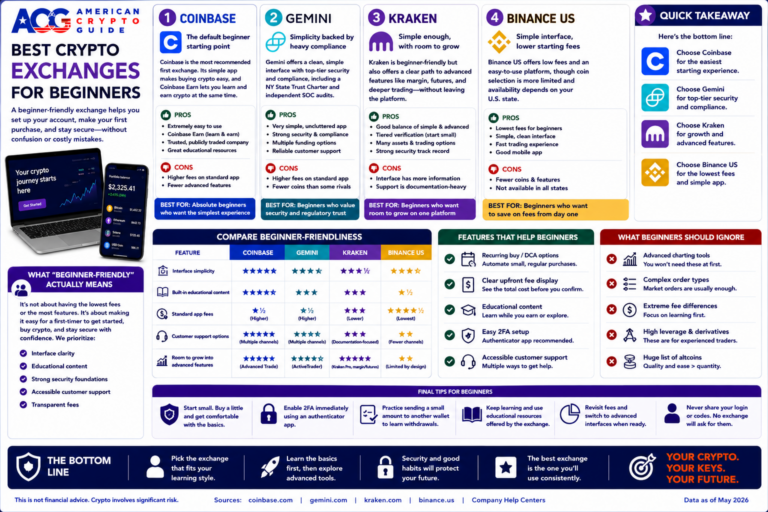
Every exchange ranking claims to have found «the best» one, but that framing hides an important truth: the right exchange depends heavily on what you’re actually optimizing for. Someone buying $50 of Bitcoin for the first time and someone actively trading a diversified portfolio need genuinely different things from a platform, even if both end up comparing the same six or seven names. This comparison ranks exchanges across the dimensions that actually matter — security track record, fees, regulatory standing, and feature depth — and is explicit about which type of user each one fits best, rather than pretending one single winner exists for everyone.
 You might also likeWhat Is Bitcoin? A Complete Beginner’s Guide
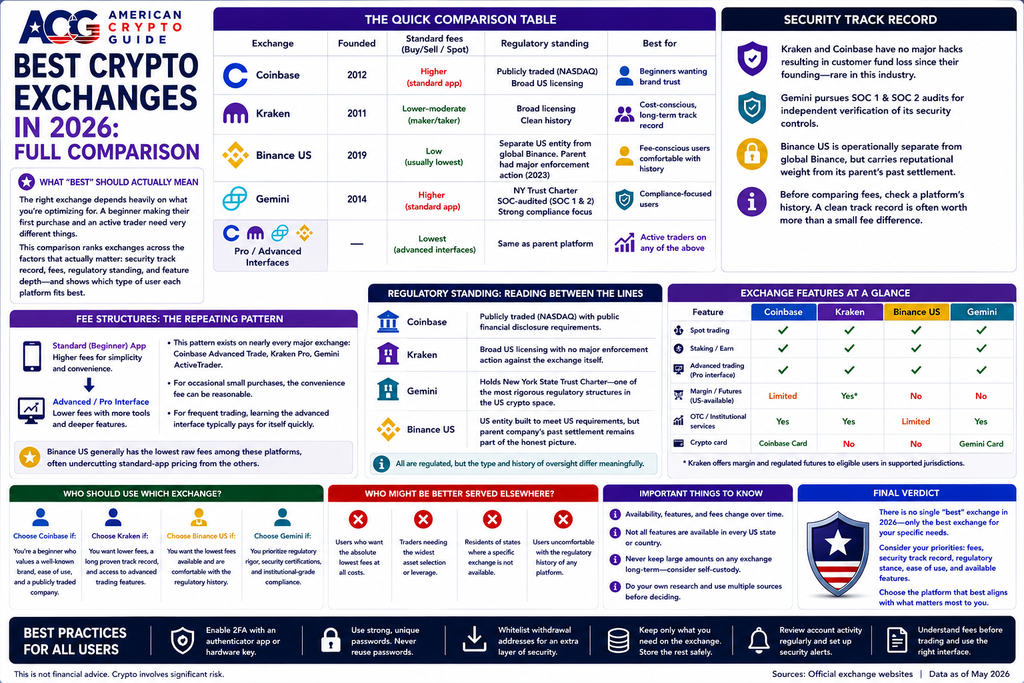
The quick comparison table
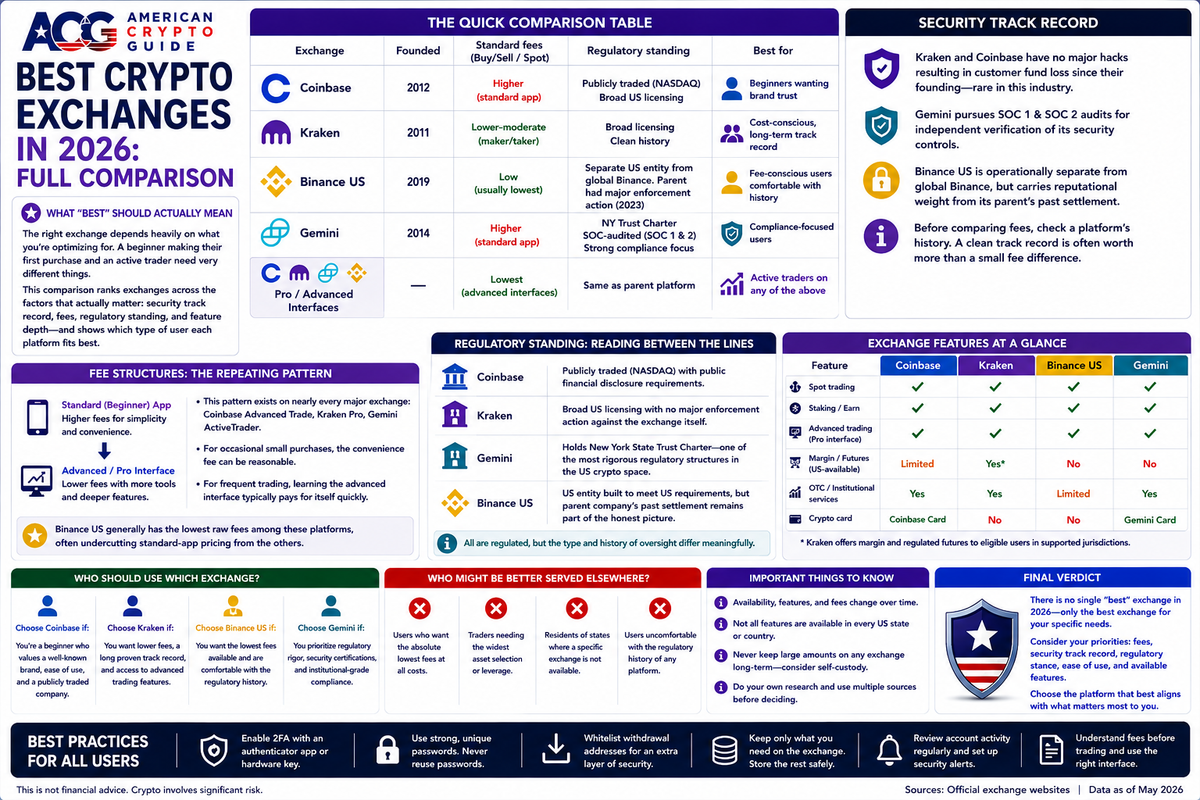
| Exchange | Founded | Standard fees | Regulatory standing | Best for |
|---|---|---|---|---|
| Coinbase | 2012 | Higher (standard app) | Publicly traded, broad US licensing | Beginners wanting brand trust |
| Kraken | 2011 | Lower-moderate | Broad licensing, clean history | Cost-conscious, long-term track record |
| Binance US | 2019 | Low | Separate entity from global Binance, parent had major enforcement action | Fee-conscious users comfortable with history |
| Gemini | 2014 | Higher (standard app) | NY Trust Charter, SOC-audited | Compliance-focused users |
| Kraken Pro / Coinbase Advanced / Gemini ActiveTrader | — | Lowest | Same as parent platform | Active traders across any of the above |
Security track record — the factor that matters most and gets discussed least
Fee comparisons dominate most exchange rankings, but security and operational history should arguably weigh more heavily than a fraction of a percent in trading fees. Kraken and Coinbase both maintain records free of major hacks resulting in customer fund loss since their founding — a genuinely rare distinction in an industry with a well-documented history of exchange collapses and breaches. Gemini has pursued independent SOC 1 and SOC 2 audits more visibly than most competitors, giving users third-party verification rather than self-reported claims alone. Binance US, while operationally distinct from global Binance, still carries the reputational weight of its parent company’s past regulatory settlement — a factor some users weigh heavily and others consider resolved history.
A framing worth adopting: before comparing a single fee percentage between two exchanges, check whether either platform has a documented history of security incidents or insolvency risk. A slightly higher fee on a platform with a clean decade-plus track record is often the better trade, not the worse one.
Fee structures — and the pattern that repeats across almost every platform
A consistent pattern shows up across nearly every major exchange covered here: the default, beginner-facing app charges noticeably more than the platform’s advanced trading interface, whether that’s Coinbase Advanced Trade, Kraken Pro, or Gemini ActiveTrader. This isn’t a hidden trick exactly — it’s a deliberate product segmentation, trading simplicity for cost. For a beginner making occasional small purchases, the standard app’s convenience fee is often a reasonable price for a simpler experience. For anyone trading more than occasionally, learning the advanced interface on whichever platform they choose typically pays for itself within the first few transactions.
Binance US remains the standout on raw fees among the platforms compared here, generally undercutting the standard-app pricing of both Coinbase and Gemini, and often beating even Kraken’s baseline fees for smaller trade sizes.
Regulatory standing — reading between the marketing
All four major platforms compared here operate under US regulatory oversight, but the type and history of that oversight differs meaningfully:
- Coinbase is publicly traded on Nasdaq, subjecting it to public financial disclosure requirements beyond what private exchanges face.
- Kraken has maintained broad US licensing without a major enforcement action against the exchange itself.
- Gemini holds a New York State Trust Charter, a specific and relatively demanding regulatory structure that goes beyond standard money transmitter licensing.
- Binance US operates separately from global Binance specifically to meet US requirements, but its parent company’s past settlement with US authorities remains part of the honest picture, regardless of Binance US’s own separate compliance record.
None of this means one platform is definitively «more legal» than another — all four operate lawfully in the US today. It means the character of their regulatory relationship differs, and that’s worth knowing before assuming all regulated exchanges carry identical risk profiles.
📬Did you like this article?
Subscribe and receive our posts directly in your inbox. Free!
Sin spam. Puedes darte de baja cuando quieras.
Feature depth — where the platforms genuinely diverge
- Coinbase offers a broad, polished feature set including staking, a separate self-custody wallet app, and Coinbase Earn for learning about specific projects.
- Kraken leans toward more advanced trading tools by default, including margin and futures products for eligible users, alongside staking and OTC access for large trades.
- Gemini differentiates through its broader financial ecosystem — a branded credit card, Gemini Pay, and institutional custody services alongside its core exchange.
- Binance US offers a more streamlined feature set, deliberately narrower than global Binance due to US regulatory constraints, focusing on core spot trading and select staking.
A realistic decision framework, not just a ranking
Rather than declaring one universal winner, here’s how the choice actually breaks down by priority:
- Prioritizing brand trust and public accountability above all else: Coinbase, given its public listing and disclosure requirements.
- Prioritizing the longest clean security track record: Kraken, given over a decade without a major fund-losing incident.
- Prioritizing the lowest possible fees and comfortable with the regulatory history involved: Binance US.
- Prioritizing independently audited compliance infrastructure: Gemini, given its SOC certifications and trust charter.
- Actively trading rather than occasionally buying: whichever platform’s advanced interface (Advanced Trade, Kraken Pro, or ActiveTrader) offers the best combination of fees and tools for your specific trading style.
Common exchange-selection mistakes worth avoiding
- Comparing only the standard app fees without checking whether the same platform’s advanced interface would meaningfully change the comparison.
- Assuming «biggest» automatically means «safest.» Platform size and security track record are correlated but not identical — a smaller platform with a clean history can be a more defensible choice than a larger one with past incidents.
- Ignoring state or country availability before comparing features, only to discover a preferred platform isn’t fully available where you live.
- Treating a single review, including this one, as the final word. Reading each exchange’s own published security and fee documentation directly remains the most reliable way to confirm current details, since terms and offerings change over time.
How customer support compares across platforms
Support quality is one of the least glamorous factors in exchange comparisons, but it’s frequently the one users notice most when something actually goes wrong — a delayed withdrawal, a locked account, or a verification issue blocking access to funds. Across independent user reviews, a fairly consistent pattern emerges: all four major platforms compared here draw some criticism for response times during periods of high demand, and none has a reputation for consistently fast, white-glove support at the free retail tier. Coinbase and Gemini both offer phone-based support options for account-specific issues, which some users find reassuring compared to email-only alternatives, though availability and wait times vary. Kraken has historically leaned more heavily on documentation and self-service resources, which works well for technically comfortable users but can feel less reassuring to someone dealing with an urgent account issue for the first time. Binance US’s support experience has generally mirrored its leaner overall feature set, with fewer dedicated support channels than its more established competitors.
The practical takeaway isn’t that one platform has dramatically better support than the others — it’s that no major exchange should be chosen primarily for its support quality, since none of the four stands out enough in either direction to be a deciding factor on its own. Weighing security track record, fees, and regulatory character will generally tell you more about the platform you’re choosing than support wait times will.
Mobile app quality and everyday usability
For most users, the mobile app is where an exchange relationship actually happens day to day, far more than a desktop trading terminal. Coinbase’s app remains widely regarded as the most approachable for a first-time user, with a design that prioritizes simplicity over information density. Gemini’s app follows a similar philosophy, leaning calm and uncluttered rather than data-heavy. Kraken’s standard mobile experience is more functional than polished, reflecting the platform’s broader tendency to prioritize substance over interface design — a reasonable trade-off for users who value that substance, less so for someone who finds a busier interface intimidating. Binance US’s app sits somewhere in between, offering core trading functions without the deeper charting tools power users on other platforms might expect.
None of these differences are dramatic enough to override the security and fee considerations already covered, but for a genuine beginner deciding where to make a first purchase, interface comfort is a legitimate factor worth testing directly — most of these platforms let you create an account and browse before funding it, which is a low-cost way to get a feel for the experience before committing.
Final thoughts
There’s no single best crypto exchange in 2026 — there’s a best fit for whichever combination of security track record, fee structure, regulatory character, and feature depth matters most to you specifically. Coinbase, Kraken, Binance US, and Gemini each make a genuinely different, defensible case depending on what you’re weighing most heavily, and understanding those trade-offs is worth more than any single ranked list, including this one.