
Common Crypto Scams and How to Spot Them

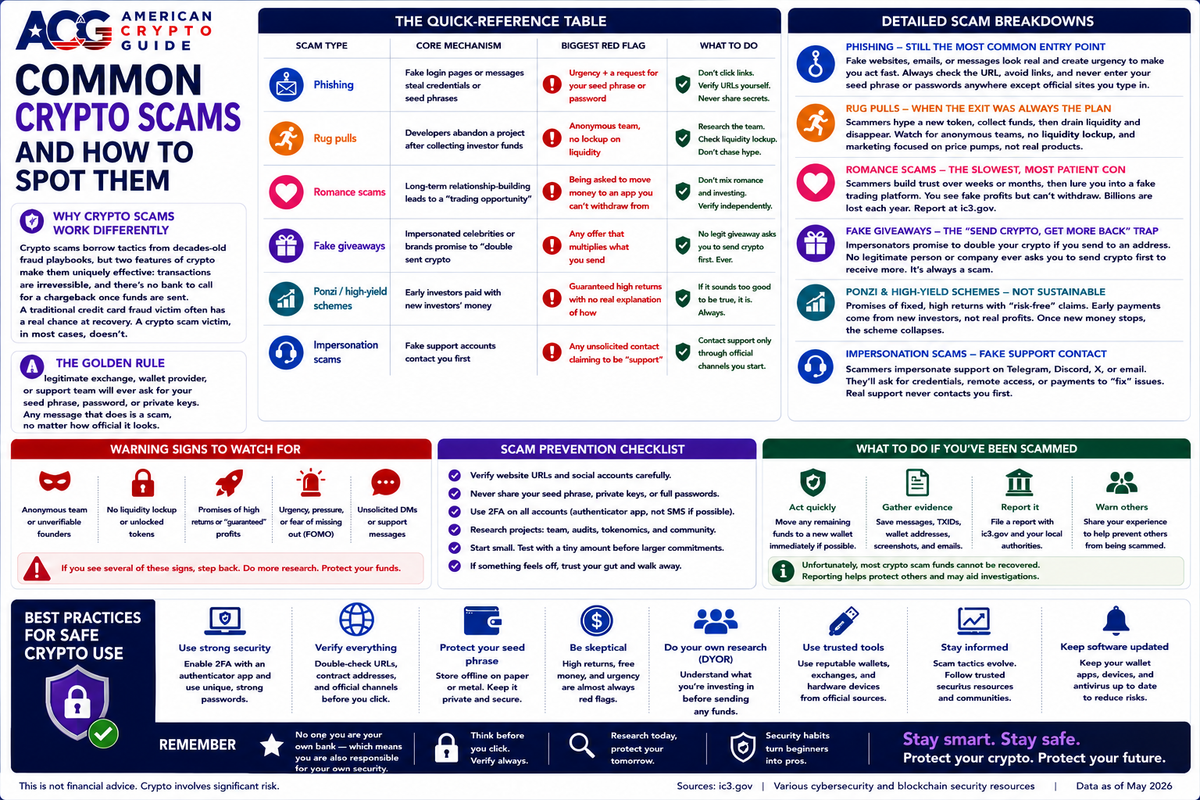
Why crypto scams work differently than traditional fraud
Crypto scams borrow tactics from decades-old fraud playbooks, but two features of crypto make them uniquely effective: transactions are irreversible, and there’s no bank to call for a chargeback once funds are sent. A traditional credit card fraud victim often has a real chance at recovery through their bank. A crypto scam victim, in most cases, doesn’t. That single structural difference is why crypto scam prevention leans so heavily on recognizing red flags before sending anything, rather than on recovery options afterward — because meaningful recovery options frequently don’t exist.
The quick-reference table
| Scam type | Core mechanism | Biggest red flag |
|---|---|---|
| Phishing | Fake login pages or messages steal credentials or seed phrases | Urgency + a request for your seed phrase or password |
| Rug pulls | Developers abandon a project after collecting investor funds | Anonymous team, no lockup on liquidity |
| Romance scams | Long-term relationship-building leads to a «trading opportunity» | Being asked to move money to an app you can’t withdraw from |
| Fake giveaways | Impersonated celebrities or brands promise to «double» sent crypto | Any offer that multiplies what you send |
| Ponzi/high-yield schemes | Early investors paid with new investors’ money | Guaranteed high returns with no real explanation of how |
| Impersonation scams | Fake support accounts contact you first | Any unsolicited contact claiming to be «support» |
Phishing — still the most common entry point
Phishing remains the workhorse of crypto scams because it doesn’t require breaking any actual encryption — it just needs to trick a person into handing over access voluntarily. This shows up as fake exchange login pages nearly identical to the real thing, fraudulent emails claiming urgent account issues, or fake wallet «support» messages asking you to «verify» your seed phrase.
The single most reliable defense: no legitimate exchange, wallet provider, or support team will ever ask for your seed phrase, under any circumstance, for any reason. Not to «verify your identity,» not to «fix an issue,» not to «unlock a frozen account.» Any message asking for it is a scam, full stop, regardless of how official it looks.
Rug pulls — when the exit was always the plan
A rug pull occurs when developers of a new token or project abandon it after collecting investor funds, often by draining liquidity they controlled or simply disappearing with raised capital. Warning signs include an anonymous or unverifiable development team, no lock-up period on the liquidity pool (meaning developers could withdraw funds instantly at any point), and marketing that emphasizes urgency and imminent price gains over any actual product or use case. Not every anonymous project is a scam, and not every rug pull is obvious in advance — but the combination of anonymity, no liquidity lockup, and aggressive hype together should raise serious caution.
Romance scams — the slowest, most patient con
Often called «pig butchering» scams in industry and law enforcement reporting, romance-based crypto scams involve a scammer building a genuine-feeling relationship over weeks or months, typically through dating apps or social media, before eventually introducing a «trading opportunity» or app. The victim is guided to deposit funds into what appears to be a legitimate trading platform, sees fabricated gains within the app, and is encouraged to deposit more — until any attempt to withdraw is blocked, delayed, or met with additional «fees» required to unlock funds that never actually existed outside the scam’s own interface. The FBI’s Internet Crime Complaint Center has published extensive reporting on this scam category, available at https://www.ic3.gov, and the financial scale involved has grown into billions of dollars annually according to their published reports.
Fake giveaways — the «send crypto, get more back» trap
Fake giveaway scams typically impersonate a well-known public figure, company, or crypto project, promising to double or multiply any crypto sent to a specific address within a short window. These often spread through hijacked or impersonated social media accounts, sometimes appearing as replies under a real public figure’s genuine post to borrow credibility from the surrounding context. The mechanism is simple to spot once named directly: no legitimate giveaway, anywhere, ever requires you to send crypto first in order to receive crypto back. That specific request — send first, receive more later — is the entire scam.
Ponzi and high-yield investment schemes
Crypto-based Ponzi schemes follow the same fundamental structure fraud investigators have documented for over a century, just wrapped in blockchain terminology: early participants are paid attractive «returns» using money from newer participants, creating an illusion of a genuinely profitable system until new investment inevitably slows and the structure collapses. Red flags include guaranteed or unusually consistent high returns regardless of market conditions, vague or overly complex explanations of how profits are actually generated, and heavy emphasis on recruiting new investors as part of the return structure itself.
📬Did you like this article?
Subscribe and receive our posts directly in your inbox. Free!
Sin spam. Puedes darte de baja cuando quieras.
Impersonation scams — fake support, fake officials
Impersonation scams involve someone posing as legitimate support staff, a government official, or even a well-known figure in the crypto industry, reaching out directly (rather than waiting for you to contact them first) to create a false sense of official communication. A consistent, reliable pattern across nearly every version of this scam: legitimate support teams almost never initiate contact through direct message, and never ask for a seed phrase, private key, or remote access to your device. If you didn’t open a support ticket yourself, treat any unsolicited «support» contact with serious suspicion by default.
How to verify whether a crypto project is legitimate
- Search for the team’s real, verifiable identities — not just first names or avatars, but LinkedIn profiles, past work history, or public appearances that can be independently confirmed.
- Check whether the project’s code is publicly available and has been reviewed by independent security auditors, and look up those audit reports directly rather than trusting a summary claim alone.
- Look for a liquidity lock on decentralized exchange listings, which prevents developers from instantly draining pooled funds.
- Search the project name alongside words like «scam» or «review» before investing, since scam patterns are frequently documented publicly once identified by other users.
- Be skeptical of urgency. Legitimate investment opportunities rarely require an immediate decision within hours to avoid «missing out.»
What to do if you’ve already sent funds to a scammer
- Stop sending any further funds immediately, even if told that an additional payment is required to «unlock» or «release» previously sent funds — this is itself part of the scam pattern.
- Document everything: wallet addresses involved, communication records, transaction hashes, and timestamps.
- Report the incident to your national fraud reporting body — in the US, that includes the FBI’s IC3 at https://www.ic3.gov — even though recovery isn’t guaranteed, reporting contributes to broader investigations and pattern tracking.
- Alert the platform if the interaction happened through a specific exchange, wallet, or social media account, since providers can sometimes flag or restrict associated accounts.
- Be cautious of «recovery services» that contact you after a scam, promising to retrieve lost funds for an upfront fee — this is itself a well-documented secondary scam targeting people who’ve already been victimized once.
The mindset that actually prevents most crypto scams
Nearly every scam pattern covered here shares a common thread beneath the surface details: manufactured urgency combined with a request that should never be reasonable — sending funds first, sharing a seed phrase, or moving money into an app you can’t independently verify. Slowing down, specifically at the moment something feels urgent or exciting, is a more reliable defense than memorizing every individual scam variant, since new versions of the same underlying tactics appear constantly.
Newer scam patterns worth watching in 2026
Scam tactics evolve alongside the technology and tools available to fraudsters, and a few patterns have become more prominent in recent years beyond the classics covered above. AI-generated voice and video impersonation has made it easier to fake a convincing «video call» or voice message from someone claiming to be a trusted contact, project founder, or even a family member requesting urgent crypto assistance — a development that makes «verify through a second, independent channel» more important than ever before sending anything based on a call or video alone. Fake wallet-draining browser extensions and apps have also grown more sophisticated, sometimes appearing in official app stores before being reported and removed, mimicking legitimate wallets closely enough that checking the developer name and download count against the wallet’s official website has become a genuinely necessary habit rather than excessive caution.
Malicious QR codes have emerged as another vector, particularly at in-person events or through altered payment displays, where scanning an unverified QR code can direct a transaction to an attacker’s address instead of the intended recipient. Always confirming the destination address displayed by your own wallet after scanning — rather than trusting the QR code blindly — closes off this specific risk.
How crypto scam losses compare across categories
Fraud tracking organizations that publish annual reporting consistently find that romance and relationship-based scams account for a disproportionately large share of total crypto fraud losses by dollar amount, even though phishing and fake giveaway scams are reported far more frequently as individual incidents. The pattern makes sense once you consider the mechanics: a romance scam typically extracts funds gradually over weeks or months from a single victim, while phishing and giveaway scams usually involve smaller individual amounts spread across many more victims. Neither category should be dismissed as less serious — but the dollar-loss concentration in longer-running relationship-based scams is a useful reminder that the most financially devastating scams often don’t look like an obvious, high-pressure fraud attempt at first. They look like patience.
Final thoughts
Crypto scams succeed by exploiting the same human patterns fraud has exploited for generations — urgency, trust, and the promise of an opportunity too good to research carefully. The technology is new; the psychological playbook mostly isn’t. Recognizing the handful of patterns covered here — the request for a seed phrase, the guaranteed impossible return, the «send first» giveaway, the unsolicited support contact — covers the overwhelming majority of scams anyone encounters in practice, long before needing to identify a scam’s specific technical mechanism.