Biggest Bitcoin News Stories This Month


Updated for August 2026. This roundup covers the stories actually moving the needle this month — not just the headlines with the most clicks.
The month in one paragraph
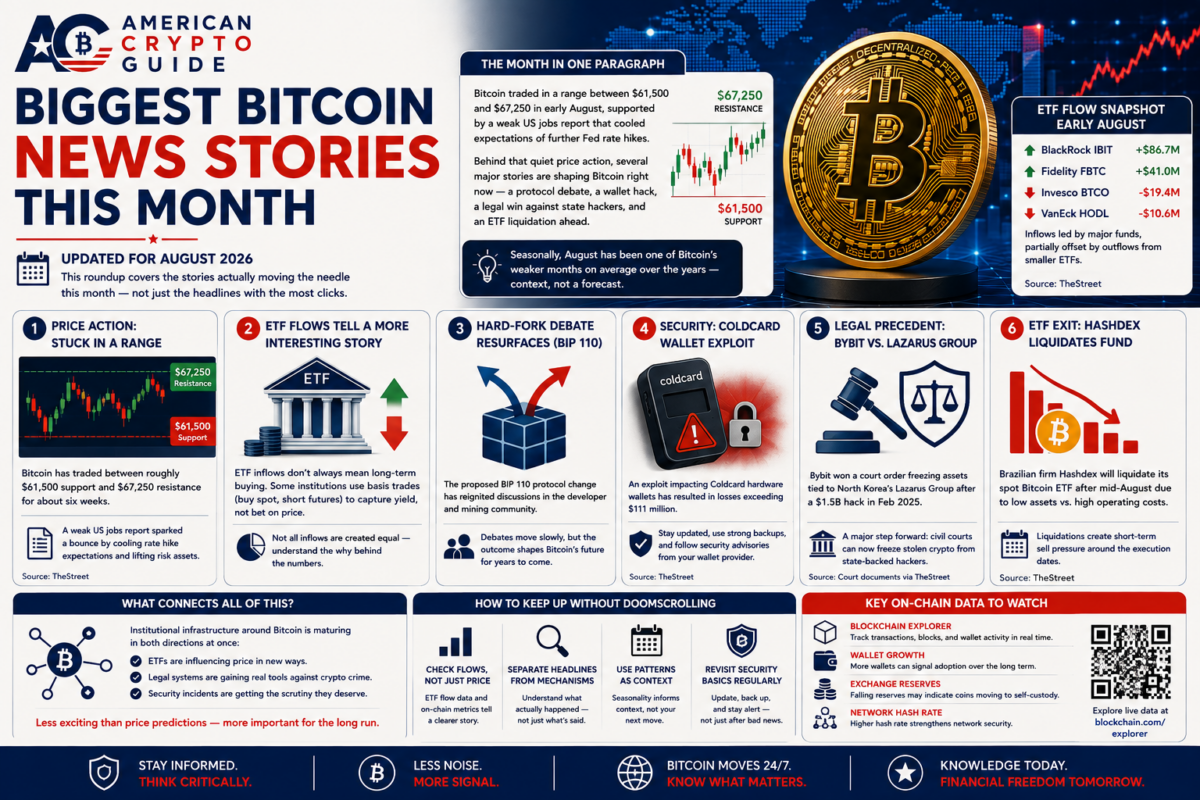
Bitcoin spent the first week of August trading in a tight band roughly between $61,500 and $67,250, holding onto gains from a surprisingly weak US jobs report that cooled expectations of further Federal Reserve rate hikes. Underneath that relatively quiet price action, though, several genuinely consequential stories were developing at once — a contested protocol change, a major hardware wallet exploit, a legal precedent against state-backed hackers, and an ETF liquidation that could add fresh sell pressure later this month. None of these individually explain the price chart, but together they’re a good snapshot of where Bitcoin’s actual risk and opportunity sit right now.
 You might also likeWhat Is Bitcoin? A Complete Beginner’s Guide
Story 1 — Price action: stuck in a range, but why
As of early August, Bitcoin has been trading in a channel between roughly $61,500 support and $67,250 resistance for about six weeks, according to TheStreet’s ongoing market coverage. The catalyst behind the latest bounce was a July jobs report that missed expectations badly — the US economy lost jobs rather than adding the roughly 80,000 economists had forecast, which cooled bets on further rate hikes and gave risk assets, Bitcoin included, some breathing room.
Worth noting: Bitcoin has also historically been one of the weaker months of the year for Bitcoin, with several analysts pointing to a multi-year pattern of average declines through the month — a reminder that seasonal patterns are observations, not guarantees, and shouldn’t be treated as a forecast on their own.
Story 2 — ETF flows tell a more interesting story than the price chart
While the price itself has been quiet, flows into and out of US spot Bitcoin ETFs have not been. Early August saw net inflows led by BlackRock’s IBIT and Fidelity’s FBTC, partially offset by outflows from smaller funds like Invesco’s BTCO and VanEck’s HODL.
| ETF | Recent flow direction | Approx. amount (single day) |
|---|---|---|
| BlackRock IBIT | Inflow | ~$86.7 million |
| Fidelity FBTC | Inflow | ~$41.0 million |
| Invesco BTCO | Outflow | ~$19.4 million |
| VanEck HODL | Outflow | ~$10.6 million |
Market maker Wintermute has flagged that a meaningful share of this gross inflow doesn’t represent straightforward long-term buying — some institutional desks are running basis trades, buying spot ETF shares while shorting futures to capture a yield spread, rather than making a directional bet on price. It’s a useful reminder that not every ETF inflow headline means what it appears to at first glance.
Story 3 — A hard-fork debate resurfaces (BIP 110)
A proposed protocol change known as BIP 110 has reignited familiar hard-fork discussions within the Bitcoin developer and mining community this month. These debates tend to move slowly and rarely result in the kind of dramatic network split that made headlines in Bitcoin’s earlier years, but they’re worth tracking because consensus changes — however incremental — shape what the network can and can’t do for years afterward.
📬Did you like this article?
Subscribe and receive our posts directly in your inbox. Free!
Sin spam. Puedes darte de baja cuando quieras.
Story 4 — Security: the Coldcard hardware wallet exploit
An ongoing exploit affecting Coldcard hardware wallets has reportedly resulted in losses exceeding $111 million, according to reporting cited by TheStreet. This is a useful, if uncomfortable, reminder for anyone reading our <a href=»/post-best-bitcoin-wallets-in-2026-ranked-and-reviewed»>best Bitcoin wallets ranking</a>: even reputable hardware wallet brands aren’t immune to serious vulnerabilities, and staying current on firmware updates and manufacturer security advisories matters regardless of which device you own.
Story 5 — Legal precedent: Bybit’s freeze against DPRK-linked hackers
Exchange Bybit secured a preliminary injunction in US District Court freezing assets tied to North Korea’s Lazarus Group, connected to a February 2025 attack that drained an estimated $1.5 billion in digital assets. Beyond the specific case, the ruling sets a notable precedent for using civil courts — not just criminal prosecution, which is far harder to pursue against state-backed actors — to freeze stolen crypto assets. For an industry that’s struggled to recover funds after major hacks, this kind of legal tool matters more than the headline dollar figure suggests.
Story 6 — An ETF exits the market entirely
Brazilian asset manager Hashdex announced it will liquidate its spot Bitcoin ETF, citing asset volume too low relative to the fund’s operating costs, with the fund selling its Bitcoin holdings after mid-August. It’s a small fund in the context of the broader ETF landscape, but liquidations like this add incremental sell pressure to the market around their execution date — worth watching for anyone tracking short-term supply dynamics rather than long-term adoption trends.
What connects all of this
Pull back from the individual headlines, and a pattern emerges: institutional infrastructure around Bitcoin is maturing in both directions at once. ETFs are becoming a genuine, if imperfect, price-influencing force; legal systems are developing real tools against crypto-specific crime; and security failures at the hardware level are getting the same scrutiny once reserved for exchange hacks. None of that is as exciting as a price prediction, but it’s arguably more important for understanding where Bitcoin actually stands.
How to keep up without doomscrolling
- Check flows, not just price. ETF inflow and outflow data, tracked by services like https://www.blockchain.com/explorer, often tells a clearer story than the price chart alone.
- Separate a headline from its actual mechanism. «Hackers stole $X» and «a court froze $X» are very different stories that get reported with similar urgency.
- Treat seasonal patterns as context, not a forecast. A multi-year average is a data point, not a guarantee about this particular month.
- Revisit security basics regularly, especially after news of a specific wallet or exchange vulnerability — not just when something happens to you directly.
Final thoughts
Most months in Bitcoin produce more real news than the price chart alone suggests, and this one is no exception — a quiet trading range sitting on top of a legal precedent, a security incident, an ETF exit, and a protocol debate, all developing in parallel. Understanding why each of these matters, beyond the headline, is what actually helps separate short-term noise from the developments worth remembering.