Best Ethereum Wallets in 2026: Ranked and Reviewed

Ethereum wallets aren’t just «storage» — they’re your login to everything
A Bitcoin wallet mostly does one job: hold your private key so you can send and receive coins. An Ethereum wallet does that too, but it’s also how you log into thousands of apps — lending platforms, marketplaces, games — without a username or password. That extra role changes what «best» means here: security still matters most, but so does how safely and smoothly a wallet lets you interact with the wider Ethereum ecosystem.
 You might also likeWhat Is Bitcoin? A Complete Beginner’s Guide
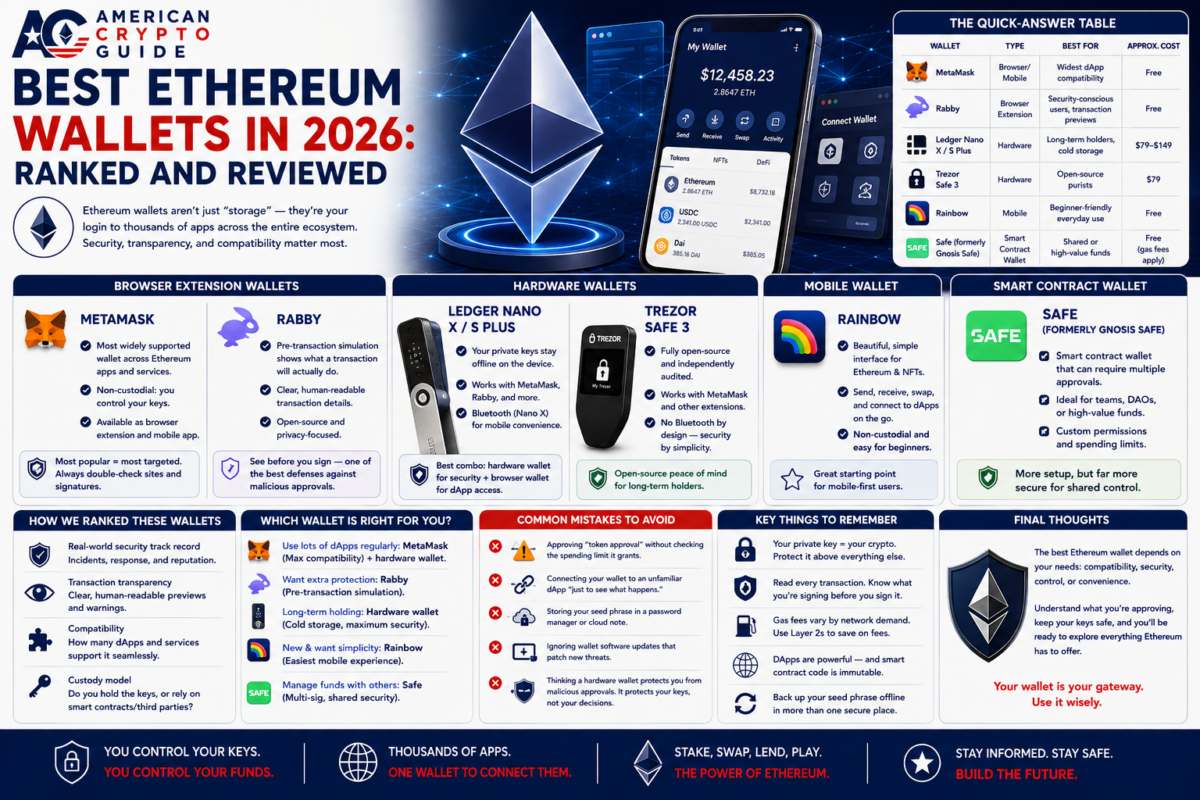
The quick-answer table
| Wallet | Type | Best for | Approx. cost |
|---|---|---|---|
| MetaMask | Browser/mobile extension | Widest dApp compatibility | Free |
| Rabby | Browser extension | Security-conscious users, transaction previews | Free |
| Ledger Nano X / S Plus | Hardware | Long-term holders, cold storage | $79–$149 |
| Trezor Safe 3 | Hardware | Open-source purists | $79 |
| Rainbow | Mobile | Beginner-friendly everyday use | Free |
| Safe (formerly Gnosis Safe) | Smart contract wallet | Shared or high-value funds | Free (gas fees apply) |
Browser extension wallets — the default way most people interact with Ethereum
MetaMask
MetaMask remains the most widely supported wallet across Ethereum apps, largely because so many dApps were built and tested against it first. It’s non-custodial, meaning you hold your own private key, and works as both a browser extension and a mobile app. The trade-off of its popularity: MetaMask is also the most common target for phishing attempts, since attackers know it’s the wallet most people already have installed.
Rabby
Rabby has gained a loyal following specifically for one feature: pre-transaction simulation, showing you in plain language what a transaction will actually do — which tokens move, to where, and how much — before you approve it. For anyone who’s ever approved a transaction blind and regretted it, this single feature is a meaningful security upgrade over wallets that only show raw technical data.
Worth remembering: the majority of Ethereum wallet losses aren’t caused by a hacked private key — they’re caused by someone approving a malicious transaction they didn’t fully understand. A wallet that shows you what you’re actually signing is solving the more common real-world problem.
Hardware wallets — the standard for meaningful holdings
Ledger Nano X and Nano S Plus
Ledger’s devices pair with browser extension wallets like MetaMask, letting you get the convenience of a familiar interface while your private key stays on a separate, offline device. This combination — hardware wallet plus browser extension — is the setup most security-conscious Ethereum users settle on for both dApp interaction and cold storage. Setup guides are published at https://www.ledger.com.
📬Did you like this article?
Subscribe and receive our posts directly in your inbox. Free!
Sin spam. Puedes darte de baja cuando quieras.
Trezor Safe 3
Trezor’s fully open-source approach applies here too, and it pairs with MetaMask and other extensions the same way Ledger does. The trade-off remains the same as on the Bitcoin side: no Bluetooth convenience, in exchange for a design independent researchers can fully audit. Documentation is available at https://trezor.io.
Mobile wallets — for everyday, on-the-go use
Rainbow
Rainbow is a mobile-first, non-custodial Ethereum wallet built with a notably simpler interface than MetaMask’s, aimed at people who find crypto UI intimidating. It supports NFT display, token swaps, and dApp connections directly from a phone, without the added friction some users report with more feature-dense wallets.
Smart contract wallets — a genuinely different security model
Safe (formerly Gnosis Safe)
Safe isn’t a traditional wallet backed by a single private key — it’s a smart contract that can require multiple approvals before any transaction executes, commonly used by teams, DAOs, and individuals managing significant funds who don’t want a single lost or stolen key to mean total loss. Setting one up is more involved than installing a browser extension, but for shared or high-value holdings, the added structure is often worth the setup time.
How we ranked these
- Real-world security track record — has the wallet or its ecosystem faced major incidents, and how were they handled?
- Transaction transparency — does it clearly show what you’re approving, or just raw technical data?
- Compatibility — how many dApps and services actually support it without friction?
- Custody model — does it give you your own keys, or introduce a smart contract layer with its own trade-offs?
Which wallet fits which type of person
- You interact with lots of different dApps regularly: MetaMask, for compatibility, paired with a hardware wallet if your holdings are meaningful.
- You want extra protection against approving something malicious: Rabby, specifically for its transaction simulation.
- You’re holding significant ETH long-term and rarely interact with apps: a hardware wallet on its own, used mostly for cold storage.
- You’re new and want the least intimidating interface: Rainbow.
- You manage funds for a team, DAO, or want multi-approval security: Safe.
Common Ethereum wallet mistakes worth avoiding
- Approving a «token approval» transaction without checking the spending limit it grants — some malicious contracts request unlimited access to a token balance.
- Connecting a wallet to an unfamiliar dApp just to «see what happens.» Malicious sites specifically design connection prompts to look identical to legitimate ones.
- Storing your seed phrase in a password manager or cloud note, defeating the purpose of offline backup.
- Ignoring wallet software updates, which frequently patch newly discovered phishing patterns and security issues.
- Assuming a hardware wallet alone protects you from malicious dApp approvals — hardware wallets protect your private key, but you still have to read what you’re signing.
Final thoughts
The best Ethereum wallet ranking, here or anywhere else, ultimately comes down to how you actually plan to use the network — casual dApp browsing, active DeFi participation, long-term cold storage, or managing funds for more than just yourself. What matters more than any single wallet’s name is understanding what you’re approving every time you sign a transaction, since that habit protects you regardless of which wallet you end up choosing.