How to Recover Stolen Crypto: What’s Actually Possible

The honest starting point
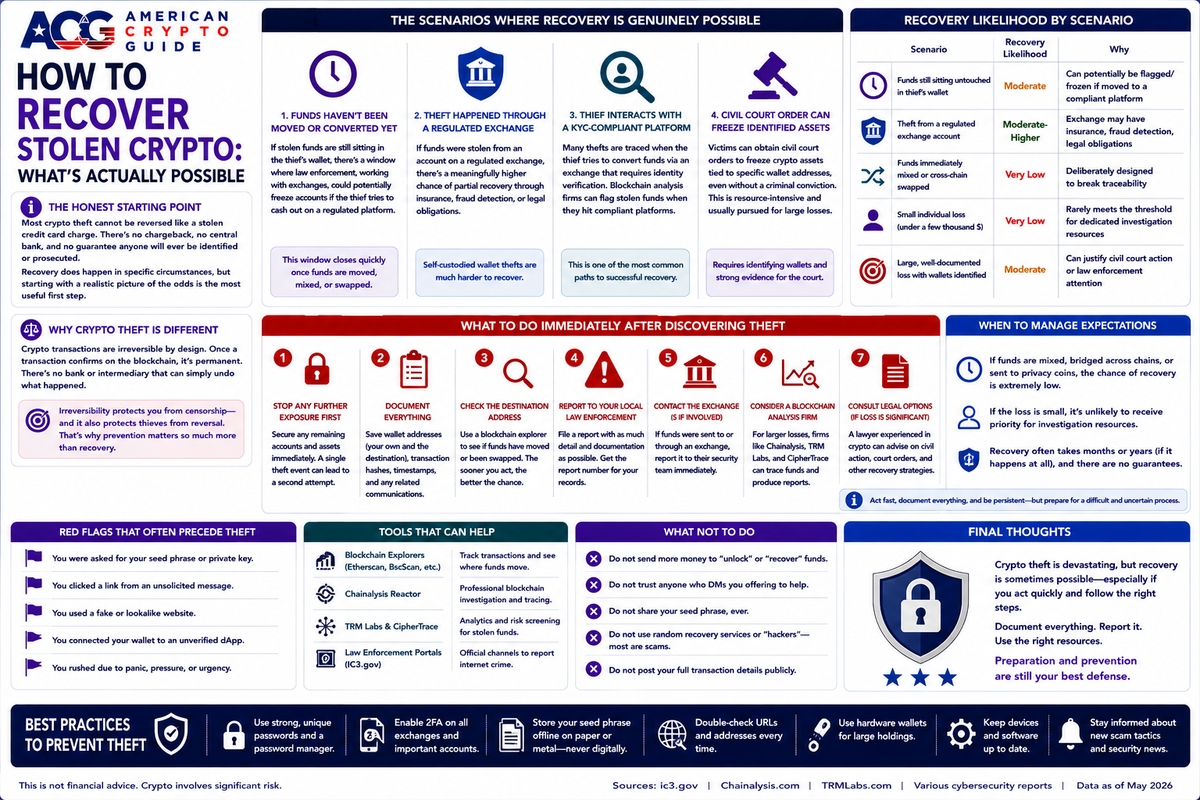
Most crypto theft cannot be reversed the way a stolen credit card charge can. There’s no central bank to freeze the transaction, no chargeback process, and no guarantee anyone will ever be identified or prosecuted. That’s not meant to discourage anyone from trying — recovery does happen in specific, documented circumstances — but starting with a realistic picture of the odds is more useful than false reassurance, especially in the emotionally difficult moments right after discovering a theft.
Why crypto theft is structurally different from other financial fraud
Traditional financial fraud recovery relies on intermediaries — banks, card networks, payment processors — that can reverse transactions, freeze accounts, and cooperate with investigations because they control the infrastructure funds move through. Crypto transactions settle directly, peer to peer, on a public ledger with no equivalent intermediary able to simply undo what happened. Once a transaction confirms, it’s permanent by design — the same irreversibility that makes crypto resistant to censorship also makes theft resistant to reversal.
Worth understanding clearly: irreversibility isn’t a bug that happened to also enable theft — it’s a deliberate design trade-off. The same property that prevents a government or company from reversing your legitimate transaction also prevents anyone from reversing a thief’s. This is precisely why prevention matters so much more in crypto than after-the-fact recovery.
The scenarios where recovery is genuinely possible
The stolen funds haven’t been moved or converted yet
If stolen funds remain sitting in the thief’s wallet, unconverted and untouched, there’s a window where law enforcement, working with exchanges, could potentially freeze associated accounts if the thief eventually tries to cash out through a regulated platform. This window closes quickly once funds are moved through mixing services or converted across multiple assets and platforms.
The theft happened through a regulated exchange
If funds were stolen from an account held on a regulated, compliant exchange — rather than a self-custodied wallet — there’s a meaningfully higher chance of partial recovery, since the exchange itself may have insurance, internal fraud detection, or legal obligations that a purely peer-to-peer theft doesn’t involve.
The thief eventually interacts with a KYC-compliant platform
Many crypto thefts are ultimately traced not through the blockchain itself, but through the moment a thief tries to convert stolen funds into usable currency via an exchange that requires identity verification. Blockchain analysis firms specialize in tracing fund movement across wallets and flagging when stolen assets touch a compliant platform, at which point law enforcement can potentially compel that platform to freeze the account and identify its holder.
A civil court order can freeze identified assets
As demonstrated in several recent cases, victims (often working through an exchange or specialized legal counsel) have successfully obtained civil court orders freezing crypto assets tied to specific wallet addresses, even without a criminal conviction. This route requires identifying at least a wallet address connected to the theft and demonstrating sufficient evidence to a court — a real but resource-intensive path, more commonly pursued for large losses than small ones.
Recovery likelihood by scenario
| Scenario | Recovery likelihood | Why |
|---|---|---|
| Funds still sitting untouched in thief’s wallet | Moderate | Can potentially be flagged/frozen if moved to a compliant platform |
| Theft from a regulated exchange account | Moderate-higher | Exchange may have insurance, fraud detection, legal obligations |
| Funds immediately mixed or cross-chain swapped | Very low | Deliberately designed to break traceability |
| Small individual loss (under a few thousand dollars) | Very low | Rarely meets the threshold for dedicated investigation resources |
| Large, well-documented loss with wallet addresses identified | Moderate | Can justify civil court action or dedicated law enforcement attention |
What to do immediately after discovering theft
- Stop any further exposure first. If the theft resulted from a compromised device, seed phrase, or password, secure any remaining accounts and assets immediately — a single theft event sometimes precedes a second attempt if the underlying compromise isn’t fully addressed.
- Document everything before doing anything else. Wallet addresses involved (both yours and the destination), transaction hashes, timestamps, and any communication related to how the theft occurred.
- Check the destination address using a blockchain explorer. Public tools let you see whether funds have moved further, to where, and whether they’ve touched any identifiable platform — useful information for any subsequent report.
- Report to the relevant platform, if the theft involved an exchange account, immediately — some platforms can flag or freeze associated accounts faster the sooner they’re notified.
- File a report with your national fraud or cybercrime authority. In the US, that includes the FBI’s Internet Crime Complaint Center at https://www.ic3.gov, which aggregates reports used for broader pattern investigation even when individual case recovery isn’t guaranteed.
Blockchain forensics — how tracing actually works
Blockchain forensics firms use specialized software to follow the movement of stolen funds across the public ledger, clustering wallet addresses believed to be controlled by the same entity and flagging when those funds interact with known exchange deposit addresses. This is possible specifically because most blockchains, including Bitcoin and Ethereum, are fully public and permanently recorded — every movement is visible, even if the identity behind a wallet address isn’t automatically known. The gap between «we can see where the funds went» and «we know who controls that wallet» is exactly where law enforcement cooperation with compliant exchanges becomes necessary — the blockchain shows movement, but converting that into an identified person almost always requires an exchange’s KYC records at some point in the chain.
📬Did you like this article?
Subscribe and receive our posts directly in your inbox. Free!
Sin spam. Puedes darte de baja cuando quieras.
 You might also likeWhat Is Bitcoin? A Complete Beginner’s Guide
Recovery services — proceed with serious caution
A secondary scam has grown alongside crypto theft itself: services that contact theft victims (or advertise directly to them) promising guaranteed fund recovery for an upfront fee. Legitimate blockchain forensics and legal recovery work essentially never involves guaranteeing an outcome in advance, and any unsolicited contact from a «recovery specialist» immediately following a theft should be treated with the same suspicion as the original scam. If pursuing professional recovery assistance, work only with established forensics firms or legal counsel found through your own independent research — never through a service that reached out to you first.
Realistic expectations for different loss amounts
- Small losses (a few hundred dollars) are, realistically, rarely recoverable through formal channels — the investigative resources required typically exceed what’s proportional to the loss, though reporting still contributes to broader pattern tracking that can help others.
- Moderate losses (several thousand dollars) sometimes justify working directly with the affected platform’s fraud team, if an exchange was involved, though success varies significantly by platform and circumstance.
- Large losses (tens of thousands of dollars or more) more commonly justify engaging blockchain forensics firms and legal counsel, particularly if wallet addresses can be identified and funds haven’t yet been fully obscured through mixing or cross-chain movement.
The most valuable lesson from every theft case
Across nearly every recovery case that succeeds even partially, the same pattern holds: speed and documentation matter enormously. The gap between a theft occurring and the victim taking action — reporting, documenting, contacting relevant platforms — is often the single biggest factor separating cases with some recovery chance from those with none. Waiting days or weeks to report, hoping the situation resolves itself, consistently reduces whatever chance existed at the outset.
The role of exchanges in freezing stolen funds
When stolen crypto eventually lands in an account at a regulated exchange, that platform becomes a genuinely important checkpoint in the recovery process. Exchanges operating under standard compliance requirements maintain the identity information of their account holders and can, when presented with a sufficiently documented request — often through law enforcement or a civil court order — freeze the account and prevent further withdrawal or conversion of the funds. This is precisely why thieves increasingly favor decentralized exchanges, cross-chain bridges, and mixing services specifically designed to avoid this exact checkpoint: they know a compliant, centralized exchange represents the single most likely point where their identity could eventually be connected to the theft.
This dynamic also explains why reporting a theft promptly to any exchange you suspect may eventually receive the funds — even before you know for certain — can meaningfully improve outcomes. Exchanges that receive an early flag on a specific address are in a stronger position to act quickly if and when that address does interact with their platform, compared to being asked to investigate only after funds have already been withdrawn and converted elsewhere.
Insurance and its real limits
Some exchanges carry insurance policies covering certain categories of loss, typically limited to breaches of the exchange’s own systems rather than losses resulting from a user’s individual account being compromised through phishing or a personal security failure. This distinction matters enormously for anyone hoping insurance might cover a personal theft: most exchange insurance policies do not cover losses caused by a user’s own credentials being stolen or a personal wallet being compromised outside the platform’s own systems. Reading an exchange’s actual insurance policy documentation, rather than assuming broad coverage exists, is a worthwhile step for anyone holding meaningful funds on any platform.
Final thoughts
Recovering stolen crypto is possible in specific, real circumstances — but it’s the exception, not the reasonable expectation, and the odds depend heavily on how quickly the theft is identified, documented, and reported, along with whether stolen funds ever touch a regulated, KYC-compliant platform. The honest takeaway isn’t that recovery never happens; it’s that prevention remains dramatically more reliable than recovery, which is exactly why the security practices covered elsewhere on this site — seed phrase storage, scam recognition, wallet security — matter more than any recovery strategy ever could after the fact.