
Biggest Crypto Hacks in History

Why looking at history actually helps you today
Crypto’s history of major hacks isn’t just a collection of dramatic headlines — it’s a genuinely useful map of where the industry’s weak points have been, how they’ve shifted over time, and what’s actually changed as a result. The specific vulnerabilities exploited in 2014 look very different from the ones exploited in 2025, and understanding that evolution tells you more about where risk currently concentrates than any single incident on its own.
Mt. Gox (2014) — the hack that defined an era
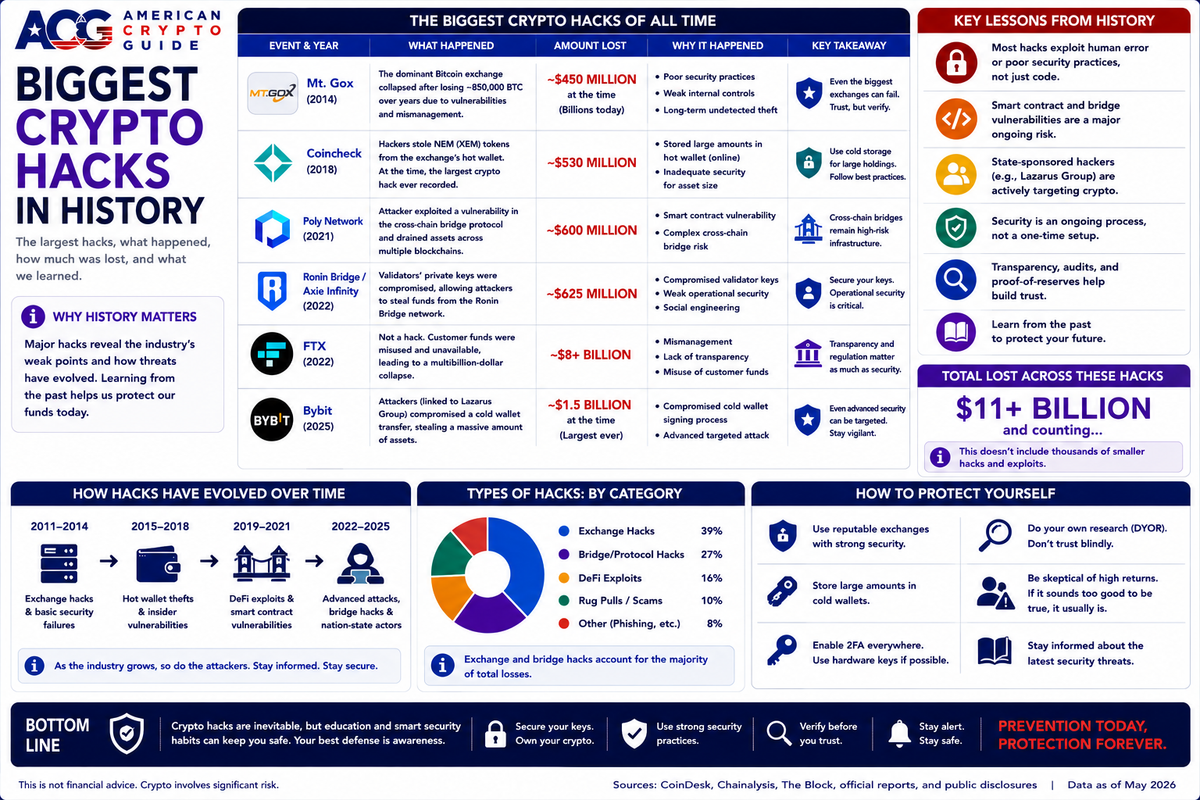
At its peak, Mt. Gox handled over 70% of all Bitcoin transactions worldwide, making it the dominant exchange of crypto’s early years. In February 2014, the exchange collapsed after revealing it had lost approximately 850,000 Bitcoin — worth roughly $450 million at the time, and worth many billions of dollars at various points since — through a combination of technical vulnerabilities and mismanagement that had reportedly been draining the exchange’s holdings for years before the collapse became public. Mt. Gox remains the reference point for «how bad can an exchange failure get» in crypto conversations more than a decade later, and its bankruptcy proceedings are, remarkably, still working through partial creditor repayments in recent years.
 You might also likeWhat Is Bitcoin? A Complete Beginner’s Guide
Coincheck (2018) — the hack that briefly topped Mt. Gox
In January 2018, Japanese exchange Coincheck lost approximately $530 million worth of NEM tokens in what was, at the time, the largest crypto hack ever recorded, surpassing even Mt. Gox in dollar terms. The breach exploited the fact that Coincheck was storing the stolen assets in a hot wallet — connected to the internet — rather than offline cold storage, despite the amounts involved being large enough to warrant the stronger protection. The incident became a widely cited case study specifically because the failure wasn’t a novel technical exploit; it was a well-understood best practice (cold storage for large holdings) simply not being followed at scale.
Poly Network (2021) — the hack the attacker gave back
In August 2021, an attacker exploited a vulnerability in Poly Network’s cross-chain bridge protocol — software connecting different blockchains — to drain over $600 million in assets across multiple chains. In an unusual turn, the attacker began returning the stolen funds within days, communicating publicly that the hack was intended to expose the vulnerability rather than to permanently steal the assets, eventually returning nearly all of it. Whatever the attacker’s actual motivation, the incident highlighted a security category that would prove recurring and costly in the years that followed: cross-chain bridges, which connect otherwise separate blockchains, have consistently proven to be among the most exploited pieces of infrastructure in the entire industry.
Ronin Bridge / Axie Infinity (2022) — a nation-state actor gets involved
In March 2022, the Ronin Bridge — infrastructure supporting the popular blockchain game Axie Infinity — was exploited for approximately $625 million, at the time the largest crypto hack ever recorded. US authorities subsequently attributed the attack to the Lazarus Group, a hacking organization linked to North Korea, which has been connected to numerous other major crypto thefts before and since. The Ronin hack specifically exploited compromised validator keys — the cryptographic signatures required to approve transactions on the bridge — rather than a flaw in the underlying blockchain itself, illustrating how bridge security often depends as much on operational key management as on code quality.
Worth sitting with: state-sponsored hacking groups targeting crypto infrastructure represent a meaningfully different threat category than opportunistic individual hackers — with more resources, more patience, and more sophisticated social engineering capabilities. Several of the largest hacks in recent years share this same attribution, a pattern that’s reshaped how seriously the industry treats bridge and validator security specifically.
FTX (2022) — not a hack, but essential context
FTX’s collapse in November 2022 wasn’t a hack in the technical sense — it was the discovery that customer funds had been misused and were unavailable when a wave of withdrawal requests hit the exchange, ultimately revealing a shortfall of billions of dollars and leading to criminal charges against its founder. It’s included here specifically because it’s frequently confused with a hack in casual conversation, and the distinction matters: a hack is an external technical breach; FTX was an internal failure of custody and honesty. Both categories cost users their funds, but they call for different kinds of vigilance — hacks are defended against through security practices, while custodial mismanagement is defended against primarily through choosing platforms with genuine transparency and regulatory accountability.
Bybit (2025) — the largest crypto hack ever recorded
In February 2025, exchange Bybit suffered a breach resulting in the theft of approximately $1.5 billion in digital assets, again attributed to the Lazarus Group, making it the largest single crypto hack in the industry’s history at the time. The attack reportedly compromised the exchange’s cold wallet transfer process itself — manipulating the interface a signer used to approve what appeared to be a routine transaction, redirecting funds instead. Bybit subsequently pursued legal action, including a US court injunction to freeze identified assets connected to the theft, illustrating the growing (though still limited) role civil legal tools play in the aftermath of major hacks.
📬Did you like this article?
Subscribe and receive our posts directly in your inbox. Free!
Sin spam. Puedes darte de baja cuando quieras.
The biggest crypto hacks compared
| Incident | Year | Approx. loss | Primary cause |
|---|---|---|---|
| Mt. Gox | 2014 | ~$450M (at the time) | Prolonged technical breach + mismanagement |
| Coincheck | 2018 | ~$530M | Large holdings left in a hot wallet |
| Poly Network | 2021 | ~$600M | Cross-chain bridge vulnerability (mostly returned) |
| Ronin Bridge | 2022 | ~$625M | Compromised validator keys, nation-state actor |
| FTX (custodial failure, not a hack) | 2022 | Billions (exact figure disputed) | Misuse of customer funds |
| Bybit | 2025 | ~$1.5B | Manipulated cold wallet signing process |
What these hacks have in common
Despite spanning over a decade and vastly different technical mechanisms, a few threads run through nearly every major incident on this list: large sums concentrated in a single point of failure, whether that’s a hot wallet, a bridge contract, or a signing process; operational or human error compounding a technical vulnerability, rather than a purely theoretical cryptographic break; and a gap between known best practices and what was actually implemented at the time of the breach. None of the hacks covered here resulted from someone breaking Bitcoin’s or Ethereum’s core cryptography directly — every one exploited a specific implementation, process, or custody decision layered on top of otherwise sound underlying technology.
How the industry has changed in response
Each major hack has left a measurable mark on subsequent security practices. Mt. Gox accelerated the shift toward offline cold storage as an industry standard rather than a nice-to-have. Coincheck reinforced that standard with a concrete, high-profile counterexample of what happens when it’s skipped. Bridge hacks like Poly Network and Ronin pushed serious investment into bridge-specific security audits and, in some cases, entirely different architectural approaches designed to reduce reliance on a small number of trusted validators. FTX’s collapse accelerated demand for proof-of-reserves reporting and stronger regulatory custody requirements industry-wide. Bybit’s 2025 breach has already prompted renewed scrutiny of cold wallet signing processes specifically, an area previously considered close to the gold standard of security.
A note on where these figures come from
Dollar figures attached to older hacks, including Mt. Gox and Coincheck, are typically calculated using the cryptocurrency’s price at the time of the theft — which means the same stolen amount can look dramatically different in today’s dollars depending on how much the underlying asset has appreciated since. Mt. Gox’s 850,000 stolen Bitcoin, valued at roughly $450 million in 2014, would represent a vastly larger sum at Bitcoin’s later prices — a distinction worth keeping in mind whenever hack rankings are compared purely by historical dollar figures rather than by the actual quantity of assets lost. Ongoing reporting and case tracking for major incidents like these is maintained by organizations such as Chainalysis, whose annual crypto crime reports are published at https://www.chainalysis.com.
Why bridges specifically keep getting targeted
Cross-chain bridges — the software connecting otherwise separate blockchains, letting assets move between them — show up disproportionately often in the largest hacks on this list, and that’s not a coincidence. A bridge typically has to hold a large pool of locked assets on one side to «back» the equivalent assets it issues on the other chain, concentrating significant value in a single smart contract or set of validator keys. That concentration makes bridges an unusually attractive target compared to, say, an individual user’s wallet: a single successful exploit can drain funds representing thousands of users at once, rather than one. This structural reality is a large part of why bridge security has become its own specialized field within crypto security research, distinct from general smart contract auditing.
None of these hacks happened to individual retail users directly — they happened to exchanges and protocols holding funds on behalf of many users at once. The practical lesson isn’t «avoid all exchanges forever,» which isn’t realistic for most people’s actual needs; it’s a more specific and actionable one: the largest losses in crypto history have consistently concentrated where large sums sat in a single custodial point of failure. Spreading meaningful holdings between a reputable exchange for active use and self-custody for long-term storage — rather than leaving everything in one place — directly addresses the exact pattern that shows up across nearly every incident on this list.
Final thoughts
Crypto’s biggest hacks read like a decade-plus case study in the same handful of lessons repeating in new forms: concentrate less risk in single points of failure, follow known security best practices even when they’re inconvenient, and treat custodial mismanagement as a genuinely different risk category from technical breaches. The dollar figures keep growing, but the underlying patterns — and the defenses that actually work against them — have stayed remarkably consistent.