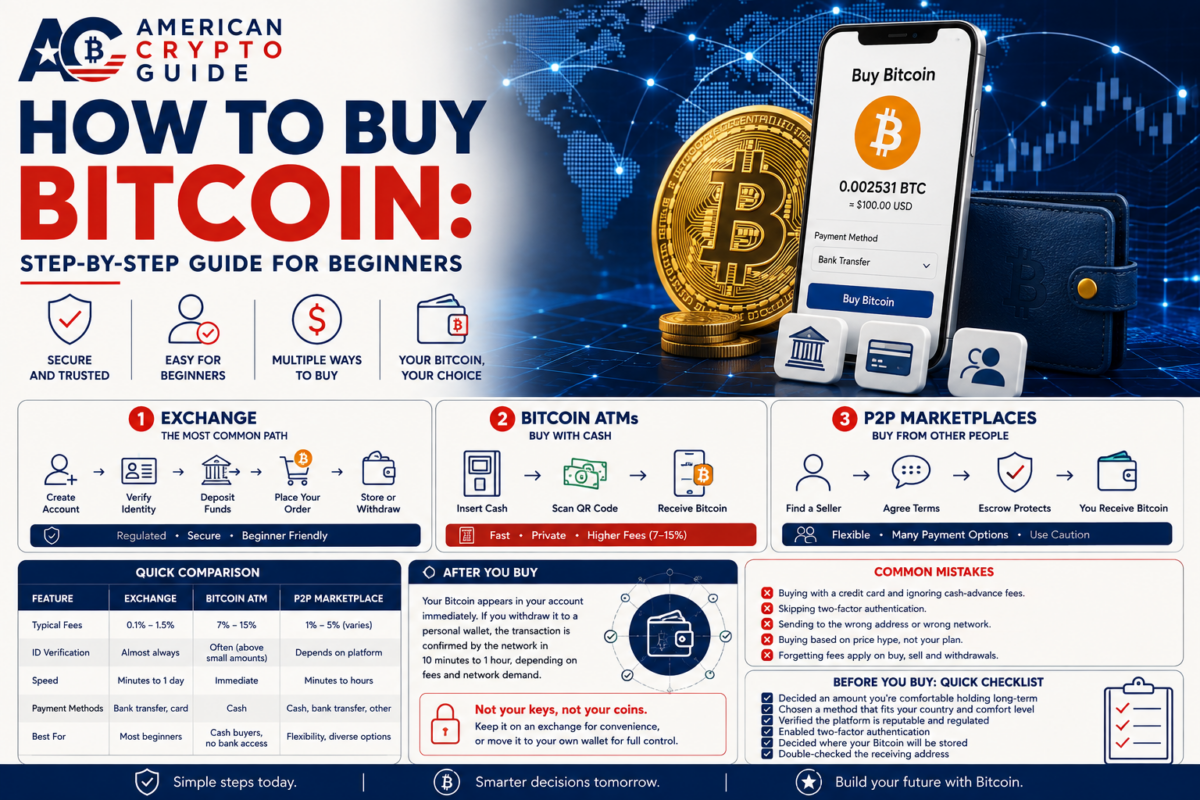
How to Buy Bitcoin: Step-by-Step Guide for Beginners.

Before you buy: three decisions that shape everything else
Buying Bitcoin isn’t one action — it’s the last step of three smaller decisions most beginners skip past without realizing it. Get these right first, and the actual «buy» button becomes the easy part.
 You might also likeWhat Is Bitcoin? A Complete Beginner’s Guide
1. How much do you actually want to buy? You don’t need a whole coin — Bitcoin is divisible down to 0.00000001 BTC. Most beginners start with an amount they’d be comfortable never seeing again, not an amount they hope to get rich from.
2. Where will the coins live afterward? On the platform you bought them from, or moved to a wallet you control? We’ll come back to this, but it’s worth deciding before you buy, not after.
3. Which method fits your country and comfort level? Not every option below is available everywhere, and some trade convenience for cost, or cost for privacy.
If you’re still fuzzy on what a wallet or a private key actually is, our guide on what Bitcoin actually is and how it works covers that groundwork first.
Method 1 — Buying through a regulated exchange (the most common path)
This is how the vast majority of beginners buy their first Bitcoin. An exchange is a company — regulated like a financial business in most countries — that lets you deposit regular currency and buy Bitcoin at the current market price.
Step 1: Choose an exchange
Look for one licensed to operate in your country, with a track record and transparent fees. Reputation and regulatory standing matter more here than shaving off a fraction of a percent in fees.
Step 2: Create and verify your account
You’ll typically need an email, a phone number, and a government ID for identity verification (known as KYC — «know your customer»). This step exists because exchanges are regulated financial businesses, not because of anything specific to you.
Step 3: Deposit funds
Bank transfer is usually the cheapest option; debit or credit card is faster but comes with higher fees, often 2–4% extra.
Step 4: Place your order
Two order types matter for beginners:
📬Did you like this article?
Subscribe and receive our posts directly in your inbox. Free!
Sin spam. Puedes darte de baja cuando quieras.
- Market order — buy immediately at the current price. Simple, and fine for small amounts.
- Limit order — set the exact price you’re willing to pay, and the order only executes if the market reaches it. Useful if you’re not in a rush.
Step 5: Decide what happens next
The coins now sit in your exchange account. That’s not the same as a personal wallet — more on that distinction below.
Method 2 — Bitcoin ATMs
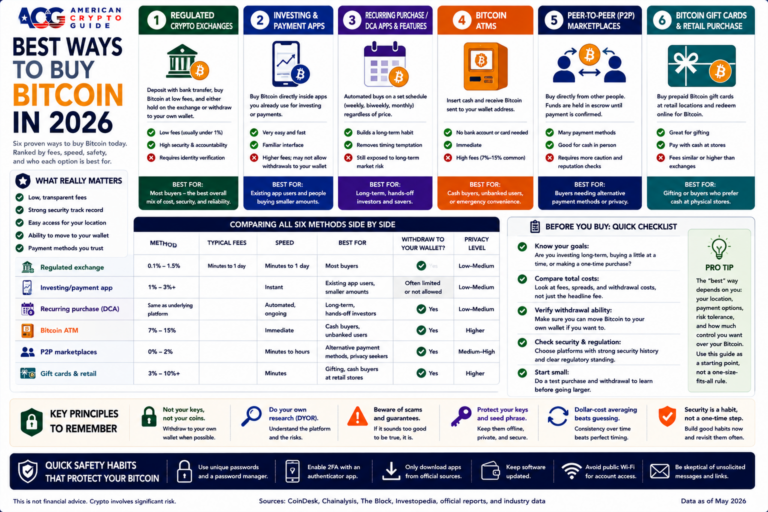
Bitcoin ATMs let you insert cash and receive Bitcoin sent directly to a wallet address, no bank account required. They’re useful if you want to buy with cash or don’t have easy access to traditional banking, but the trade-off is real: fees at Bitcoin ATMs commonly run 7–15%, several times higher than an online exchange.
A Bitcoin ATM is convenience you pay for directly — worth it occasionally, expensive as a habit.
Method 3 — Peer-to-peer (P2P) marketplaces
P2P platforms connect you directly with another person selling Bitcoin, with the platform holding the coins in escrow until payment is confirmed. This opens up more payment methods (including cash in person, in some cases) and works in places where exchanges have limited coverage, but it demands more caution: verify the counterparty’s reputation and never release funds outside the platform’s escrow protection.
Comparing your three main options
| Exchange | Bitcoin ATM | P2P marketplace | |
|---|---|---|---|
| Typical fees | 0.1%–1.5% | 7%–15% | Varies, often 1%–5% |
| ID verification required | Almost always | Often, above small amounts | Depends on platform |
| Speed | Minutes to 1 day | Immediate | Minutes to hours |
| Payment methods | Bank transfer, card | Cash | Cash, bank transfer, other options |
| Best for | Most beginners | Cash buyers, no bank access | Flexibility, less common payment methods |
What happens after you click «buy»
Once your order fills, the Bitcoin appears in your exchange balance almost immediately. Behind the scenes, if you withdraw it to an external wallet, that transaction gets broadcast to the Bitcoin network and confirmed by miners — typically taking anywhere from 10 minutes to an hour depending on the fee you pay and how busy the network is.
Should you leave it on the exchange, or move it to your own wallet?
This is the single most debated question among beginners, and there’s a well-known saying in the space: «not your keys, not your coins.» Leaving Bitcoin on an exchange means trusting that company with custody — convenient, but it carries the same risk as leaving money at any company that could be hacked, mismanaged, or restrict withdrawals. Moving it to a wallet you control removes that dependency, but makes you fully responsible for backing up your private key correctly.
There’s no universally correct answer:
- Smaller, active amounts you might trade again soon are commonly left on a reputable exchange.
- Larger amounts you plan to hold long-term are more commonly moved to a personal wallet, often a hardware wallet.
Common first-purchase mistakes
- Buying with a credit card and ignoring cash-advance fees some card issuers apply to crypto purchases.
- Skipping two-factor authentication on the exchange account, leaving it protected by a password alone.
- Sending a test transaction to the wrong address format — Bitcoin addresses aren’t interchangeable with other cryptocurrencies’ addresses.
- Buying based on price hype rather than an amount decided on calmly beforehand.
- Forgetting that fees apply on both the buy and the eventual sell or withdrawal, not just the purchase.
A simple checklist before you buy
- [ ] Decided an amount you’re comfortable holding long-term
- [ ] Chosen a method that fits your country and comfort level
- [ ] Verified the exchange or platform is reputable and regulated where required
- [ ] Enabled two-factor authentication on the account
- [ ] Decided whether coins will stay on the platform or move to a personal wallet
- [ ] Double-checked the receiving address before confirming any withdrawal
Buying Bitcoin for the first time feels like a bigger decision than it needs to be, mostly because of how much conflicting advice exists online. The mechanics themselves are closer to opening a brokerage account than anything exotic — the part that actually deserves your attention is what happens after the purchase, not the purchase itself.