Best Ways to Buy Bitcoin in 2026

Ranking the methods by what actually matters
Six genuinely different ways exist to buy Bitcoin in 2026, and none of them is universally «best» — each trades off cost, speed, privacy, and convenience differently. This list ranks them by a combination of typical fees, accessibility, and safety, with an honest note on who each option actually fits, rather than pretending one single winner works for everyone.
 You might also likeWhat Is Bitcoin? A Complete Beginner’s Guide
#1 — Regulated crypto exchanges
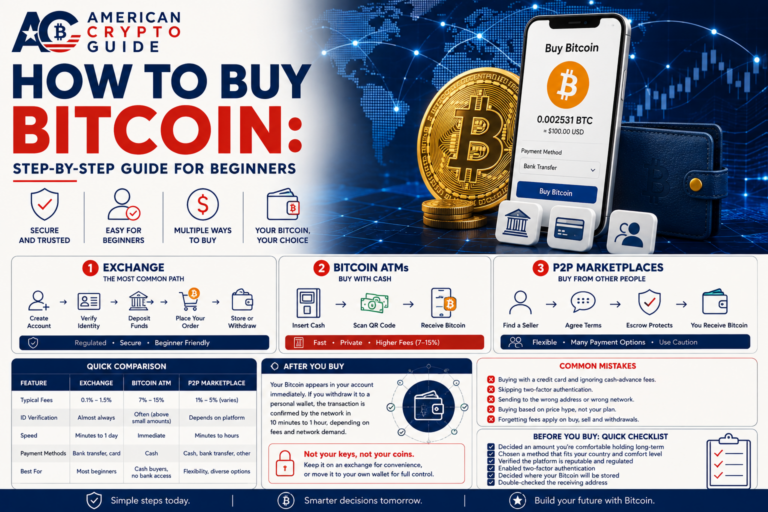
For the large majority of buyers, a regulated exchange remains the best overall combination of low fees, security, and reliability. Platforms with a strong security track record let you deposit via bank transfer, often at fees well under 1%, with straightforward identity verification and the option to either hold funds on the platform or withdraw to your own wallet. The main friction is the identity verification step itself, which some buyers find unnecessary for smaller purchases — but that same verification is part of what makes regulated exchanges more accountable and traceable than less formal alternatives.
#2 — Investing and payment apps with built-in crypto
Mainstream investing and payment apps — the kind many people already use for stocks or everyday payments — have increasingly added Bitcoin purchase options directly inside their existing interface. This is often the lowest-friction entry point for someone already comfortable with the app for other purposes, since there’s no new account to create. The trade-off is usually higher fees than a dedicated crypto exchange, and in some cases, restrictions on withdrawing the Bitcoin to an external wallet — meaning your coins stay locked inside that specific app’s ecosystem rather than becoming fully yours in the self-custody sense.
Worth checking before you buy through any of these apps: whether Bitcoin purchased through the app can actually be withdrawn to an external wallet at all. Some apps only allow buying and selling within their own platform, which functions more like a price-tracking IOU than true ownership of the underlying asset.
#3 — Recurring purchase / dollar-cost averaging apps and features
Many exchanges and apps now offer automated recurring purchases — buying a fixed dollar amount on a set schedule (weekly, biweekly, monthly) regardless of price. This isn’t a separate platform so much as a feature worth specifically seeking out, since it removes the temptation to time purchases around short-term price movements, a pattern that tends to work against less experienced investors more than it helps them. Setting up a recurring buy is usually a checkbox or toggle within an exchange’s standard interface, rather than a separate signup process.
#4 — Bitcoin ATMs
Bitcoin ATMs let you insert cash and receive Bitcoin sent directly to a wallet address, with no bank account or card required — genuinely useful for anyone without easy access to traditional banking, or who specifically wants to pay with cash. The trade-off is real: fees at Bitcoin ATMs commonly range from 7% to 15%, several times higher than a typical online exchange, making this a convenience purchase rather than a cost-efficient one for anyone buying regularly.
#5 — Peer-to-peer (P2P) marketplaces
P2P platforms connect buyers directly with individual sellers, with the platform holding funds in escrow until payment is confirmed by both parties. This opens up payment methods exchanges typically don’t support, including cash in person in some cases, and can work well in regions with limited exchange coverage. It requires more caution than a centralized exchange: verifying a counterparty’s reputation and never releasing funds outside the platform’s escrow protection are essential, since disputes here are resolved by the platform rather than a bank’s fraud department.
📬Did you like this article?
Subscribe and receive our posts directly in your inbox. Free!
Sin spam. Puedes darte de baja cuando quieras.
#6 — Bitcoin gift cards and retail purchase
A smaller but genuinely available option: prepaid Bitcoin gift cards, purchasable at some retail locations, which can be redeemed for Bitcoin through the issuing platform. This method typically carries fees comparable to or higher than a standard exchange, and is most useful as a specific gifting option or for buyers who prefer paying with cash at a physical retail location over any digital payment method.
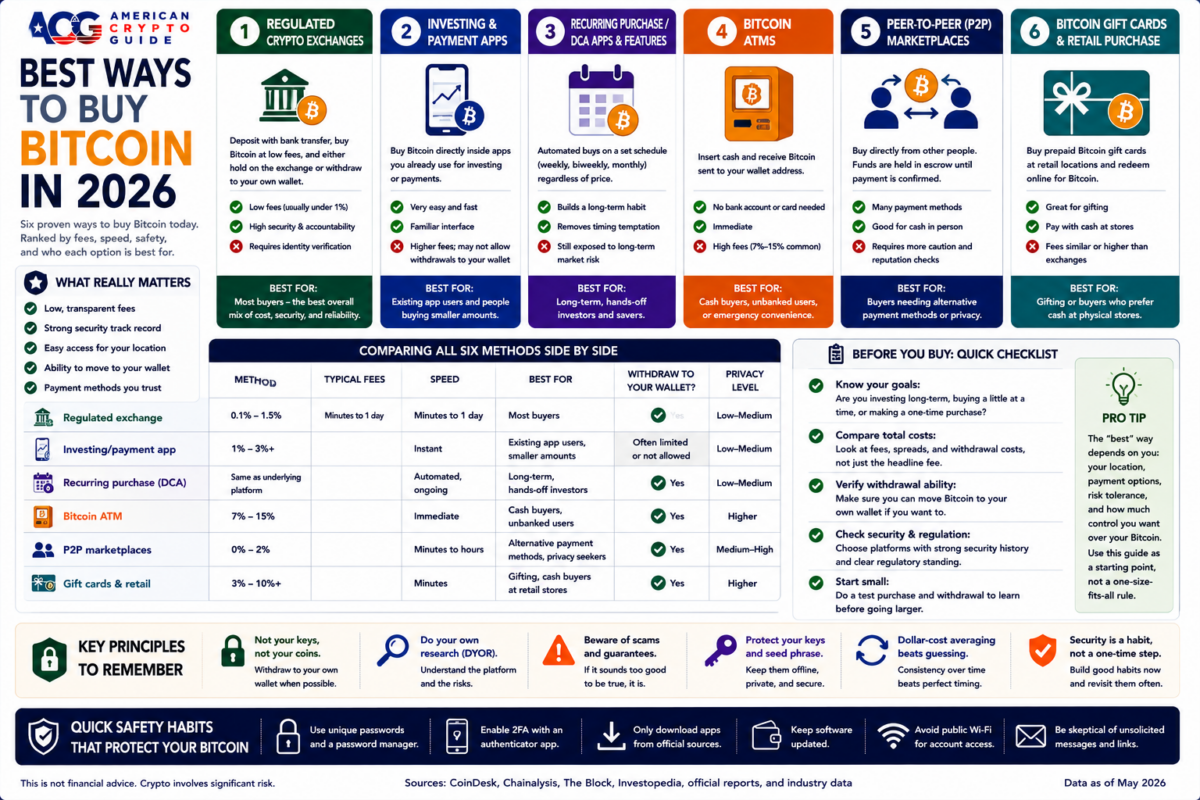
Comparing all six methods side by side
| Method | Typical fees | Speed | Best for |
|---|---|---|---|
| Regulated exchange | 0.1%–1.5% | Minutes to 1 day | Most buyers |
| Investing/payment app | 1%–3%+ | Instant | Existing app users, smaller amounts |
| Recurring purchase (DCA) | Same as underlying platform | Automated, ongoing | Long-term, hands-off investors |
| Bitcoin ATM | 7%–15% | Immediate | Cash buyers, no bank access |
| P2P marketplace | 1%–5%, varies | Minutes to hours | Flexible payment methods |
| Retail gift card | Comparable to or above exchange rates | Immediate at purchase, redemption may take longer | Cash-preferring buyers, gifting |
Which method actually fits which situation
- You want the lowest fees and plan to buy regularly: a regulated exchange, ideally paired with its recurring purchase feature.
- You already use an investing or payment app daily and want the simplest possible entry point: the app’s built-in crypto option, understanding the fee and withdrawal trade-offs going in.
- You’re building a long-term position without wanting to actively manage timing: a recurring purchase (DCA) setup on a low-fee exchange.
- You need to buy with cash and don’t have easy bank access: a Bitcoin ATM, accepting the higher fee as the cost of that specific convenience.
- You want payment flexibility an exchange doesn’t offer, or live somewhere with limited exchange coverage: a reputable P2P marketplace, with extra care taken on counterparty verification.
- You’re buying as a gift, or specifically want a cash-at-retail option: a Bitcoin gift card.
What to avoid regardless of which method you choose
- Any platform promising guaranteed returns or «doubling» your Bitcoin — this is a scam pattern regardless of how the purchase itself is framed.
- Buying more than you’re prepared to see drop significantly in value — Bitcoin’s price history includes multiple 50%+ declines, and purchase method doesn’t change that underlying volatility.
- Skipping two-factor authentication setup immediately after account creation, regardless of which platform you choose.
- Sending funds to a wallet address you haven’t carefully double-checked, particularly with P2P or ATM purchases where there’s no automated safety net catching a mistyped address.
- Assuming every method gives you the same thing. Bitcoin purchased through an app that doesn’t allow external withdrawal isn’t functionally identical to Bitcoin held in a wallet you fully control — know which one you’re actually getting before you buy.
How payment method affects your effective cost, beyond the platform’s fee
The platform’s advertised fee is only part of what a purchase actually costs. Payment method itself changes the total price in ways many buyers overlook: bank transfers are typically the cheapest funding method across nearly every platform type, since they carry lower processing costs than card payments. Debit and credit card purchases, by contrast, often carry an additional 2–4% surcharge on top of the platform’s base fee, and some credit card issuers separately classify crypto purchases as a cash advance — triggering yet another fee and, often, a higher interest rate that begins accruing immediately rather than during a standard grace period. Before assuming a platform’s advertised low fee is the full picture, checking how your specific chosen payment method is treated by both the platform and your card issuer is worth the extra few minutes.
Timing purchases: does it actually matter which method you use?
A common question once the «how» of buying is settled is whether the «when» matters just as much. For most buyers, the answer leans toward it mattering less than people assume, particularly for those using recurring purchases specifically to avoid the stress of timing decisions altogether. Attempting to time individual purchases around short-term price dips has a poor track record among casual investors, largely because predicting short-term price movements reliably has proven difficult even for professional traders with far more time and data than a casual buyer typically has access to. This is, again, part of why the recurring purchase method ranked above tends to outperform manually timed purchases for most people over a long enough horizon — not because it guarantees a better price on any single purchase, but because it removes a decision that’s genuinely difficult to get right consistently.
Rather than optimizing purely for the lowest fee on a single transaction, it’s worth weighing three questions together: How much am I buying? (Small amounts make ATM or app fees less consequential in absolute terms.) How often will I buy? (Frequent buyers benefit disproportionately from a low-fee exchange over time.) Do I want full control of the coins, or is convenience the priority? (This determines whether an investing app’s restrictions matter to you at all.) Answering these honestly narrows six options down to one or two sensible choices far faster than comparing every method’s fine print from scratch.
The US Consumer Financial Protection Bureau publishes general guidance on evaluating financial products and services, including newer categories like crypto purchase platforms, at https://www.consumerfinance.gov, a useful general resource alongside crypto-specific research when comparing any new platform.
Final thoughts
There’s no single best way to buy Bitcoin in 2026 — there’s a best method for your specific combination of purchase frequency, fee sensitivity, banking access, and how much control you want over the coins afterward. A regulated exchange remains the strongest default for most people, but the other five methods covered here each solve a real, specific need that a standard exchange doesn’t always address as well.