How Does Bitcoin Work? Explained Simply

The 60-second mental model
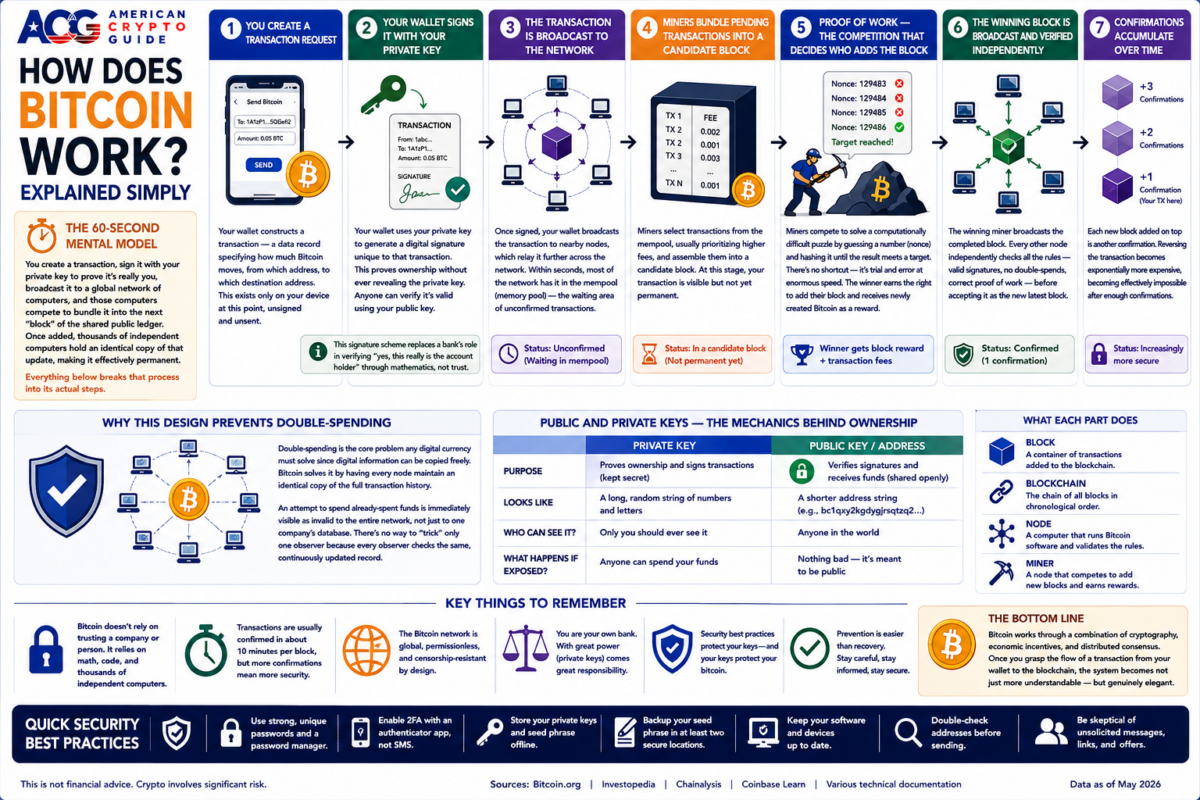
Before walking through the mechanics step by step, here’s the shape of the whole process in one paragraph: you create a transaction, sign it with your private key to prove it’s really you, broadcast it to a global network of computers, and those computers compete to bundle it into the next «block» of the shared public ledger. Once added, thousands of independent computers hold an identical copy of that update, making it effectively permanent. Everything below breaks that process into its actual steps.
Step 1: You create a transaction request
Sending Bitcoin starts with your wallet software constructing a transaction — a data record specifying how much Bitcoin moves, from which address, to which destination address. This isn’t yet visible to anyone else; it exists only on your device at this point, unsigned and unsent.
 You might also likeWhat Is Bitcoin? A Complete Beginner’s Guide
Step 2: Your wallet signs it with your private key
Before broadcasting, your wallet uses your private key — a secret number only you have — to generate a digital signature unique to that specific transaction. This signature mathematically proves the transaction came from the legitimate owner of the funds, without ever revealing the private key itself in the process. Anyone can later verify the signature is valid using your corresponding public key, but only someone holding the private key could have created it in the first place.
Worth understanding, not just memorizing: this signature scheme is what replaces a bank’s role in verifying «yes, this really is the account holder.» No password is transmitted, no central database is checked — the mathematics of the signature itself does that verification work, and it can be checked independently by anyone on the network.
Step 3: The transaction is broadcast to the network
Once signed, your wallet broadcasts the transaction to nearby nodes — computers running Bitcoin’s software — which relay it further across the network in a pattern similar to how a rumor spreads through a crowd. Within seconds, most of the globally distributed network has received a copy of your pending transaction, sitting in what’s called the mempool (memory pool) — the waiting area of transactions that haven’t yet been confirmed.
Step 4: Miners bundle pending transactions into a candidate block
Miners — specialized computers competing for a reward — select transactions from the mempool, typically prioritizing ones offering higher fees, and assemble them into a candidate block. At this stage, the transaction is visible on the network but not yet permanent; it could still theoretically be left out of the next block if a miner chooses differently.
Step 5: Proof of work — the competition that decides who adds the block
Miners then compete to solve a computationally difficult puzzle — repeatedly guessing a number and running it through a cryptographic function until the result meets a specific target. This process, called proof of work, has no shortcut; it’s pure trial and error at enormous speed. Whoever solves it first earns the right to add their candidate block to the chain and receives newly created Bitcoin as a reward.
Step 6: The winning block is broadcast and verified independently
Once a miner solves the puzzle, they broadcast the completed block to the rest of the network. Every other node independently checks that the block follows every rule — valid signatures, no double-spent funds, a correctly solved puzzle — before accepting it as the new latest block. This independent verification, performed by potentially thousands of separate computers rather than trusted from a single source, is what makes the ledger trustworthy without any central authority.
Step 7: Confirmations accumulate over time
Once included in a block, your transaction has one confirmation. As additional blocks are added on top of it — roughly every 10 minutes — the confirmation count increases, and reversing the transaction becomes progressively more computationally expensive with each additional block, to the point of being effectively impossible after enough confirmations accumulate. This is why services often wait for multiple confirmations before treating a large transaction as fully final.
📬Did you like this article?
Subscribe and receive our posts directly in your inbox. Free!
Sin spam. Puedes darte de baja cuando quieras.
Why this design prevents double-spending
Double-spending — attempting to spend the same Bitcoin twice — is the core problem any digital currency has to solve, since digital information can normally be copied freely. Bitcoin solves it through the combination of the steps above: every node maintains an identical copy of the full transaction history, so an attempt to spend already-spent funds is immediately visible as invalid to the entire network, not just to one company’s internal database. There’s no way to «trick» only one observer, because every observer is checking against the same shared, continuously updated record.
Public and private keys — the mechanics behind ownership
| Private key | Public key / address | |
|---|---|---|
| Purpose | Signs transactions, proves ownership | Receives funds, verifies signatures |
| Shared with anyone? | Never | Yes, this is its purpose |
| Derived from | Randomly generated (via seed phrase) | Mathematically derived from the private key |
| What happens if exposed | Total loss of funds at that address | Nothing — exposure is expected and safe |
The relationship between these two keys is a one-way mathematical function: it’s computationally trivial to derive a public key from a private key, but effectively impossible to reverse the process and derive the private key from the public key — the same asymmetry that underlies most modern cryptography, not just Bitcoin specifically.
Bitcoin’s ledger vs a traditional bank ledger
| Bitcoin’s ledger | A bank’s ledger | |
|---|---|---|
| Who maintains it | Thousands of independent nodes worldwide | The bank alone |
| Visibility | Fully public | Private to the bank and account holder |
| Update mechanism | Consensus among distributed nodes | Internal database update |
| Can a single party alter history | No, effectively impossible | Yes, technically possible internally |
| Speed of final settlement | Minutes to about an hour | Instant internally; days for international transfers |
What «decentralized» actually means in this specific process
The word «decentralized» gets used loosely in crypto conversations, but in the context of how Bitcoin works, it has a precise meaning: no single computer, company, or person controls which transactions get added to the ledger. Thousands of independently operated nodes each enforce the same rules and independently verify every block, and miners compete openly rather than being appointed by any authority. This is different from, say, a company’s internal database being «distributed» across multiple servers it still owns and controls — Bitcoin’s nodes are run by unrelated, independent parties worldwide with no single entity able to unilaterally change the rules for everyone else.
What happens to the transaction fee you pay
Every Bitcoin transaction typically includes a small fee, paid to whichever miner successfully includes it in a block. This fee isn’t a fixed amount set by any authority — it’s effectively a bid: transactions offering a higher fee relative to their data size get prioritized by miners assembling the next block, since miners are financially motivated to include the most profitable set of transactions available in the limited space each block allows. During quiet periods, fees can be negligible; during high-demand periods, they rise as users compete for limited block space. This fee market is also part of why «how does Bitcoin work» naturally leads to «why do fees fluctuate» — both are consequences of the same underlying block-space auction happening every ten minutes.
Why block time is roughly ten minutes, not faster
Bitcoin’s roughly 10-minute average block time isn’t an arbitrary technical limitation — it’s a deliberate design choice balancing two competing needs. A faster block time would let transactions confirm more quickly, but it would also increase the chance of two miners solving a block at nearly the same moment, creating temporary competing versions of the ledger that the network would need to reconcile. Ten minutes gives enough time for a newly found block to propagate across the globally distributed network before the next one is likely to be found, keeping the number of these temporary conflicts low and making the overall system more reliable, even at the cost of slower individual transaction confirmation compared to a centralized payment system.
- «Mining searches for actual bitcoins hidden somewhere.» Mining doesn’t discover anything physical — it’s a computational competition to add the next block, with new Bitcoin issued as a reward for winning that competition.
- «Transactions are instant.» Broadcasting is nearly instant, but confirmation — the point where a transaction becomes practically irreversible — takes minutes to roughly an hour, depending on the fee paid and network conditions.
- «Bitcoin transactions are completely anonymous.» They’re pseudonymous — addresses aren’t automatically tied to real names, but the entire transaction history is public and permanently traceable between addresses.
- «A private key is the same thing as a password.» A password is checked against a stored copy somewhere; a private key generates a cryptographic signature that’s verified mathematically, with nothing equivalent to a password ever transmitted or stored centrally.
Bitcoin’s original technical design is documented in its founding paper, still publicly available at https://bitcoin.org/bitcoin.pdf, for anyone wanting to read the mechanics described here directly from the source.
Final thoughts
Bitcoin’s process can sound abstract described in a single sentence — «a decentralized, cryptographically secured ledger» — but broken into its actual steps, it’s a fairly linear sequence: sign, broadcast, bundle, compete, verify, confirm. Each step exists to solve a specific problem that a system without a central authority would otherwise face, and understanding that sequence is what turns Bitcoin from a vague concept into a system whose behavior — fees, confirmation times, irreversibility — actually makes sense.