
How Bitcoin ETFs Are Changing the Market

What a Bitcoin ETF actually is (and isn’t)
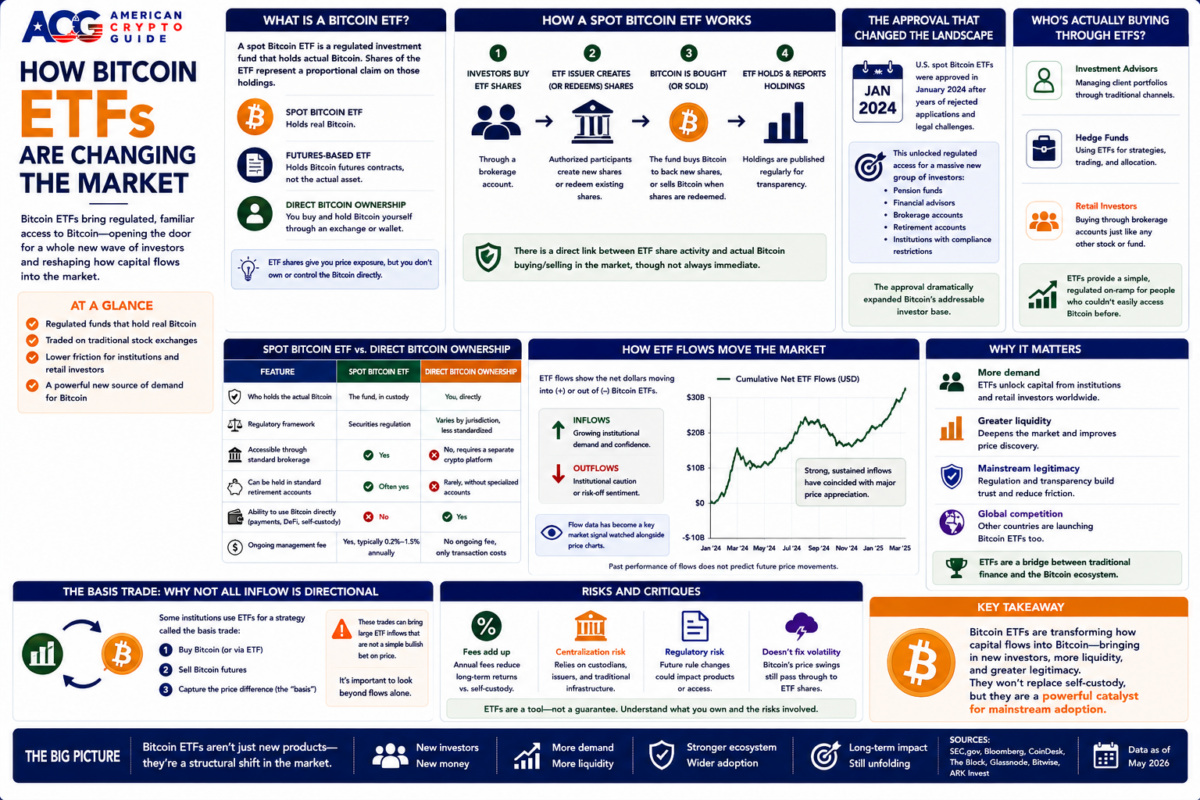
A spot Bitcoin ETF is a regulated investment fund, traded on a traditional stock exchange, that holds actual Bitcoin and issues shares representing a proportional claim on those holdings. Buying a share gives an investor price exposure to Bitcoin without directly holding it, managing a wallet, or dealing with an exchange account — the fund handles custody and the underlying purchase entirely. This is meaningfully different from a futures-based ETF, which holds contracts betting on Bitcoin’s future price rather than the asset itself, and different again from simply buying Bitcoin directly through an exchange, where the investor holds (or can withdraw) the actual asset.
 You might also likeWhat Is Bitcoin? A Complete Beginner’s Guide
How a spot Bitcoin ETF actually works, mechanically
When investors buy shares of a spot Bitcoin ETF, the fund issuer (or an authorized intermediary) typically needs to acquire additional Bitcoin to back those new shares, and conversely may need to sell Bitcoin when shares are redeemed. This creates a direct, though not always immediate, link between ETF trading activity and actual Bitcoin buying and selling in the underlying market. The fund publishes its holdings and share structure regularly, giving investors and outside observers visibility into approximately how much Bitcoin sits behind the fund at any given time — a level of transparency and regulatory reporting that direct crypto exchange holdings don’t typically provide to the same degree.
Worth understanding clearly: an ETF share isn’t literally Bitcoin — it’s a claim on Bitcoin held by the fund, governed by traditional securities regulations rather than crypto-specific rules. That distinction shapes nearly everything else about how ETFs behave differently from direct ownership.
The approval that changed the landscape
US spot Bitcoin ETFs received regulatory approval in January 2024, following years of prior rejected applications and legal challenges. This approval mattered less for the specific date itself and more for what it structurally unlocked: regulated access for institutional and retail investors who were previously unable or unwilling to hold crypto directly — pension funds, financial advisors managing client portfolios through traditional brokerage platforms, and retirement accounts with restrictions on directly holding digital assets. The approval effectively extended Bitcoin’s addressable investor base far beyond the crypto-native audience that had driven earlier market cycles.
Who’s actually buying through ETFs
ETF ownership data, disclosed through regulatory filings, has revealed a genuinely broad buyer base: registered investment advisors managing client portfolios, hedge funds using ETF shares as part of broader trading strategies, and a meaningful share of direct retail investment through standard brokerage accounts. This diversity matters because it represents demand that, in prior cycles, simply had no easy regulated pathway into Bitcoin exposure — a financial advisor managing a client’s retirement account generally couldn’t (and often still can’t) simply buy Bitcoin directly on an exchange on the client’s behalf, but can buy ETF shares through the same brokerage infrastructure used for any other fund.
How ETF flows move the market
Financial media closely tracks daily and weekly ETF flow data — the net dollar amount moving into or out of these funds — as a proxy for institutional sentiment toward Bitcoin. Sustained inflows suggest growing institutional demand; sustained outflows suggest the opposite. This data has become a genuinely influential market signal, watched alongside price charts themselves, precisely because it offers visibility into a category of buyer that was previously difficult to observe directly.
| Spot Bitcoin ETF | Direct Bitcoin ownership | |
|---|---|---|
| Who holds the actual Bitcoin | The fund, in custody | You, directly |
| Regulatory framework | Securities regulation | Varies by jurisdiction, less standardized |
| Accessible through standard brokerage | Yes | No, requires a separate crypto platform |
| Can be held in standard retirement accounts | Often yes | Rarely, without specialized accounts |
| Ability to use Bitcoin directly (payments, DeFi, self-custody) | No | Yes |
| Ongoing management fee | Yes, typically 0.2%-1.5% annually | No ongoing fee, only transaction costs |
The basis trade — why not all ETF inflow is directional
A significant nuance often missing from casual ETF flow coverage: not every dollar flowing into a Bitcoin ETF represents a straightforward bullish bet on price. Some institutional desks run a basis trade — buying spot ETF shares while simultaneously shorting Bitcoin futures contracts — to capture a yield spread between the two markets, largely market-neutral on Bitcoin’s actual price direction. This means gross ETF inflow figures can overstate genuine directional bullish sentiment during periods when this trade is particularly attractive, a distinction worth understanding before treating every inflow headline as a simple demand signal.
📬Did you like this article?
Subscribe and receive our posts directly in your inbox. Free!
Sin spam. Puedes darte de baja cuando quieras.
Fees and the competitive landscape among providers
Since the initial wave of approvals, competition among ETF issuers has pushed management fees down considerably from early levels, with several major providers offering fee waivers or reduced rates to attract early asset flows. This fee competition matters for long-term holders specifically, since even a modest annual percentage fee compounds meaningfully over years of holding — making fee comparison a genuinely relevant factor for anyone choosing between competing funds offering essentially the same underlying exposure.
What ETFs don’t give you
- No direct use of the underlying Bitcoin. ETF shares can’t be spent, sent, or used to interact with crypto applications the way directly held Bitcoin can.
- No self-custody. You’re trusting the fund’s custodian, not holding your own private keys — a meaningfully different security and control model.
- Trading hours limited to traditional market hours, unlike Bitcoin itself, which trades continuously, meaning ETF prices can gap significantly at market open following news that broke while markets were closed.
- An ongoing management fee, unlike simply holding Bitcoin directly, which carries no recurring cost beyond the initial transaction.
The global ETF landscape beyond the US
While US spot Bitcoin ETF approval drew the most attention, several other jurisdictions had already launched similar regulated products earlier, including Canada, which approved spot Bitcoin ETFs years before the US did. Europe has similarly developed exchange-traded products offering Bitcoin exposure, though regulatory structures and specific product types vary by country. This broader global infrastructure reinforces the same underlying trend: regulated, exchange-traded access to Bitcoin has expanded considerably beyond crypto-native platforms across multiple major markets, not just the United States specifically.
How ETFs have reshaped market narrative and coverage
Financial media that previously covered Bitcoin primarily through a crypto-specific lens now regularly covers it alongside traditional asset classes, largely because ETF structures make Bitcoin directly comparable to other exchange-traded holdings in a portfolio context. This shift in coverage has, in turn, influenced how a broader audience encounters Bitcoin-related news — increasingly through the same financial outlets and analysis used for stocks and bonds, rather than exclusively through crypto-specific publications. The US Securities and Exchange Commission publishes its own documentation on ETF regulation and investor considerations at https://www.sec.gov/investor, a useful primary source for understanding the regulatory framework these products actually operate under.
How ETF approval affected Bitcoin’s supply dynamics
Beyond opening a new category of buyer, spot Bitcoin ETFs introduced a structural dynamic worth understanding on the supply side as well. Each dollar of net ETF inflow that results in the fund purchasing additional Bitcoin represents coins moving out of circulating exchange liquidity and into long-term custodial holding on behalf of fund shareholders — similar in effect, though not identical in mechanism, to Bitcoin moving into cold storage. Sustained periods of net inflows can meaningfully reduce the amount of Bitcoin readily available for trading on exchanges, a dynamic some analysts point to as a contributing factor in periods of sharper price movement, since a smaller pool of liquid supply can be moved proportionally further by the same dollar amount of buying or selling pressure.
The role of authorized participants in keeping ETF prices aligned
A structural feature worth understanding is the role of authorized participants — typically large financial institutions with the ability to create or redeem large blocks of ETF shares directly with the fund, exchanging them for the underlying Bitcoin (or cash equivalent, depending on the fund’s specific redemption structure). This mechanism is what keeps an ETF’s trading price closely aligned with the actual value of the Bitcoin it holds; if the ETF’s share price drifted meaningfully away from the underlying asset’s value, authorized participants have a direct financial incentive to arbitrage that gap away by creating or redeeming shares. This is a standard mechanism across traditional ETFs generally, not unique to Bitcoin funds, but it’s worth understanding specifically in this context since it’s part of why ETF prices track spot Bitcoin prices as closely as they generally do, despite trading on an entirely separate market infrastructure during different hours.
Bitcoin ETFs haven’t changed what Bitcoin fundamentally is, but they’ve meaningfully changed who can easily access it and how that access gets tracked and reported, pulling a substantial new category of institutional and retail capital through familiar, regulated infrastructure. Understanding the mechanics — the basis trade, fee competition, what an ETF share does and doesn’t actually give you — matters more than treating every flow headline as a simple signal, since the reality behind those numbers is considerably more nuanced than the daily inflow or outflow figure alone suggests.