Ethereum Staking Rewards Explained

What «staking rewards» actually consist of
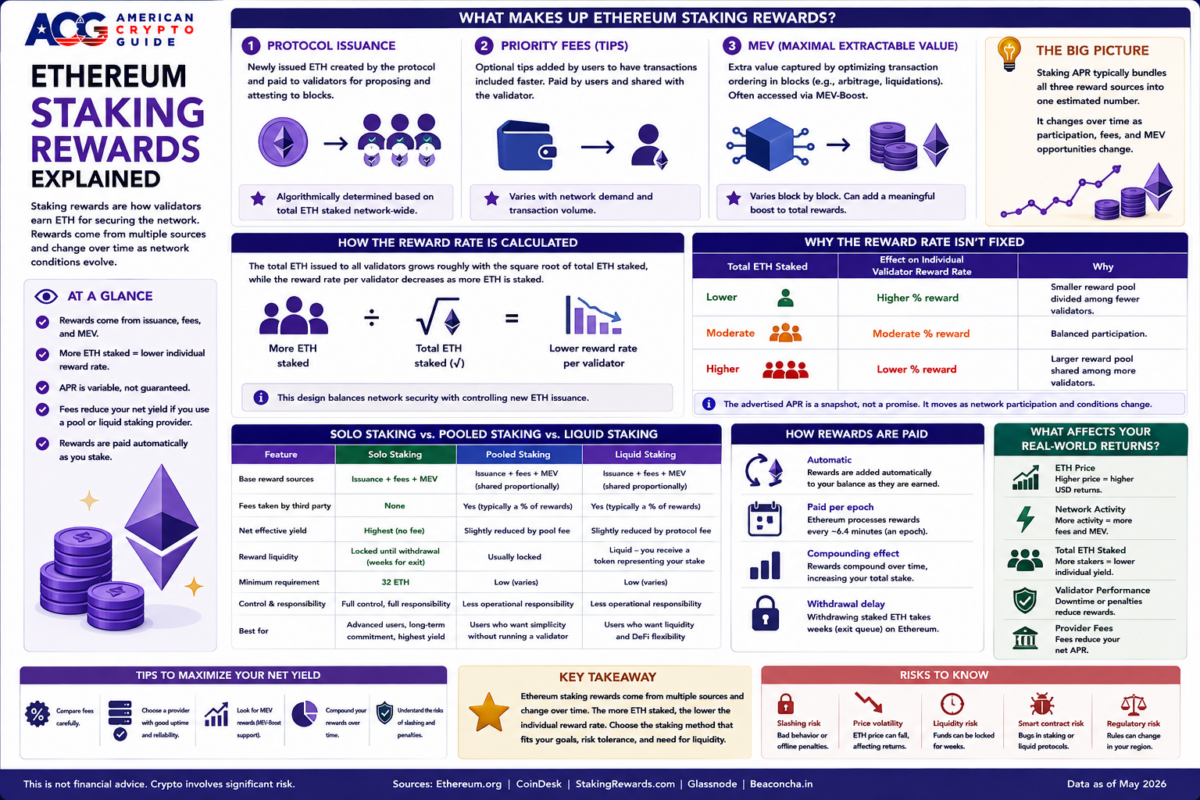
Ethereum staking rewards aren’t a single, simple interest payment — they’re made up of several distinct components, each with a different source and different variability. Understanding those components separately is what makes an advertised staking «APR» actually meaningful, rather than a single confusing number that seems to shift for no clear reason from one week to the next.
Source 1: Protocol issuance
The base component of staking rewards comes from newly issued ETH, created by the protocol specifically to compensate validators for proposing and attesting to blocks — the core work that keeps the network running. This issuance rate is determined algorithmically based on the total amount of ETH currently staked network-wide, following a formula built into Ethereum’s protocol rules rather than being set manually by any authority.
Source 2: Priority fees (tips)
Beyond newly issued ETH, validators also earn a share of priority fees — the optional «tip» users can add to a transaction to have it processed faster. Unlike protocol issuance, priority fee revenue fluctuates directly with network demand: busy periods with high transaction volume generate more in tips, while quiet periods generate less. This component is inherently less predictable than issuance, since it depends entirely on real-time network activity rather than a fixed formula.
Source 3: MEV (Maximal Extractable Value)
A less widely understood but genuinely significant component is MEV — additional value validators can capture by strategically ordering transactions within a block, for example by placing certain trades before or after specific user transactions in ways that generate extra profit. Most stakers today access MEV rewards indirectly through specialized software (often called MEV-boost) that outsources block construction to specialized builders competing to offer the highest value, with the resulting extra revenue passed back to the validator. This component varies considerably block to block, contributing an additional, somewhat unpredictable boost on top of the more stable issuance and fee components.
Worth understanding as a full picture: when you see an advertised Ethereum staking APR, it’s typically bundling all three of these sources into one estimated figure. That figure will drift over time as network conditions change, which is normal and expected — it’s not a sign that something is wrong with your specific staking setup.
How the reward rate is actually calculated
Ethereum’s issuance-based reward rate follows a formula where the total ETH being issued to all validators combined grows roughly with the square root of total ETH staked, while the reward rate per individual validator actually decreases as more total ETH joins staking. In plain terms: as more people stake, the total reward pool grows, but it gets divided among more participants, so each individual validator’s percentage return declines somewhat. This is a deliberate design choice, intended to balance encouraging enough staking to keep the network secure against not issuing excessive new ETH if participation grows very large.
Why the reward rate isn’t fixed
| Total ETH staked (illustrative) | Approximate effect on individual validator reward rate |
|---|---|
| Lower total staked | Higher percentage reward per validator |
| Moderate total staked | Moderate percentage reward per validator |
| Higher total staked | Lower percentage reward per validator |
This relationship means the «current APR» you’ll see quoted by any staking provider is a snapshot, not a guarantee — it moves gradually as the total amount of staked ETH network-wide shifts over time, which is itself influenced by price conditions, sentiment, and how attractive staking looks relative to other opportunities at any given moment.
Solo, pooled, and liquid staking rewards compared
| Solo staking | Pooled staking | Liquid staking | |
|---|---|---|---|
| Base reward source | Full issuance + fees + MEV | Same sources, shared proportionally | Same sources, shared proportionally |
| Fees taken by a third party | None | Yes, typically a percentage of rewards | Yes, typically a percentage of rewards |
| Net effective yield | Highest (no fee taken) | Slightly reduced by pool fee | Slightly reduced by protocol fee |
| Reward liquidity | Locked until withdrawal | Usually locked | Often liquid via the staking token itself |
Solo staking offers the highest net reward specifically because no intermediary is taking a cut — but it requires the 32 ETH minimum and meaningful technical setup covered elsewhere. Pooled and liquid staking sacrifice a portion of the reward for accessibility and, in liquid staking’s case, ongoing flexibility to use the staked position elsewhere while it continues earning.
What can reduce your rewards — penalties, downtime, and slashing
Staking rewards aren’t purely one-directional. Validators face several mechanisms that can reduce or, in serious cases, eliminate expected rewards:
📬Did you like this article?
Subscribe and receive our posts directly in your inbox. Free!
Sin spam. Puedes darte de baja cuando quieras.
- Inactivity penalties apply when a validator is offline and fails to perform its expected duties, resulting in small, ongoing reductions to that validator’s balance until it comes back online.
- Slashing is a much more serious penalty, applied when a validator behaves maliciously or is critically misconfigured — for example, signing conflicting blocks. Slashing results in an immediate loss of a portion of staked ETH and forced exit from the validator set, well beyond a simple missed reward.
- Pool or liquid staking provider fees, while not a penalty in the technical sense, function as a consistent reduction to the reward an individual staker actually receives compared to the full protocol-level rate.
For solo stakers specifically, maintaining reliable uptime and correctly configured software is the primary defense against the first two categories — a well-run validator on stable infrastructure faces minimal realistic risk of either.
Taxes on staking rewards — a brief but important note
In many jurisdictions, staking rewards are treated as taxable income at the time they’re received, based on their value at that moment, with a separate capital gains calculation applying later if and when the rewards are eventually sold. Tax treatment varies meaningfully by country and is an area still evolving in several jurisdictions, so consulting current guidance for your specific location — rather than assuming a single universal rule — is worth doing before treating staking income as straightforward passive earnings.
Realistic expectations — what a «good» APR actually means
Staking APRs fluctuate with total network participation and network activity, and any specific number quoted risks going stale quickly. What’s more durable than a specific figure is the underlying relationship: more total ETH staked network-wide generally means a lower individual reward rate, and higher network activity generally means higher fee and MEV revenue on top of the base issuance rate. Comparing a currently advertised APR against this relationship — rather than against a remembered number from a different point in the network’s staking history — gives a more accurate read on whether a specific offer is genuinely competitive.
Ethereum’s official documentation on staking rewards and their calculation is maintained at https://ethereum.org/staking, useful for checking current network-wide staking statistics directly rather than relying on a single provider’s advertised figure.
How rewards actually accrue and when you can access them
Rewards don’t arrive as a lump sum or a periodic deposit the way traditional interest payments often do — they accrue continuously as your validator performs its duties, added incrementally to your validator’s balance with each successful block proposal and attestation. For solo and pooled stakers, these accruing rewards typically remain locked alongside the original staked ETH until you initiate an exit from the validator set, at which point both the original stake and accumulated rewards become withdrawable, subject to the network’s exit queue at that time. Liquid staking works differently in practice: since the liquid staking token itself is designed to appreciate in value relative to ETH as rewards accrue, holders can effectively access the economic value of their rewards at any time by selling or swapping the token, without needing to formally exit a validator position first.
Comparing advertised rates across providers responsibly
When comparing staking rewards across different pooled or liquid staking providers, the advertised APR alone doesn’t tell the whole story. Two providers drawing from the same underlying network-wide reward pool can show different advertised rates due to differences in fee structure, how consistently their validators perform (avoiding downtime penalties), and how effectively they capture MEV through their block-building setup. A provider with a slightly lower advertised base rate but meaningfully better uptime and MEV capture can, in practice, deliver a comparable or better net return than a competitor advertising a marginally higher headline number. This is why looking at a provider’s actual historical performance and fee transparency matters more than comparing headline APR figures in isolation.
Ethereum staking rewards are the sum of three genuinely different sources — protocol issuance, priority fees, and MEV — combined into a single advertised rate that shifts as network conditions change. Understanding that composition, along with the trade-offs between solo, pooled, and liquid staking, turns a vague «staking APR» figure into something you can actually evaluate against your own priorities, rather than a number to simply trust at face value. The most useful habit going forward is checking a provider’s actual track record and fee structure directly, rather than anchoring a decision to whichever headline percentage happens to look highest at a glance.