Gemini Exchange Review 2026

The short verdict
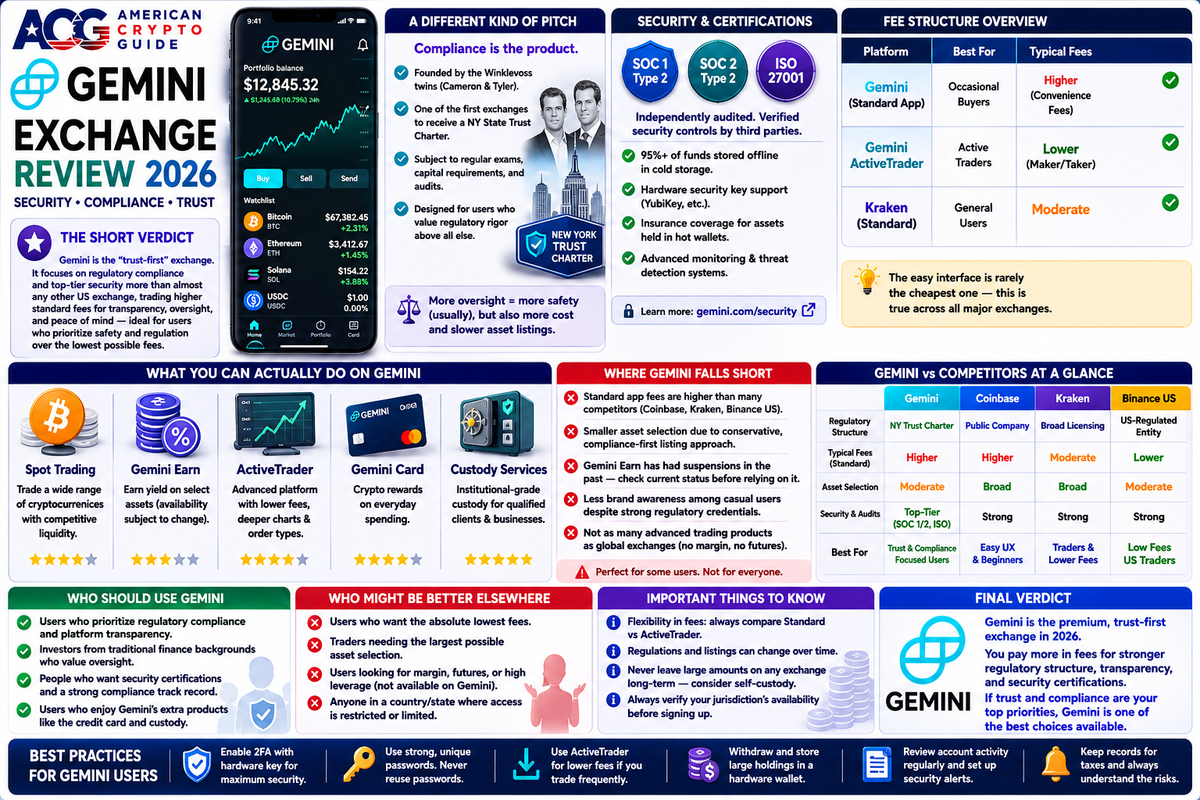
Gemini has built its reputation on regulatory compliance and security certifications more aggressively than almost any other US exchange, positioning itself as the «trust-first» option for users who prioritize regulatory rigor above all else. That positioning comes at a real cost — higher standard fees than several competitors — but for a specific type of user, particularly those coming from traditional finance, it remains one of the more defensible choices in 2026.
A different kind of pitch: compliance as the product
Founded by Cameron and Tyler Winklevoss, Gemini was built from the outset around the idea that regulatory compliance itself is a competitive advantage, not just a legal requirement to satisfy quietly. It was one of the first exchanges to obtain a New York State Trust Charter, subjecting it to a level of regulatory oversight — including regular examinations and capital requirements — that goes beyond what many competitors are required to meet. Whether that additional oversight matters to you depends on how much weight you place on regulatory structure specifically, as opposed to track record or fees alone.
Account setup and verification
Gemini’s onboarding follows the standard identity verification pattern common to regulated exchanges: email, phone, and government ID, with account limits generally tied to verification level. The process is comparable in friction to Coinbase and Kraken, without significant differentiation in this specific area.
Fee structure
Gemini’s standard fee structure has historically sat on the higher end among mainstream exchanges, similar in pattern to Coinbase’s standard app pricing, with a separate, lower-fee interface — ActiveTrader — aimed at more frequent traders.
| Gemini (standard app) | Gemini ActiveTrader | Kraken (standard) | |
|---|---|---|---|
| Typical fee on a smaller trade | Higher, convenience-fee style | Lower, maker/taker model | Moderate |
| Fee transparency | Less clear upfront | Clear fee schedule | Generally clear |
| Best for | Occasional buyers | Active traders | Cost-conscious general users |
Worth understanding, not just noting: this same standard-app-versus-pro-interface fee gap shows up across nearly every major regulated exchange, not just Gemini. It’s a consistent industry pattern worth remembering regardless of which specific platform you end up using — the «easy» interface is rarely the cheapest one.
Security features and certifications
Gemini has pursued security certifications more visibly than most competitors, including SOC 1 Type 2 and SOC 2 Type 2 audits — independent verification of its security controls conducted by outside auditors, rather than Gemini’s own claims alone. It stores the substantial majority of customer funds in offline cold storage and offers hardware security key support for two-factor authentication. Gemini also carries insurance coverage for assets held in its hot wallet, disclosed through its published security documentation at https://www.gemini.com/security.
What you can actually do on Gemini
- Spot trading across a solid, though not the industry’s largest, range of supported cryptocurrencies.
- Gemini Earn, a program for earning yield on select holdings (subject to changing availability based on regulatory and market conditions).
- ActiveTrader, the platform’s advanced, lower-fee trading interface with deeper charting tools.
- Gemini Pay and a branded credit card, extending crypto rewards and spending into more everyday financial products than most competitors offer.
- Custody services, aimed at institutional and high-net-worth users wanting regulated third-party custody rather than self-custody or standard exchange storage.
Where Gemini falls short
- Standard app fees are genuinely higher than several competitors, echoing the same criticism leveled at Coinbase’s default interface.
- Smaller asset selection than exchanges that prioritize rapid listing of newer tokens — a direct consequence of Gemini’s more conservative, compliance-first listing approach.
- Earn program history has included periods of suspended availability tied to broader market and regulatory events, worth researching current status before relying on it.
- Less brand recognition among casual crypto users compared to Coinbase, despite comparable or stronger regulatory credentials in some respects.
Gemini vs its direct competitors
| Gemini | Coinbase | Kraken | |
|---|---|---|---|
| Regulatory structure | NY Trust Charter | Broad US licensing | Broad US licensing |
| Security audits | SOC 1 & SOC 2 certified | Standard practices disclosed | Standard practices disclosed |
| Standard fees | Higher | Higher | Lower |
| Asset selection | Moderate | Broad | Broad |
Who should use Gemini
- Users who specifically prioritize regulatory structure and independent security certification over the broadest possible asset selection.
- Anyone interested in Gemini’s broader financial products — the credit card, Pay, and institutional custody options — as part of a more integrated ecosystem.
- Users coming from traditional finance who find Gemini’s compliance-forward positioning more reassuring than a less formally structured competitor.
Who might be better served elsewhere
- Fee-conscious users unwilling to use ActiveTrader, for whom Gemini’s standard app costs would add up faster than lower-fee alternatives.
- Users wanting access to a broader range of newer or smaller-cap tokens, which Gemini’s more conservative listing standards tend to limit.
A closer look at Gemini’s insurance and custody structure
One detail that separates Gemini from several competitors is how explicitly it separates and discloses its insurance coverage. Assets held in Gemini’s online hot wallet are covered by insurance obtained through a group of underwriters, while the much larger share of funds sitting in offline cold storage rely on the inherent security of being disconnected from the internet rather than insurance alone — a structure similar to what most major exchanges use, but one Gemini has historically been more explicit about documenting publicly.
📬Did you like this article?
Subscribe and receive our posts directly in your inbox. Free!
Sin spam. Puedes darte de baja cuando quieras.
For users specifically interested in institutional-grade custody, Gemini also operates a separate custody business aimed at funds, corporations, and high-net-worth individuals who need regulated third-party storage rather than either self-custody or a standard retail exchange account. This isn’t relevant to most individual beginners, but it’s part of why Gemini positions itself differently from purely retail-focused competitors — it’s built serious infrastructure for larger institutional clients alongside its consumer-facing app.
A distinction worth remembering: insurance on a crypto exchange almost never means «100% of your funds are guaranteed no matter what happens.» It typically covers specific scenarios, like a breach of the exchange’s own systems, and usually applies to a portion of total holdings rather than the entire balance. Reading the actual scope of any exchange’s coverage — Gemini included — matters more than the reassurance of the word «insured» on its own.
How Gemini has responded to past industry stress
The broader crypto industry has been through several periods of acute stress — exchange collapses, lending platform failures, and sharp market downturns — and how a platform handles those periods often reveals more than its marketing materials during calmer times. Gemini’s Earn program, which let users lend out holdings for yield through a third-party partner, was affected during one such period of industry-wide lending platform trouble, leading to withdrawal delays for affected users before funds were eventually made available again. It’s a useful case study, not to single Gemini out unfairly — several competitors had similar programs with similar exposure — but as a reminder that «yield» products on any exchange carry counterparty risk beyond the exchange’s own core security, since the yield itself typically comes from lending assets to a third party rather than the exchange holding them passively.
Gemini’s mobile app and everyday usability
Beyond the trading interfaces already covered, Gemini’s mobile app is worth evaluating on its own terms, since most casual users interact with an exchange primarily through their phone rather than a desktop browser. The app supports the core functions most users need — buying, selling, viewing balances, and basic portfolio tracking — with a design that leans toward calm and uncluttered rather than data-dense. For someone checking their holdings occasionally rather than actively trading throughout the day, that restraint is a genuine usability advantage, even if it means power users will eventually want to graduate to ActiveTrader for deeper functionality.
Gemini’s branded credit card, which offers cryptocurrency rewards on everyday purchases instead of traditional cash back or points, is another piece of that broader ecosystem strategy. It’s a niche product relevant mainly to users already comfortable holding crypto long-term, but it illustrates Gemini’s broader approach: building a connected set of financial products around the core exchange, rather than treating the exchange as a standalone destination.
Final verdict
Gemini’s core pitch in 2026 — regulatory rigor and independently audited security as the primary differentiator — is a genuine, verifiable claim, not just marketing language, backed by certifications competitors haven’t all pursued to the same degree. Whether that’s worth its higher standard fees comes down to how much you personally value that specific kind of assurance over raw cost or asset breadth. For a beginner weighing exchanges primarily on trust signals, Gemini’s SOC audits and trust charter are among the strongest documented credentials in the industry — worth the fee premium if that’s genuinely the deciding factor for you, and worth skipping past if ActiveTrader’s fee schedule was always going to be your actual endpoint anyway. Either way, the honest starting point is reading Gemini’s own published disclosures rather than any single review, this one included, and deciding for yourself how much that documented rigor is worth relative to what you’d pay elsewhere.