Kraken Review 2026: Is It Still a Top Exchange?

The short verdict
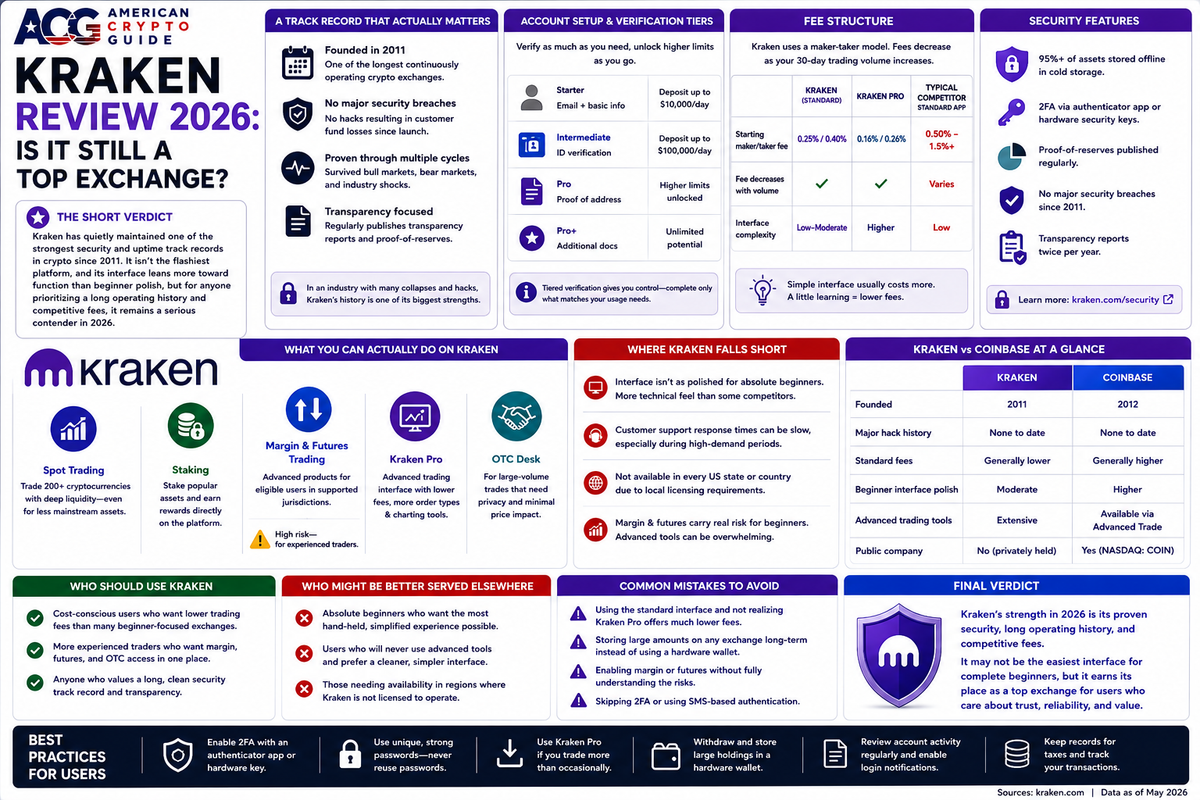
Kraken has quietly maintained one of the strongest security and uptime track records in the crypto exchange industry since launching in 2011, without the dramatic scandals that have taken down several higher-profile competitors over the years. It isn’t the flashiest platform, and its interface leans more toward function than beginner polish, but for anyone prioritizing a long operating history and genuinely competitive fees, it remains a serious contender in 2026.
A track record that actually matters
Kraken is one of the longest continuously operating cryptocurrency exchanges in existence, having launched in 2011 and survived multiple full market cycles without a major security breach resulting in customer fund loss. In an industry where exchange collapses and hacks have been common enough to become a recurring news category, that track record isn’t a minor detail — it’s arguably the single most important factor for anyone deciding where to trust meaningful funds.
Account setup and verification tiers
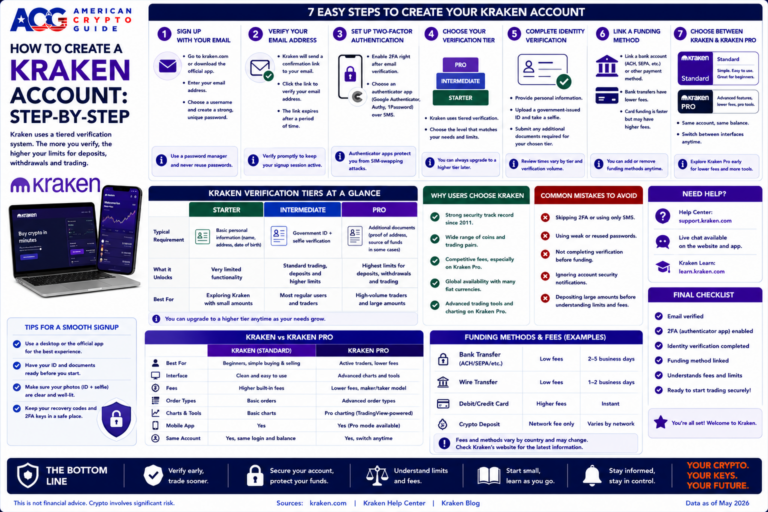
Kraken uses a tiered verification system, where the amount of personal information required scales with how much you want to deposit, withdraw, and trade. Basic tiers require standard information like email and identity verification; higher tiers unlock larger limits but require additional documentation. This tiered approach gives users more control over how much verification they complete relative to their actual usage needs, compared to platforms with a single all-or-nothing verification process.
Fee structure
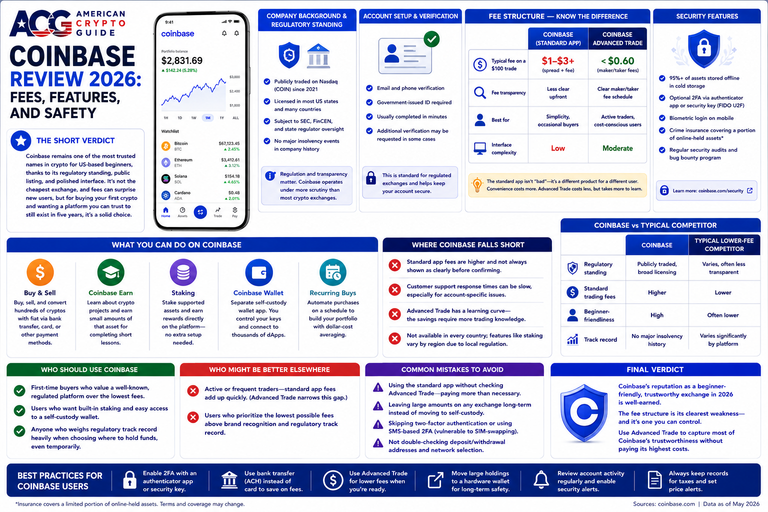
Kraken’s standard fee schedule is generally competitive with, and often lower than, Coinbase’s standard app pricing, using a maker-taker model where fees decrease as your 30-day trading volume increases.
📬Did you like this article?
Subscribe and receive our posts directly in your inbox. Free!
Sin spam. Puedes darte de baja cuando quieras.
| Kraken (standard) | Kraken Pro | Typical competitor standard app | |
|---|---|---|---|
| Starting maker/taker fee | 0.25%/0.40% | 0.16%/0.26% | 0.50%–1.5%+ |
| Fee decreases with volume | Yes | Yes | Varies by platform |
| Interface complexity | Low-moderate | Higher | Low |
Worth understanding, not just noting: Kraken Pro offers meaningfully lower fees than the standard interface, similar to how Coinbase’s Advanced Trade undercuts its own standard app. The pattern across major exchanges is consistent — the simplest interface usually isn’t the cheapest one, and a small amount of extra learning typically pays for itself quickly for anyone trading more than occasionally.
Security features
Kraken stores the large majority of customer funds in cold storage and has never suffered a hack resulting in customer losses since its founding — a genuinely rare claim among exchanges operating for over a decade. It offers robust two-factor authentication options, including hardware security key support, and has historically been proactive about publishing transparency reports and proof-of-reserves data, giving users independently verifiable insight into whether the exchange actually holds what it claims to. Kraken’s security practices are documented directly at https://www.kraken.com/security.
What you can actually do on Kraken
- Spot trading across a wide range of cryptocurrencies, with generally deep liquidity even for less mainstream assets.
- Staking, for a range of supported proof-of-stake assets, directly through the platform.
- Margin and futures trading, available to eligible users in supported jurisdictions — a feature set aimed more at experienced traders than beginners.
- Kraken Pro, a separate, more advanced trading interface with lower fees and deeper charting tools.
- OTC (over-the-counter) desk access for very large trades that would otherwise cause significant price impact on the open order book.
Where Kraken falls short
- Interface isn’t as polished for absolute beginners as some competitors — the standard trading view can feel more technical than necessary for someone making their first purchase.
- Customer support has drawn criticism in user reviews for response times during high-demand periods, a common complaint across the exchange industry broadly.
- Not available in every US state or country, due to varying local licensing requirements.
- Margin and futures products carry real risk that beginners specifically should approach cautiously, if at all — Kraken’s advanced feature set can be a downside for users who’d prefer those options simply weren’t visible by default.
Kraken vs Coinbase at a glance
| Kraken | Coinbase | |
|---|---|---|
| Founded | 2011 | 2012 |
| Major hack history | None to date | None to date |
| Standard fees | Generally lower | Generally higher |
| Beginner interface polish | Moderate | Higher |
| Advanced trading tools | Extensive | Available via Advanced Trade |
Who should use Kraken
- Cost-conscious users who want lower standard fees than several beginner-focused competitors offer by default.
- More experienced traders who want margin, futures, and OTC access without switching platforms.
- Anyone who weighs long-term security track record heavily, given Kraken’s unusually clean history for an exchange of its age.
Who might be better served elsewhere
- Absolute beginners who want the most hand-held interface possible — Kraken’s standard experience, while capable, isn’t designed primarily around minimizing every point of friction the way some newer, beginner-first platforms are.
- Users who will never touch margin, futures, or advanced trading tools and would rather not have those options cluttering the interface at all.
Final verdict
Kraken’s case for being a top exchange in 2026 rests less on flashy features and more on something harder to fake: over a decade of operating without a customer-fund-losing security incident, combined with genuinely competitive fees for users willing to spend a little time learning the platform. For anyone who values that track record as much as ease of use, it remains one of the stronger choices available.