Binance US Review 2026: Fees, Features, and Safety
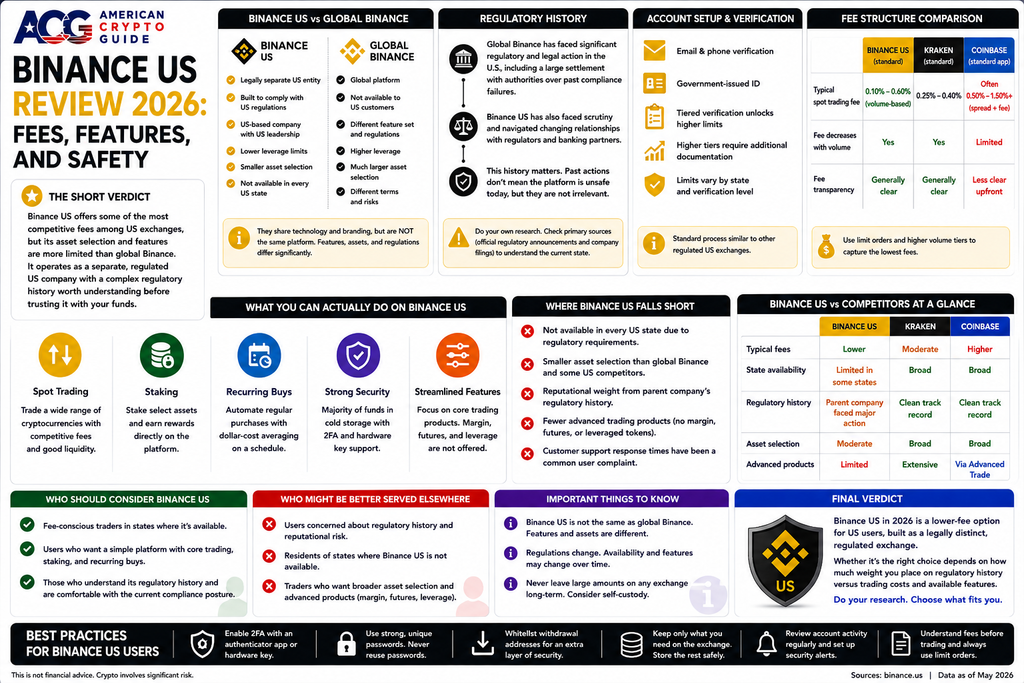
The short verdict
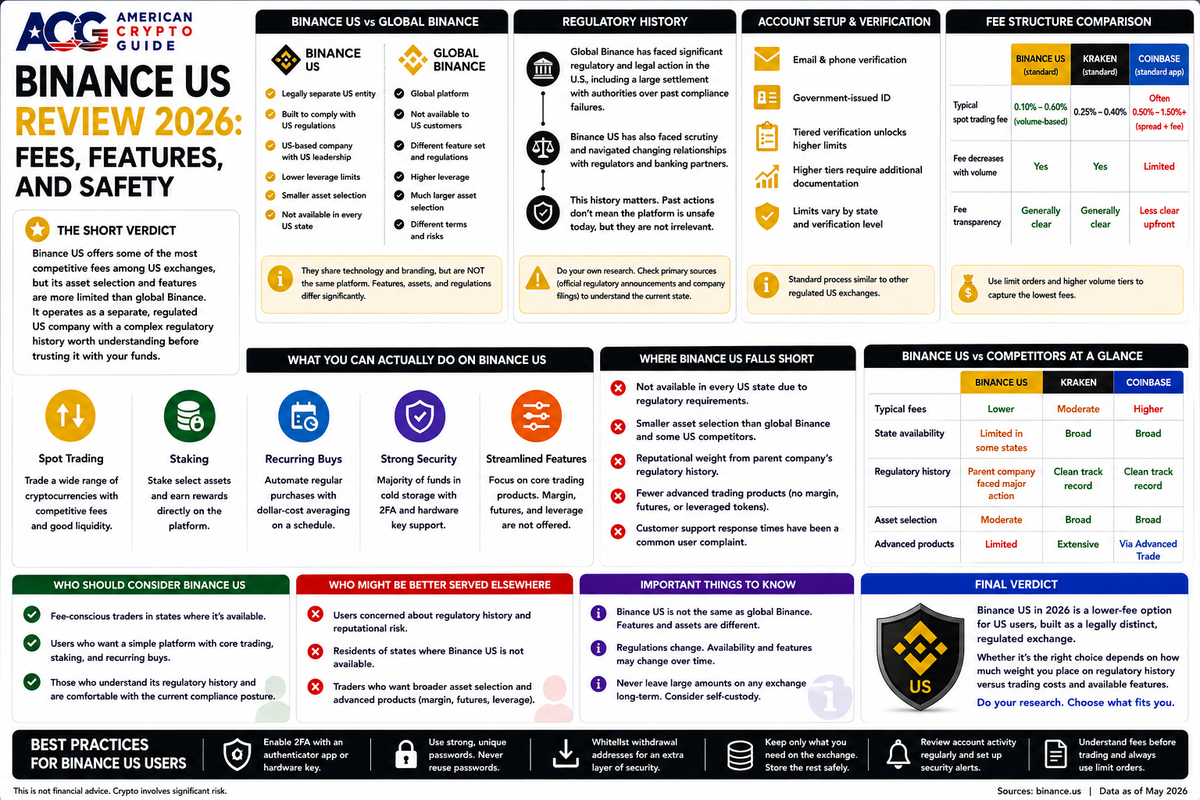
Binance US operates as a legally separate entity from the global Binance exchange, built specifically to comply with US regulation — a distinction that matters more than most reviews give it credit for. It offers some of the most competitive fees among US-available exchanges, but its feature set and available assets are noticeably more limited than the global Binance platform, and it’s carried the reputational weight of its parent company’s regulatory history. Here’s what that actually means for someone deciding whether to use it in 2026.
Understanding the Binance US and global Binance split
This is the single most important thing to understand before evaluating Binance US on its own merits: it is not the same platform as global Binance, despite sharing a name, branding, and some underlying technology. Binance US was set up as a separate US-based company specifically to operate within American regulatory requirements, following a licensing structure closer to domestic competitors like Coinbase and Kraken than to Binance’s international platform. Confusing the two — assuming Binance US has the same asset selection, leverage products, or global feature set as Binance.com — is a common and understandable mistake.
Regulatory history worth knowing
Binance, the global parent company, has faced significant regulatory and legal action in the United States, including a large settlement with US authorities over past compliance failures. Binance US itself has also faced scrutiny and had to navigate an evolving relationship with US regulators and banking partners. None of that history should be waved away — it’s a legitimate factor in evaluating trust, and worth reading about directly from primary sources like official regulatory announcements rather than secondhand summaries, including this one.
Worth being direct about: past regulatory settlements don’t automatically mean a platform is unsafe to use today, but they’re also not irrelevant history to ignore. The honest approach is weighing the current state of compliance and operations, not assuming either «it’s all fixed now» or «it’s permanently untrustworthy» without looking at what’s actually changed.
Account setup and verification
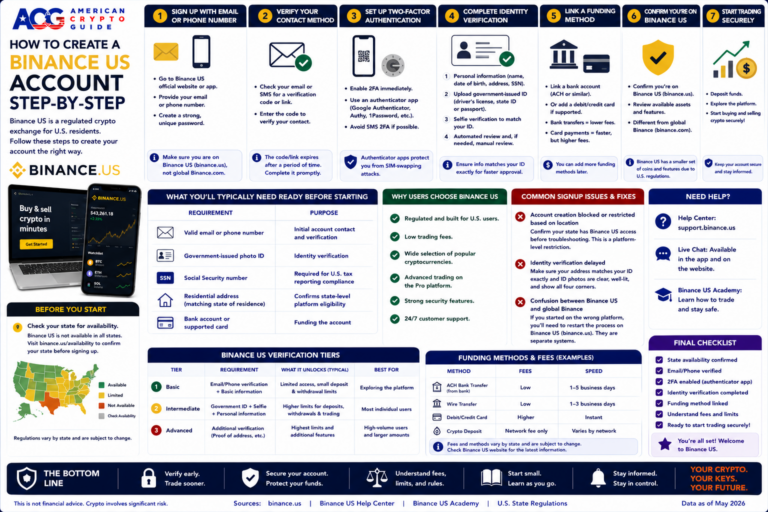
Binance US requires standard identity verification — email, phone, and government ID — similar to other regulated US exchanges. Verification tiers affect deposit and withdrawal limits, and completing higher tiers requires additional documentation, following a pattern common across the industry.
📬Did you like this article?
Subscribe and receive our posts directly in your inbox. Free!
Sin spam. Puedes darte de baja cuando quieras.
Fee structure
Binance US has historically positioned itself as one of the lower-fee options among mainstream US exchanges, particularly compared to Coinbase’s standard app.
| Binance US | Kraken (standard) | Coinbase (standard) | |
|---|---|---|---|
| Typical spot trading fee | 0.10%–0.60% (volume-based) | 0.25%–0.40% | Often higher, less transparent |
| Fee decreases with volume | Yes | Yes | Limited on standard app |
| Fee transparency | Generally clear | Generally clear | Less clear upfront |
Security features
Binance US states that it stores the substantial majority of user funds in cold storage, with standard two-factor authentication options including hardware security key support. As with any exchange, the meaningful security question isn’t just what protections exist on paper, but the platform’s actual operational track record — worth researching directly through Binance US’s own published security information at https://www.binance.us/security alongside independent reporting, rather than taking any single source’s word for it.
What you can actually do on Binance US
- Spot trading across a more limited but still substantial range of cryptocurrencies compared to global Binance.
- Staking, for select supported assets, directly through the platform.
- Recurring buys, for automating regular purchases on a schedule.
- A more streamlined feature set overall — notably absent are the margin, futures, and leveraged trading products available on global Binance, largely due to US regulatory constraints.
Where Binance US falls short
- Not available in every US state. Regulatory requirements vary significantly by state, and Binance US has had to adjust its availability as a result — check current state availability directly before assuming access.
- Smaller asset selection than global Binance, which can be a genuine limitation for users specifically wanting access to newer or smaller-cap tokens.
- Reputational baggage from its parent company’s regulatory history, which some users reasonably factor into their trust calculus regardless of Binance US’s own separate compliance record.
- Historically less feature-rich than direct US competitors in areas like advanced charting and margin products, given the more conservative regulatory environment it operates within.
Binance US vs its direct competitors
| Binance US | Kraken | Coinbase | |
|---|---|---|---|
| Typical fees | Lower | Moderate | Higher (standard app) |
| State availability | Limited in some states | Broad | Broad |
| Regulatory history | Parent company faced major action | Clean track record | Clean track record |
| Asset selection | Moderate | Broad | Broad |
Who should consider Binance US
- Fee-conscious traders in states where it’s available, who want some of the lowest spot trading costs among mainstream US platforms.
- Users comfortable with its regulatory history who’ve done their own research and are satisfied with the platform’s current compliance standing.
Who might be better served elsewhere
- Users specifically concerned about regulatory track record who’d rather use a platform without a parent company’s past enforcement action in its history.
- Residents of states where Binance US isn’t available or has limited functionality — worth checking directly before signing up.
- Traders wanting the broader asset selection and advanced products available on global platforms, which US regulation keeps off Binance US specifically.
Final verdict
Binance US in 2026 is a genuinely lower-fee option for US users, built as a legally distinct, more conservative platform than its global namesake. Whether that’s the right trade-off depends heavily on how much weight you personally place on regulatory history versus trading costs — a judgment call this review can inform, but shouldn’t make for you.